
 salehunter.net
 Every American homeowner eventually reaches the same frustrating breaking point. You step out of the shower feeling like your skin is coated in a faint layer of swimming pool chemicals, or you look at the stubborn, chalky white crust dominating your kitchen faucet and decide you have finally had enough.
Upgrading to a Point-of-Entry (POE) filtration system is one of the highest-value home improvements you can invest in. However, premium systems routinely carry sticker prices ranging from $900 to well over $4,000. That reality makes catching a genuine whole house water filter sale less of a casual shopping goal and more of a vital financial strategy.
The problem? The residential water treatment industry is notoriously murky. Between inflated Manufacturer’s Suggested Retail Prices (MSRPs), aggressive “free installation” gimmicks, and confusing flow-rate jargon, figuring out whether a 35% discount is a legitimate bargain or a digital marketing mirage requires an insider’s eye. This guide breaks down the mechanics of water filter promotions so you can secure elite water for your entire home at absolute bottom-dollar pricing.
The Retail Calendar: When Do the Real Discounts Actually Drop?
If you are browsing for a whole-home water system on a random Tuesday in mid-October, take your hand off the mouse. Much like mattresses, major kitchen appliances, and outdoor grills, whole house water systems follow a rigid, highly predictable promotional cycle.
Because water filtration sits right at the intersection of home improvement and personal wellness, manufacturers align their deepest price cuts with specific calendar events:
- Earth Day Week (Late April): This is the industry’s quietest powerhouse sale event. Because the holiday centers on environmentalism and reducing single-use plastic water bottles, direct-to-consumer filtration brands roll out their most aggressive bundle deals of the year here—often throwing in free under-sink reverse osmosis units or extra pre-filters.
- Memorial Day & Labor Day: These two three-day weekends represent the peak of the American DIY home-improvement season. Discounts during these windows typically range from 15% to 25% off site-wide, but the real win here is usually discounted or waived freight shipping (which can otherwise add $150+ to heavy tank shipments).
- The “Spring Melt” (March through May): This is a lesser-known regional phenomenon. As snowpacks melt across the Northern and Midwestern states, local water tables shift, causing a massive spike in municipal sediment runoff and private well contamination. Brands target these specific months with heavy promotions on heavy-duty well water systems and iron filters.
- Black Friday & Cyber Week: While you will see massive headline numbers (e.g., “Up to 50% Off!”), approach November with caution. Many big-box retailers artificially inflate the base price in October just to slash it in November. Look strictly at the final out-the-door dollar amount rather than the advertised percentage off.
The “Razor and Blades” Trap: Look Past the Sticker Price
The single most expensive mistake consumers make during a major flash sale is shopping exclusively for the upfront cost of the hardware. Companies routinely run promotions slashing 40% off the main tank because they operate on the classic razor-and-blades business model.
They will gladly sell you a high-grade stainless steel housing at near-cost today, knowing they have successfully locked your household into a proprietary replacement cartridge ecosystem for the next ten years.
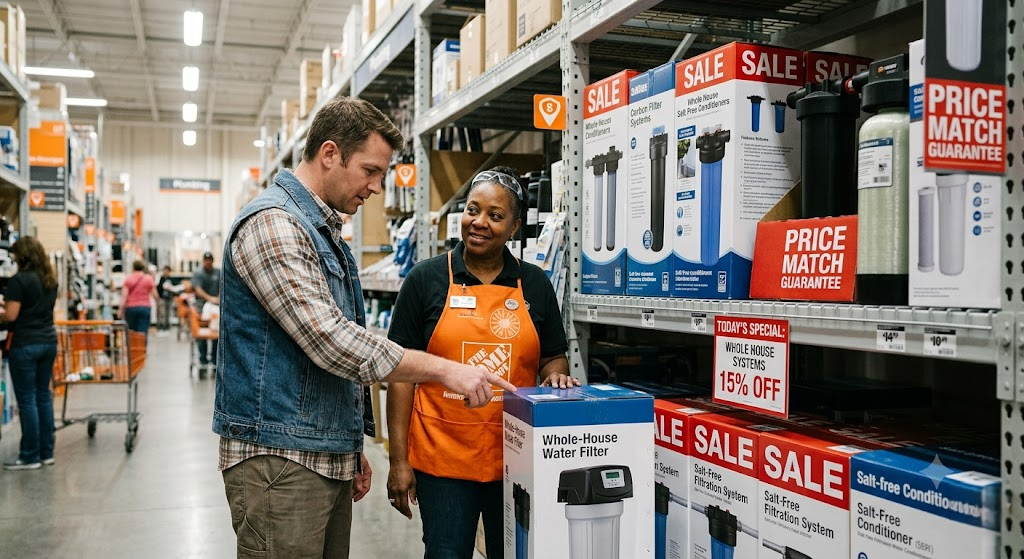
Before you let a ticking countdown clock rush you into entering your credit card, run the Five-Year Total Cost of Ownership (TCO) math. Grab a notepad and calculate these three variables:
1. Gallon Capacity vs. Time Limits
Look at the fine print of the filter media. A bargain system on sale for $450 might boast a 100,000-gallon capacity. For an average American family of four using roughly 300 gallons of water a day, that filter will exhaust itself in under a year. A higher-end system on sale for $1,100 might feature a 1,000,000-gallon capacity, meaning the internal media won’t need touching for six to ten years. Over a decade, the “cheap” sale item actually costs double.
2. Standardized vs. Proprietary Housings
Inspect the physical shape of the filter cartridges. Does the unit accept universal, industry-standard 10-inch or 20-inch “Big Blue” drop-in cartridges? Or does it require a custom, branded, twist-and-lock cartridge sold exclusively by that specific manufacturer? Universal housings allow you to jump online five years from now and buy high-grade third-party carbon blocks for $30; proprietary replacements can easily hold your plumbing hostage at $160 a pop.
3. Wastewater Drain Rates
If the sale involves a backwashing filter or an integrated whole-house reverse osmosis setup, check the discharge ratio. Older or cheaply manufactured sale units can flush up to 100 gallons of treated utility water down your sewer line every few days just to clean their internal media bed. In cities with tiered water rates, that “discounted” filter will quietly inflate your monthly municipal utility bill.
Decoding the Specs: Don’t Buy a City Filter for a Well
A discounted system is a total waste of money if it is engineered to fight the wrong water chemistry. In the United States, residential water falls strictly into two camps: Municipal (City) Water and Private Well Water. Promotional landing pages frequently lump them together to move overstocked inventory, but their internal mechanics are fundamentally different.
Shopping a Sale for City Water
If you pay a water bill to a city or county, your primary enemies are disinfection chemicals and aging distribution pipes. You do not need heavy iron removal; you need high-grade adsorption.
- The Chloramine Trap: Over 70% of American municipalities have transitioned from using chlorine to chloramine (a stable bond of chlorine and ammonia). Standard Activated Carbon (GAC) filters—which are heavily discounted during sales—do a terrible job removing chloramine. If your city uses chloramine, you must ensure the sale unit specifically contains Catalytic Carbon.
- Sub-Micron Pre-Filtration: To catch micro-plastics and pipe rust breaking off from city mains, ensure the system bundles at least a 5-micron spun polypropylene pre-filter.
Shopping a Sale for Private Well Water
If your water comes out of your own backyard, it is wild, untreated water. Standard city carbon filters will clog and turn into biological petri dishes within weeks on a well.
- Target the Big Three: Look strictly for sale setups that specialize in Iron, Manganese, and Hydrogen Sulfide (the rotten egg smell).
- Demand Air Injection: The best well deals feature AIO (Air Injection Oxidizing) systems. These use a pocket of air inside the tank to oxidize dissolved metals into solid particles, which are then trapped by a bed of Katalox Light or Greensand media.
The Certification Check: Spotting Sneaky Legal Copy
During massive holiday sale events, marketing copywriters push language to the absolute boundaries of consumer law. You will see shiny gold digital badges plastered across sale banners claiming: “Designed to meet NSF standards,” or “Tested to NSF/ANSI Standard 42.”
Do not fall for this phrasing.
There is a massive legal and financial difference between a filter being “tested to a standard” by an unverified, in-house warehouse technician, and a system being officially Certified by the NSF, the WQA (Water Quality Association), or IAPMO.
To earn real certification, a manufacturer has to hand over their equipment to independent laboratories, subject their plastics to structural burst tests, and prove that the water coming out the other side is free of chemical leaching. When evaluating a flash sale, scroll past the colorful graphics down to the raw specifications sheet and verify actual certification numbers for:
- NSF/ANSI Standard 42: Covers aesthetic reduction (chlorine taste, odor, and visible particulates).
- NSF/ANSI Standard 53: Covers documented health hazards (lead, heavy metals, Cryptosporidium, and VOCs).
- NSF/ANSI Standard 401: Covers emerging trace contaminants (prescription pharmaceuticals, over-the-counter painkillers, pesticides, and herbicides).
- NSF/ANSI Standard P473: The gold-standard benchmark for the reduction of PFOA and PFOS (“forever chemicals”).
If a sale price looks suspiciously cheap compared to established competitors, it is almost always because the brand bypassed the tens of thousands of dollars required to put their product through genuine independent lab certification.
Anatomy of a Bad Deal: 4 Red Flags to Walk Away From
When the digital banners are flashing yellow and red, keep your guard up for these four common promotional traps:
The “Free Pro Installation” Gimmick: If a national brand offers a whole-house filter on sale for $3,500 with “Free Installation Included,” ask for an itemized breakout. Often, the hardware itself is a basic $700 tank setup, and the company has baked a $2,800 plumbing markup directly into the “sale” price. You are almost always better off buying high-grade equipment directly online during a sale and paying a local, trusted master plumber $400 to $600 for a straightforward two-hour install.
1. The Flow Rate Bottleneck (Low GPM): Whole house filters clean water as it rushes past the media. Cheaply made sale units often restrict your home’s water flow to 6 or 7 Gallons Per Minute (GPM). If someone flushes a toilet while you are taking a shower, your water pressure will drop to a miserable trickle. For a standard 2-to-3 bathroom American home, do not buy any system on sale unless it guarantees a minimum peak flow rate of 10 to 12 GPM.
2. Vague “Proprietary Media” Descriptions: If the specifications page refuses to tell you what is actually inside the tank—using buzzwords like “Retain-Ion Blend” or “Miracle-Sorb Crystals”—close the tab. Reputable manufacturers proudly state the exact sourcing of their media (e.g., “1.5 cubic feet of Jacobi Jacobi AquaSorb high-activity coconut shell carbon”).
3. The Ghost Drop-Shipper: Third-party marketplaces are currently flooded with white-labeled filtration tanks shipped directly from overseas factories. They look sleek in rendered photos and feature massive 40%-off coupons. However, try finding a physical US corporate headquarters or a live customer service phone number. When a plastic fitting cracks under 60 PSI of basement water pressure on a Sunday night, you need a domestic warranty department that actually picks up the phone.
Five-Year Cost Comparison: Cheap Sale vs. Smart Sale
To put the true cost of these promotions into perspective, look at how two hypothetical sale purchases play out over a five-year timeline in a standard municipal home:
| Expense Metric | The “Bargain” Flash Sale Unit | The Premium Tier Sale Unit |
|---|---|---|
| Upfront Sale Price | $399.00 | $950.00 |
| System Filtration Capacity | 60,000 Gallons | 1,000,000 Gallons |
| Cartridge Replacements Required | 2x per year (@ $85 each) | Pre-filter only (@ $25/yr) |
| Plumbing Adaptors Needed | Custom proprietary fittings ($60) | Standard 1″ NPT (Included) |
| 5-Year Replacement Costs | $850.00 | $125.00 |
| Total Realized 5-Year Spend | $1,309.00 | $1,075.00 |
Despite costing over $500 more at checkout, the engineered system saves the homeowner over $230 in hard cash—while saving them the physical labor of crawling into a wet basement crawlspace ten separate times to wrench open stuck filter housings.
The Checklist: What to Do 48 Hours Before a Sale Drops
When a major holiday weekend approaches, do not wait until the promotional email hits your inbox to start researching. Do your homework ahead of time so you can pull the trigger instantly before high-demand inventory goes on backorder:
- Order an independent lab test. Stop guessing what is in your water. Spend $100 on a mail-in tap water test kit from a certified lab like Tap Score. Having a lab report showing exact parts-per-billion of lead, chloroform, or iron allows you to cross-reference filter data sheets with cold, hard science.
- Measure your main trunk line. Walk to where your water meter enters the house. Is the incoming pipe made of copper, PEX, or CPVC? Use a piece of string or a caliper to verify whether the pipe diameter is 3/4-inch or 1-inch. Buying a system with 3/4-inch ports for a 1-inch plumbing line will permanently choke your household water volume.
- Verify your physical footprint. Whole-house tanks are massive. A standard 1,000,000-gallon system stands roughly 50 to 60 inches tall and requires roughly three feet of clear wall space once you account for the bypass valves and pre-filter mounting brackets. Measure your utility closet or garage space twice.
- Check your home’s static water pressure. Buy a $15 pressure gauge that screws onto a standard outdoor hose bib. Most high-performance POE systems require an incoming pressure window of 45 to 80 PSI. If your city pushes water to your house at 95 PSI, you will need to buy a Pressure Reducing Valve (PRV) alongside your filter to keep the tank from splitting open over time.
A whole house water filter sale should never be an emotional, impulse purchase. By treating the buying process like a commercial plumbing procurement—ignoring the flashy strikethrough graphics, demanding strict third-party lab certifications, and calculating the long-term cost of replacement media—you can transform a simple promotional weekend into a permanent, health-promoting upgrade for your home.