
 salehunter.net
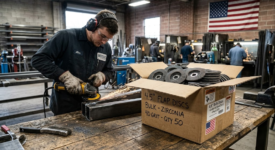
Walk into any serious metal fabrication facility, custom automotive shop, or mobile welding rig in the United States, and you will hear the unmistakable, high-pitched whine of a 4.5-inch angle grinder. It is the undisputed workhorse of the American shop floor. Whether an operator is beveling pipe, hogging out a messy MIG bead, or prepping cold-rolled steel for a powder coat, the 4-1/2″ grinder is the tool reached for first.
Yet, despite being the most frequently consumed accessory in the metalworking industry, flap discs are routinely purchased with surprisingly little strategic forethought. Too many shop managers and independent contractors treat them like an emergency run to the local big-box hardware store—buying three or four retail packs at a time. This habit creates a slow, invisible bleed on project margins. Transitioning your shop to a dedicated flap disc 4.5 angle grinder bulk buy strategy is one of the fastest ways to lower overhead, provided you know how to decode the spec sheets before ordering a box of one hundred.
The Economics of the Shop Floor: Retail vs. Wholesale Burn Rates

To understand the necessity of bulk purchasing, you have to look at abrasive consumption through the lens of “Cost Per Cut” rather than “Cost Per Disc.” At a standard retail supply hardware chain, a single high-tier 4.5-inch flap disc will routinely set you back anywhere from $6.50 to $9.00. When you shift to wholesale industrial purchasing in quantities of 50, 100, or 250 units, that exact same tier of disc drops into the $1.75 to $2.60 unit range.
Consider the math for a mid-sized fabrication shop running four active grinders that consume a combined total of twenty discs per week:
- The Retail Habit: 20 discs @ $7.25 average retail = $145.00 per week ($7,540 annually).
- The Bulk Buy Strategy: 20 discs @ $2.10 bulk rate = $42.00 per week ($2,184 annually).
That is an immediate net retention of over $5,300 a year for doing nothing more than changing the procurement logistics of a single consumable item. Furthermore, bulk inventory eliminates “grinder downtime”—the notorious fifteen-minute dead periods where a fabricator has to stop working, search the shop for a fresh disc, or drive down the street to buy more because the last 60-grit wheel loaded up with aluminum.
Decoding the Spec Sheet: What to Demand in a Bulk Order
When you buy discs two at a time, buying the wrong spec is a ten-dollar mistake. When you order two hundred units in bulk, a bad spec leaves your fabricators stuck with a mountain of inventory that fights them on every weld. Before signing off on a bulk purchase order, scrutinize four specific construction variables.
1. The Abrasive Grain: Why Zirconia is the Bulk Sweet Spot
Flap discs are manufactured using three primary grain types: Aluminum Oxide, Zirconia Alumina, and Ceramic Alumina. For a general American fabrication shop, ordering bulk Aluminum Oxide is a trap; it dulls instantly on structural steel and should be relegated purely to woodworking or light DIY plastics.
For 80% of steel fabrication shops, Zirconia Alumina (often labeled as “Zirc”) is the king of bulk purchasing. Zirconia features a micro-fracturing property: as the grain encounters the high friction of a weld bead, the crystal structure breaks off at microscopic angles, constantly exposing fresh, razor-sharp edges. It offers the highest ratio of stock-removal-to-dollar spent.
While premium Ceramic discs cut cooler and last up to 50% longer than Zirconia, their high upfront bulk cost only makes financial sense if your shop works almost exclusively with stainless steel, titanium, or high-nickel alloys where heat tinting is a catastrophic failure.
2. Type 27 vs. Type 29: Matching Geometry to the Task
A frequent error made by purchasing agents is ordering a hundred discs without checking the shape profile. Flap discs come in two industry-standard geometries:
- Type 27 (Flat Profile): The flaps sit parallel to the backing plate. These are engineered for finishing work, blending, and smooth surface preparation across flat planes. They perform best when held at a shallow angle (0 to 15 degrees) relative to the workpiece.
- Type 29 (Conical/Beveled Profile): The flaps are angled downward at roughly 10 degrees. This creates a much more aggressive angle of attack. Type 29 is built for heavy stock removal, chamfering edges, and biting into heavy structural weld seams at a 15 to 35-degree working angle.
If your shop primarily builds heavy structural frames, order Type 29. If your shop does sheet metal auto restoration or ornamental ironwork, lean your bulk order toward Type 27.
3. Standard Density vs. High Density (Jumbo) Flaps
Not all 100-packs are created equal. Pay close attention to whether the distributor is selling standard-density discs or “High Density” (often marketed as Jumbo or XL) discs. High-density discs pack roughly 20% to 40% more abrasive cloth onto the backing plate, using wider flaps that overlap tighter. While they cost slightly more per unit in a bulk tier, they conform better to irregular surfaces and absorb significantly more vibration, reducing operator hand fatigue over an eight-hour shift.
The Shop Blueprint: How to Split a 100-Pack Order
One of the biggest amateur mistakes in bulk purchasing is buying a monolithic case of a single grit—usually 60-grit. A highly efficient shop operates on a tiered abrasive matrix. If you are placing a standard 100-disc bulk buy for a mixed-duty metal shop, instruct your supplier to divide the shipment into the following ratio:
- 25% — 40 Grit: The “demolition” disc. Used exclusively for beveling thick plate edges, hogging out slag, and cutting down massive multi-pass welds.
- 45% — 60 Grit: The daily driver. This is the sweet spot that balances rapid material removal with a finish clean enough to send straight to a secondary welding operation.
- 20% — 80 Grit: The blender. Used for cleaning up mill scale, rounding over sharp sheared edges, and smoothing surface imperfections.
- 10% — 120 Grit: The pre-paint finisher. Used specifically on visible cosmetic welds or parts heading to a high-gloss powder coating system where deep scratch marks would telegraph through the paint.
Four Hidden Pitfalls of Bulk Abrasive Purchasing
Scaling your purchasing volume introduces logistical risks that solo-pack buyers never have to worry about. Keep your shop safe and profitable by avoiding these lesser-known industry oversights.
Pitfall 1: The Invisible Expiration Date
Most operators treat abrasive discs like they are made of inert stone. They are not. Flap discs consist of cotton/polyester cloth bonded to a fiberglass or nylon backing plate via industrial phenolic resins. Over time—specifically in unheated, humid shop environments—these resins degrade and absorb airborne moisture. A bulk pack of flap discs generally has an optimal shelf life of two to three years. Buying a five-year supply of discs because the price break looked good on paper can result in adhesive failure, causing flaps to delaminate and turn into high-speed shrapnel at 11,000 RPM.
Pitfall 2: The Underpowered Grinder Trap
If you decide to bulk-upgrade your shop to top-tier Ceramic flap discs, check the amperage of your angle grinders first. Ceramic grains require extreme pressure and high rotational torque to force the micro-fracturing process to happen. If an operator mounts a stiff, high-end ceramic disc onto a cheap 6-amp corded grinder or a low-voltage cordless tool, the grinder will bog down. Instead of fracturing, the grain will simply round off and “glaze over,” rendering an expensive disc useless in ten minutes.
Pitfall 3: The Mixed-Metal Cross-Contamination Nightmare
If your facility processes both standard carbon steel and 304/316 stainless steel, your bulk storage protocol must be strictly segregated. If an operator grabs a fresh Zirconia disc from the bulk bin, uses it to dress a mild steel bracket, and puts it back on the bench, that disc is now impregnated with free iron particles. If another operator picks that disc up tomorrow to polish a stainless steel food-grade hopper, those embedded carbon particles will transfer into the stainless grain, causing aggressive surface rusting weeks after the product ships to the client.
Pitfall 4: Arbor Hub Compatibility
Before hitting “submit” on a freight order, verify your shop’s locking nut infrastructure. The standard American 4.5″ grinder utilizes a 7/8-inch open arbor hole, requiring the operator to use the grinder’s factory spanner nut. However, many high-volume production shops prefer 5/8″-11 quick-change threaded hubs (such as Type R or spin-on zinc hubs). Ensure the bulk lot you are procuring matches the tooling setup on your floor, or you will be forced to buy dozens of aftermarket adapter nuts.
Smart Inventory Storage Protocol
To protect your capital investment once the pallet arrives at your loading dock, institute strict shop-floor handling rules. Never leave bulk flap discs sitting in raw cardboard shipping boxes directly on a concrete floor; concrete sweats and wicks moisture upward into the bottom layers of the boxes.
Unpack the bulk cases into sealed metal storage cabinets kept at a stable room temperature (ideal conditions are 60°F–80°F with relative humidity resting below 50%). Keep the discs stacked flat horizontally rather than hung vertically on pegboard hooks, which can slowly warp the fiberglass backing plates over several seasons of seasonal temperature swings.
The Bottom Line
In the modern American manufacturing landscape, controlling profitability is rarely about finding a massive, revolutionary breakthrough; it is about tightening up a hundred small operational inefficiencies. The 4.5-inch angle grinder is going to run all day in your shop regardless of what you do. By shifting away from reactive, piecemeal hardware store purchases and taking command of your abrasive supply chain through targeted bulk buying, you turn a chaotic daily expense into a predictable, highly discounted operational metric.


