
 salehunter.net
 Every automotive technician, trailer repair specialist, and weekend 12-volt DIYer knows the exact moment of frustration: it is 4:15 PM on a Sunday, you are halfway through wiring an auxiliary LED light bar, and your bench organizer is completely empty of blue 14-gauge wire taps. You drive to the nearest big-box auto parts store, grab a branded blister pack of five connectors off the pegboard, and pay $5.99 at the register.
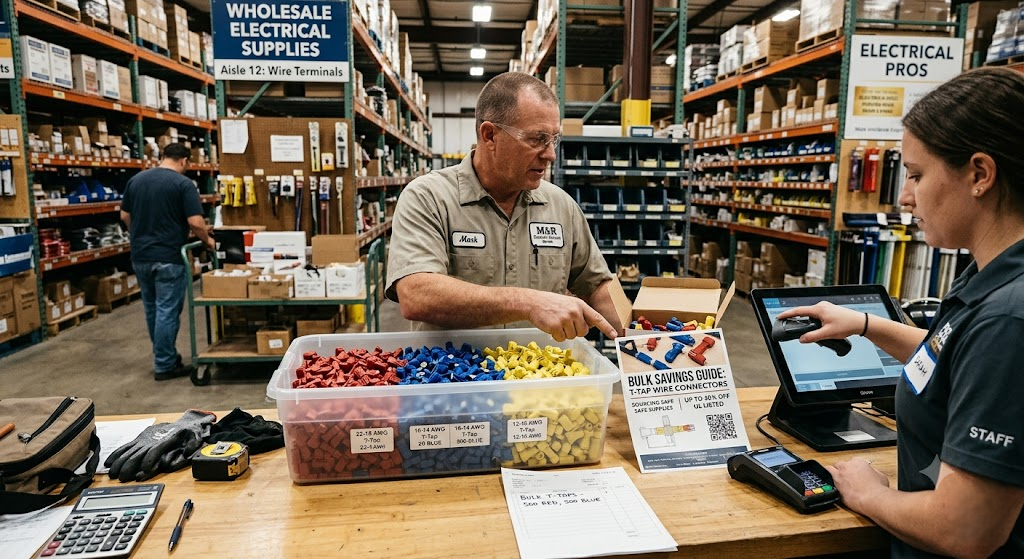
That is $1.20 per connector—for a tiny piece of stamped metal wrapped in a nylon jacket. When you realize that high-volume electrical upfitters source those exact same components for roughly six to nine cents apiece, the search for a legitimate t tap wire connectors discount becomes a matter of basic shop economics.
However, shopping for discounted electrical components is a unique minefield. In the world of drywall screws or zip ties, a cheap knockoff just breaks. In the world of 12-volt DC wiring, a cheap knockoff introduces high resistance, creates a localized thermal hot spot, melts its own plastic housing, and quietly sets a vehicle’s carpet on fire. Finding real savings means learning how to bypass retail markups without accidentally buying counterfeit hardware.
The Hidden Anatomy of a Wire Tap (Why Cheap Knockoffs Melt)
To understand why some bulk discounts are dangerous traps, you have to look at the physics of an Insulation Displacement Connector (IDC). When you squeeze a T-tap closed with a pair of pliers, a sharp, slotted metal blade is forced down over the host wire. This blade must slice cleanly through the tough vinyl or cross-linked polyethylene (XLPE) insulation, slide past the outer surface of the copper strands, and grip the conductor with permanent spring tension—all without severing the actual copper strands.
When you buy an ultra-cheap, unbranded 500-piece discount kit online, the manufacturer usually cuts costs in three invisible places:
- The Blade Metallurgy: Premium taps (like those manufactured by 3M, Molex, or TE Connectivity) use high-grade phosphor bronze or tin-plated hard brass. Cheap discount taps use stamped low-carbon steel plated in a micro-thin layer of zinc. Steel has roughly six to eight times the electrical resistance of copper. When current passes through that steel blade, it generates heat. Over time, that thermal cycling causes the cheap steel to lose its temper and relax its grip on the wire.
- The Housing Plastic: Real connectors use Nylon 6.6, which possesses a high melting point and remains slightly flexible even in sub-zero winter temperatures. Counterfeit bulk hardware almost exclusively uses rigid Polypropylene or cheap recycled PVC. In a freezing engine bay, a PVC tap will literally snap in half the first time the engine vibrates over a pothole.
- The Dimensional Tolerances: If the slot in the metal blade is stamped 0.15 millimeters too wide, it won’t make consistent contact with the copper; your stereo or lights will flicker every time you hit a bump. If it is stamped 0.15 millimeters too narrow, it acts like a wire cutter, shearing half the copper strands inside the host wire and permanently crippling that circuit’s current capacity.
Decoding the American Wire Gauge (AWG) Color Standard
One of the easiest ways people waste money on bulk connector sales is buying the wrong distribution of sizes. In the United States, low-voltage wiring adheres strictly to a universal color standard. If a discount variety pack offers equal amounts of all three colors, it is usually a bad deal for American hobbyists, because real-world projects consume these sizes at vastly different rates.
| Color Code | AWG Wire Range | Max Current (12V DC) | Typical US Applications | Ideal Bulk Consumption Ratio |
|---|---|---|---|---|
| Red | 22 – 18 AWG | 10 Amps | Sensor triggers, dash gauges, stereo remote-turn-on leads, LED accent strips. | 25% of your stash |
| Blue | 16 – 14 AWG | 15 Amps | Headlight harnesses, standard dome lights, 12V cigarette sockets, CB radios. | 60% of your stash |
| Yellow | 12 – 10 AWG | 24 Amps | Heavy-duty air compressors, marine bilge pumps, primary distribution feeds. | 15% of your stash |
Pro Tip for Bulk Buying: When hunting for discount packs, look for suppliers who allow you to buy single-color bags of 100 or 250 count. Buying a 300-piece mixed kit usually leaves you with 80 yellow connectors sitting in your drawer for the next decade while you constantly run out of blues.
Where to Hunt for Genuine Tier-1 Sourcing Discounts
If you want to stop paying retail prices without resorting to anonymous e-commerce dropshippers, you have to change *where* you stand in the supply chain. There are three legitimate channels in the USA for acquiring high-grade T-taps at wholesale rates:
1. Authorized Industrial Surplus Distributors
Companies like Waytek Wire, Del City, and Mouser Electronics supply the commercial fleet industry, municipal bus garages, and agricultural equipment builders. They sell genuine 3M Scotchlok and Molex connectors in bulk bags of 500 or 1,000. While their website interfaces feel like they were built in 2004, their tier-pricing is unbeatable. If you buy a 500-count bag of genuine 3M 952 (Blue) taps from an industrial house, your price per unit drops down to roughly $0.11 to $0.14—a saving of over 85% compared to local auto parts stores, backed by genuine product traceability.
2. Commercial Electrical “Reel Ends”
Major manufacturing plants buy wire connectors on massive continuous cardboard reels containing 5,000 to 10,000 pieces for automated feeding machines. When a production run finishes, a reel might have 420 genuine, top-tier connectors left on it. The factory cannot load a partial reel into their machinery for the next run, so liquidators buy these “reel ends” for pennies on the dollar and flip them on eBay. Search terms like “Molex T-Tap surplus lot” or “3M Scotchlok open box” will frequently yield genuine aerospace-grade hardware priced lower than Chinese knockoffs.
3. Automotive Trade Account Overruns
If you have a tax ID or a registered business (even a part-time mobile detailing or handyman LLC), open a commercial account at regional auto distributors or auto-body supply warehouses. Trade accounts generally unlock “Jobber Pricing” on consumable electrical packs, instantly slicing 30% to 40% off the counter price.
Five Golden Rules for Spotting Counterfeit Electrical Hardware
When browsing online marketplaces for discount wire terminals, the product photos are almost universally photoshopped. Once the padded envelope arrives at your front door, perform these five physical shop tests before letting those connectors anywhere near a live battery:
- The Magnet Test: Take a standard rare-earth neodymium magnet from your toolbox and touch it to the metal blade inside the tap. Pure brass, phosphor bronze, and electrical copper are entirely non-ferrous. If the blade snaps to your magnet, it is made of zinc-plated steel. Return the package immediately; it is a fire hazard.
- The UL File Lookup: Counterfeiters love printing the classic “UL Listed” circle on their cardboard packaging. However, real Underwriters Laboratories listings require an authorized E-File Number (usually formatted as E123456) printed directly beneath the logo. If the box boasts UL certification but lacks an E-file code, the certification is entirely fabricated.
- The Hinge Flex Test: Take a connector at room temperature and snap the nylon locking gate shut, then pry it back open with your thumb. Repeat this five times. High-quality Nylon 6.6 will survive 15+ cycles without whitening or tearing at the hinge. Cheap PVC or recycled plastic will turn bright white at the stress point on the second bend and snap entirely by the fourth.
- The Translucency Check: Hold the connector up to a bright shop light. Virgin electrical nylon possesses a distinct, slightly milky, semi-translucent quality—you should be able to vaguely see the dark silhouette of the internal metal blade through the side of the plastic. If the plastic is a dead-flat, opaque, chalky primary color, it is low-grade injection plastic.
- The “Micrometer Strip” Audit: Sacrifice one tap. Clamp it down onto a scrap piece of 14 AWG wire, then carefully use a razor blade to carve the plastic housing away to inspect the copper conductor. The internal blade should have parted the insulation and made firm contact with the copper bundle, but the copper strands themselves should be 100% intact. If the outer layer of copper wire is notched or sliced through, the stamping die used to make that batch of connectors was out of spec.
Pro-Level Installation: Protecting Your Discounted Hardware
Even the highest-end wire tap on earth will fail if installed with improper technique. The single biggest reason mechanics speak poorly of T-taps is not the connector itself—it is the use of standard needle-nose pliers.
When you squeeze a T-tap closed with standard hinged pliers, the jaws close at an angle. This forces the internal metal blade to drive down into the wire diagonally, twisting the conductor and often causing one side of the blade to miss the copper entirely. To get a factory-grade termination, invest $20 in a pair of parallel-jaw crimping pliers. Because parallel jaws press straight down on the connector’s cap at a flat 90-degree angle, the blade seats perfectly balanced across the wire insulation every single time.
Furthermore, if you are installing T-taps anywhere outside the insulated cabin of a vehicle—such as along a trailer frame, inside a Jeep engine bay, or behind a marine dashboard—you must fight galvanic corrosion. Copper wire interacting with a tin-plated brass blade in the presence of atmospheric humidity creates a tiny battery, leading to green copper oxide fluff that eventually chokes off the electrical current.
Before you fold the T-tap over your target wire, squeeze a single, rice-sized drop of silicone dielectric grease directly into the blade channel. When you clamp the connector shut, the grease will displace 100% of the oxygen and moisture around the fresh cut in the wire insulation. This ten-cent chemical barrier effectively converts a discounted indoor wire tap into a waterproof, marine-grade connection that will survive a decade of winter road salt.
The Legal Code Reality: Where Never to Use a T-Tap
As a final point of safety for DIYers in the United States, it is critical to understand the boundaries of the National Electrical Code (NEC). While this guide focuses heavily on 12-volt automotive and DC applications, many home hobbyists look at a bulk bag of cheap T-taps and wonder if they can use them to tap into a 120-volt wall outlet circuit in their garage or attic.
The answer is a definitive, absolute no. Under NEC Article 110.14, insulation-displacement T-taps are strictly prohibited for use on 120V/240V residential AC branch wiring. Residential house wiring relies on solid-core copper (usually 14 or 12 AWG NM-B Romex). T-taps are engineered specifically for *stranded* wire. If you force a T-tap blade down onto a solid Romex copper conductor, the blade cannot spread the strands apart; instead, it scores a sharp notch directly into the solid copper copper core, creating a massive mechanical weak point that will eventually snap from the natural 60Hz magnetic expansion and contraction of AC power.
Keep your discounted T-taps strictly in the garage, inside your project cars, inside your custom solar generator boxes, and along your utility trailers. Sourced intelligently from industrial surplus channels, verified for basic metallurgical quality, and installed with parallel pressure and dielectric grease, they remain one of the most cost-effective, time-saving weapons in an electrical technician’s arsenal.