
 salehunter.net
 Picture this: You just dropped seventy dollars on the year’s most anticipated AAA console release. Your TV is dialed into game mode, the snacks are staged, and you sit down—right onto a stiff, unforgiving living room sofa that forces you to crane your neck at a 45-degree angle for the next six hours.
For console gamers, the floor has always been the prime real estate. But sitting cross-legged on a carpet gets old right around your twenty-fifth birthday. This is where the gaming rocker comes in. However, take one look at the market, and you’ll see flagship models sporting built-in massage motors, synced RGB lighting, and $300+ price tags.
Here is the open secret of the peripheral industry: you do not need to spend a week’s groceries on a floor seat. A cheap gaming rocker chair can deliver 90% of the practical utility of a high-end throne, provided you know which corners the manufacturers cut—and which ones you can safely live with.
The Physics of the Floor: Why Rockers Beat Pedestals
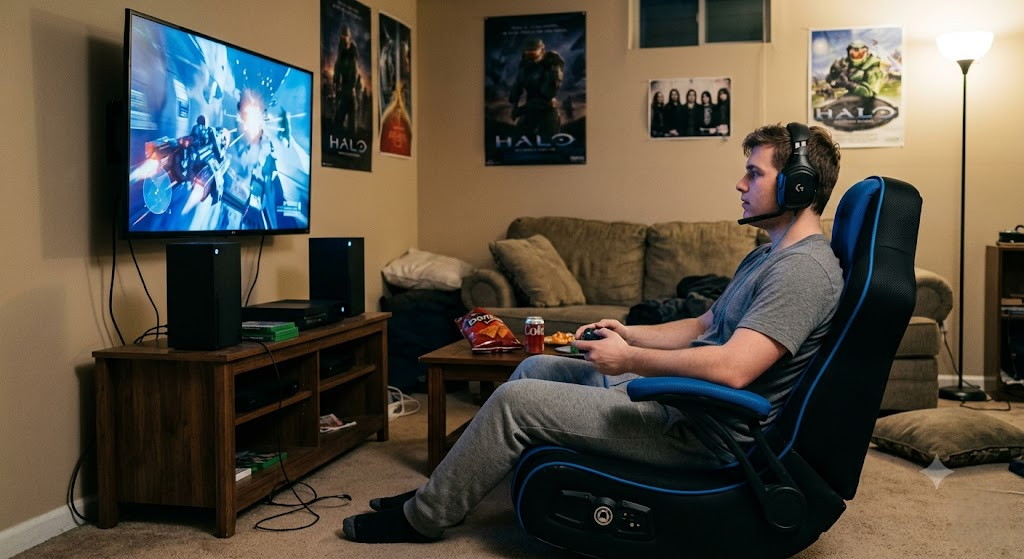
Before hunting for budget options, it helps to understand why the rocker form-factor exists. Originating from the low-slung “banana chairs” popularized in 1970s hi-fi listening rooms, the modern floor rocker operates on a simple principle of passive ergonomics.
Traditional PC gaming chairs force your spine into a rigid, 90-to-100-degree upright posture designed for someone typing at a 30-inch desk. A floor rocker naturally tilts your pelvis into a slight anterior shift. When you lean back into a rocker’s standard 105-to-115-degree resting curve, it transfers the weight of your upper torso away from your L4 and L5 lumbar discs and distributes it across your shoulder blades.
Furthermore, there is a hidden acoustic benefit to being low to the ground. Because your seat rests directly on the sub-floor, low-frequency sound waves (bass) from your television or home theater speaker setup travel through the floorboards and into the frame of the chair. A $60 basic rocker sitting on a hardwood floor will actually give you tactile, physical feedback during in-game explosions simply through natural room vibration—no expensive internal subwoofer required.
The Budget Spectrum: What Your Money Actually Buys
When we talk about a “cheap” gaming rocker in the current retail landscape, we are generally looking at the $45 to $110 range. To shop smartly, you have to mentally divide this bracket into three distinct tiers:
- The Under-$50 Tier (The Dorm Special): At this price point, you are buying a bent steel tube wrapped in Polyurethane (PU) foam and covered in basic polyester canvas. These rarely have armrests, they feature zero audio pass-through, and their weight limit strictly tops out around 175 to 200 lbs. They are fantastic for kids, tweens, or ultra-lightweight adults, but will flatten out like a pancake under a 220-lb frame within six months.
- The $55–$85 Tier (The Sweet Spot): This is where the smartest money goes. In this bracket, manufacturers stop trying to pack cheap, gimmicky electronics into the chair and instead spend their budget on internal plywood reinforcing boards and higher-density rebond foam. You get foldable hinges for storage, breathable mesh striping, and genuine adult proportions.
- The $85–$110 Tier (The Budget Tech Tier): Here, you begin seeing entry-level 2.0 wired or basic Bluetooth headrest speakers reappear. While tempting, proceed with caution: a $95 rocker with Bluetooth speakers usually features the exact same foam quality as a $45 non-tech rocker; you are simply paying a $50 markup for two $4 speaker drivers and a cheap copper receiver.
The 5 Hidden Compromises of Budget Rockers
If a company is selling a chair for seventy bucks with free shipping, they saved money somewhere on the assembly line. When shopping budget floor chairs, keep your eyes peeled for these five notorious manufacturing shortcuts:
1. The “Peeling PU Leather” Trap
Budget chairs love faux leather because it looks glossy and premium in Amazon product thumbnails. In reality, sub-$100 bonded PU leather is paper-thin. Within twelve months of friction from denim jeans, it will begin flaking off in tiny, black, static-charged dandruff flakes all over your living room carpet. The fix: Actively seek out chairs wrapped in microfiber, automotive-grade canvas, or 3D spacer mesh. They look less like a racecar, but they will look identical five years from now.
2. The Phantom Audio Lag
If you buy a cheap rocker marketed with “Wireless Bluetooth Audio,” check the Bluetooth version. Many budget manufacturers clear out ancient Bluetooth 4.0 or 4.1 chips. When gaming, this results in a disastrous 150-to-200-millisecond audio latency. You will see your character pull a trigger on screen, and hear the gunshot through the headrest a fraction of a second later. If you want audio in a budget rocker, buy an analog wired 3.5mm AUX model, or skip the chair audio entirely and use a good pair of 2.4GHz wireless headphones.
3. The Tailbone Grind
Cheap rockers use standard open-cell packing foam rather than high-resilience (HR) cold-cured foam. When you first sit down, it feels plush. Two hours into a Elden Ring session, the air escapes the foam, the foam compresses to three millimeters, and your tailbone is resting directly against the internal wooden base pivot.
4. The Scale Illusion
Pay strict attention to the “Seat Back Height” spec in the product description. Many budget rockers are photographed using teenage models or shot from low angles to appear massive. A standard adult male requires a backrest of at least 26 to 28 inches to rest their neck comfortably. Anything listed at 21 to 23 inches is an adolescent chair; your head will hang over the back into empty air.
5. The Hinge Pinch
To save shipping box volume, almost all budget rockers fold in half via a heavy-duty steel locking pin. On ultra-cheap chairs, the fabric covering this hinge joint is single-stitched. When leaning back heavily, the internal scissor mechanism can catch the fabric (or worse, loose sweatpants) and tear it.
Material Showdown: What to Look For at the Checkout
When staring down two competing budget chairs side-by-side, use this quick cheat-sheet to break the tie:
| Feature | The “Red Flag” Spec | The “Green Light” Spec |
|---|---|---|
| Upholstery | 100% Glossy PU / PVC Leather | Woven Linen, Polyester Mesh, or Dacron |
| Internal Frame | Hollow plastic tubing / Untreated particle board | Tubular powder-coated steel / Solid plywood |
| Weight Rating | Unlisted (or listed under 180 lbs) | Explicitly rated for 240 lbs or higher |
| Base Underside | Raw fabric seam touching the floor | Reinforced nylon or rubberized scuff-guard strip |
| Portability | Rigid, fixed L-shape | Spring-loaded folding lock with carry handle |
How to Make a $60 Rocker Feel Like a $250 Throne
Let’s assume you bought a sensible, no-nonsense $65 fabric floor rocker. It fits your body, the frame is solid, but the padding is just a tiny bit lacking. Instead of returning it, you can execute three $10 DIY modifications that elevate the chair into bespoke territory:
- The “Memory Travel” Lumbar Hack: Budget rockers almost never include adjustable lumbar support—they are just a static curved board. Go to any target or airport shop and buy a basic memory foam travel neck pillow (the U-shaped ones). Slip it behind your lower back inside the curve of the chair. Because of the U-shape, it cradles the spine without pushing your hips weirdly forward.
- The Yoga Mat Floor Guard: If you are gaming on hardwood or luxury vinyl plank (LVP) flooring, the hard rocking base of a budget chair will eventually leave micro-scratches on your floor finish, and the rocking motion will sound like a wooden rolling pin. Buy a $8 high-density NBR yoga mat, cut it in half, and lay it under your gaming zone. It acts as a silent shock absorber and keeps the chair from drifting backward as you shift your weight.
- The Foam Stuffing Refresh: Most budget fabric chairs feature a discreet zipper at the very bottom of the rear fabric panel (originally used by the factory to slide the foam over the frame). If your seat bottoms out after a year, unzip this flap, buy a $12 bag of shredded memory foam refill from a craft store, and pack it tightly into the seat cavity alongside the original foam. You instantly double the seat’s lifespan.
The “Hard Truth” Checklist: Who Should Absolutely Avoid Floor Rockers?
Honesty saves return shipping fees. While budget rockers are incredible space-savers for apartment living rooms, bedroom setups, and dorms, they are biomechanically hostile to specific groups of people.
Do not buy a budget floor rocker if you suffer from chronic patellar (knee) issues or tight hip flexors. Getting down into a seat that sits four inches off the carpet is easy; hoisting a 200-pound adult body *out* of a dead-stop floor recline requires generating 100% of the upward leverage using your quad muscles and hip drive. If your knees make a sound like a bowl of Rice Krispies when you stand up from a standard dining chair, a floor rocker will quickly become an inescapable wooden trap.
Similarly, if your gaming setup involves a keyboard and mouse resting on a coffee table, look elsewhere. Floor rockers naturally recline your shoulders backward away from your knees. Attempting to lean forward to operate a mouse while sitting in a rocker forces your thoracic spine into a severe, hunched “C-curve” that will trigger tension headaches within twenty minutes.
The Bottom Line
The console gaming space has been thoroughly hijacked by the aesthetic of the esports arena. We have been conditioned to believe that unless our seating looks like it was ripped out of a German touring car, our kill/death ratio will suffer.
The reality of the living room is much simpler: your body just wants its weight distributed evenly, its neck supported at eye-level with the screen, and its feet free to kick out onto the rug. If you bypass the trap of cheap Bluetooth speakers and peeling faux-leather, a simple, well-built budget rocker remains one of the absolute highest-ROI comfort purchases in the entire consumer tech landscape.