

 salehunter.net
 Every working artist, studio manager, and art educator eventually hits the same mathematical wall. You stand in the aisle of a retail craft store holding a single 16×20-inch stretched canvas priced at $18.99, do the quick mental arithmetic for an upcoming twenty-piece exhibition or a weekend workshop of thirty students, and feel your stomach drop. Paying retail MSRP for painting surfaces is the fastest way to starve an art business.
Transitioning to a canvas bulk buy is the single most effective lever you have to protect your operating margins. However, ordering canvases by the case, pallet, or 50-yard roll is fundamentally different from picking a single frame off a well-lit shelf. When you buy in volume, you are no longer just shopping; you are acting as a procurement manager making a blind bet on wood chemistry, textile warp, and gesso elasticity.
Whether you are outfitting a high-volume Paint & Sip franchise, stocking a university fine arts department, or launching a boutique screen-printing brand, this breakdown covers the economics, the physical red flags, and the insider logistics of buying canvas in bulk across the United States.
The Big Three: Choosing Your Volume Format
Before looking at price per unit, you have to decide how much sweat equity your operation can afford to spend. Commercial bulk canvas is distributed in three distinct formats, each serving a radically different business model.
1. Case-Packed Stretched Canvas
This is the plug-and-play standard. Arriving in cardboard cases of 6, 12, 20, or 40 units, these canvases are pre-stretched over wooden wooden spline frames and factory-primed.
- The Profile Choice: You will generally choose between a standard 0.75-inch profile (traditional, designed to be framed later) and a 1.5-inch “Gallery Wrap” (designed to hang unframed with painted edges).
- The Best Fit: Paint & sip studios, K-12 classrooms, and prolific commercial painters who need zero prep time between finishing one piece and starting the next.
2. Canvas Panels (Canvas Boards)
Panels consist of primed cotton fabric glued to a rigid core—traditionally heavy paperboard, but increasingly Medium-Density Fiberboard (MDF) in modern commercial tiers.
- The Space Advantage: A case of fifty 11×14-inch canvas panels takes up roughly the same shelf volume as four standard stretched canvases.
- The Best Fit: Plein air painters who travel, art therapists, elementary school programs, and artists conducting quick color studies or daily painting challenges.
3. Unstretched Canvas Rolls
The undisputed king of cost-per-square-inch. Sold in standard widths (typically 54, 60, or 72 inches) and lengths ranging from 6 to 50 yards, raw or primed rolls turn the artist into the manufacturer.
- The Math: A 60-inch by 10-yard roll of double-primed 10oz cotton duck yields roughly 150 square feet of painting surface. Even after factoring in the cost of buying raw wholesale stretcher bars, building your own supports cuts your surface overhead by 60% to 70%.
- The Best Fit: Large-scale muralists, custom-size commission artists, and dedicated studio painters with basic carpentry comfort.
The Hidden Anatomy of Bulk Specs (What the Labels Conceal)
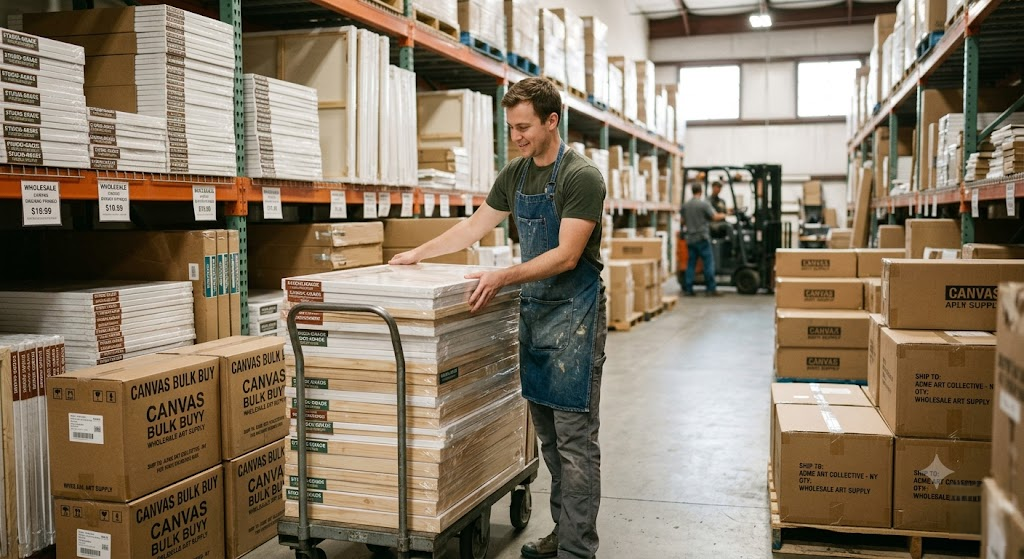
When mass-market distributors price a case of canvas aggressively low, they rarely achieve that discount through corporate generosity. They achieve it by shaving microscopic percentages off the materials. When reviewing a bulk distributor’s catalog, scrutinize these three metrics:
The “Primed vs. Unprimed” Weight Deception
You will frequently see budget listings marketing a “12-ounce canvas.” What the seller often omits is that the raw cotton textile weighs only 7 ounces, and the factory sprayed 5 ounces of heavy, brittle calcium carbonate chalk filler onto it to reach the 12-ounce mark.
True studio-grade canvas will explicitly state both weights—for example: “7oz raw / 10oz double-primed.” If a bulk product listing only offers a single weight metric, assume it is the inflated primed weight hiding a flimsy, loosely woven cotton base.
Kiln-Dried Wood vs. Green Wood
The greatest threat to a bulk shipment of stretched canvas is not a forklift puncture in transit; it is atmospheric warp. Stretcher bars must be constructed from kiln-dried wood (usually Paulownia, yellow pine, or Douglas fir) brought down to a **moisture content of 8% to 12%**.
To hit rock-bottom wholesale price points, overseas factories frequently assemble frames using “green” (un-dried) timber. As those sealed cartons sit in the hull of a cargo ship for three weeks, the timber slowly breathes out its moisture. By the time you open the case in a heated winter studio in Chicago or a dry warehouse in Phoenix, the wood shrinks unevenly, twisting the frames into permanent, un-hangable diagonals.
Weave Density and the “Tooth” Factor
Zoom in on the supplier’s macro photograph of the surface. Look at the grid formed by the warp (vertical threads) and weft (horizontal threads). A cheap bulk canvas uses thick threads spaced far apart. To disguise the gaps, the manufacturer floods the cotton with cheap liquid gesso. Once that thick layer of gesso dries, it becomes stiff; the moment you lean hard into the canvas with a palette knife or rest a heavy hand on the center, the primer spider-web cracks across the gaps in the weave.
The Unit Economics: Retail vs. Case vs. Pallet
To understand the scaling power of wholesale procurement, look at the median cost breakdown for standard mid-tier 16×20-inch cotton surfaces across the US market:
| Purchasing Tier | Volume Bought | Avg. Cost Per Unit | Est. Shipping Factor |
|---|---|---|---|
| Big Box Retail | 1 – 4 Units | $14.00 – $18.00 | Free (In-Store) |
| Online Master Case | 20 Units | $5.80 – $7.50 | $0.75 / unit (Standard Parcel) |
| Distributor Half-Pallet | 100 Units | $4.10 – $4.90 | $0.40 / unit (LTL Freight) |
| Unstretched Roll + Bars | Equivalent of 40+ | $2.60 – $3.40 | Negligible (Roll weight) |
The LTL Freight Reality: Shipping Oversized Bulk
If you are buying standard 11×14 or 16×20 cases, standard parcel carriers (UPS, FedEx, USPS) handle the freight smoothly. The moment your artistic ambition pushes your bulk order into 30×40-inch territory or larger, you enter the unforgiving world of **LTL (Less Than Truckload) shipping**.
Parcel carriers impose severe “Dimensional Weight” (DIM) penalties on large boxes. A box of six 36×48 canvases weighs almost nothing, but takes up the cubic space of a washing machine; standard couriers will bill you as if it weighs 90 pounds. Consequently, commercial suppliers will automatically pivot oversized bulk orders to freight trucks.
Before checking out on an oversized bulk buy, audit your delivery location for three standard freight trap-fees:
- The Residential Surcharge ($75–$150): Freight lines assume they are backing up to a commercial loading dock. If an 18-wheeler has to navigate a suburban residential cul-de-sac to reach your home studio, you will be billed an automatic accessorial fee.
- The Liftgate Fee ($50–$100): Freight trucks sit four feet off the ground. If you do not possess a commercial forklift on site to pull the pallet down, the driver has to deploy a hydraulic tailgate to drop your shipment to the asphalt.
- Limited Access Fees: Schools, rural estates, churches, and downtown art collectives often trigger extra fees simply for being difficult to park near.
Beyond the Easel: Bulk Canvas for Soft Goods & Apparel
The phrase “canvas bulk buy” carries a massive second life outside of the fine art studio. In the American textile trade, heavy-duty utility cotton canvas—historically termed **Cotton Duck** (derived from the Dutch word *doek*, meaning cloth)—is the foundational backbone of the custom tote bag, apron, and workwear industries.
If you are sourcing utility fabric or blank canvas totes in bulk for screen printing or embroidery, forget standard artist measurements and look strictly at the **Numbered Duck Classification System** (ranging from No. 1 to No. 12):
The golden rule of textile duck is counter-intuitive: The smaller the number, the heavier and stiffer the fabric.
- No. 4 Duck (~15.25 oz/sq yd): Extremely heavy, rugged, plain-weave fabric. Too stiff for standard apparel; utilized heavily for industrial tool bags, sea sacks, and heavy-duty floor floor cloths.
- No. 8 Duck (~18 oz double-filled): The sweet spot for premium, high-end heritage tote bags and heavy workshop aprons. It stands up on its own when set on a table.
- No. 10 Duck (~14.75 oz) & 10oz Single-Filled: The undisputed champion of the promotional merch world. When you buy a bulk 100-pack of blank tote bags for an event or a boutique print drop, this is the pliable, smooth-surfaced cotton you are aiming for.
Pro-Tips for Studio Warehouse Management
When the freight courier drops a half-dozen 40-pound cardboard cartons on your doorstep, the actual work of preservation begins. Improper warehouse hygiene can destroy a thousand dollars of inventory before a brush ever touches it.
1. Store Vertically Like Vinyl Records
Never stack stretched canvases horizontally in a flat tower. Gravity is relentless; the stacked weight of the upper canvases will concentrate squarely on the center of the bottom canvas, turning the lowest frame into a stretched hammock. Over a three-month storage window, that bottom canvas will develop a permanent, un-fixable belly sag. Store them upright, spine-to-spine, in a dry rack.
2. Do Not Strip the Corner Protectors
Those cheap, folded cardboard triangles stapled or slipped over the four corners of your bulk canvases look unsightly. Leave them on. The primary point of failure for stretched canvas in a bustling studio is a dropped corner striking a concrete floor, which instantly splinters the mitered wood joint inside the canvas fold.
3. Allow for Thermal Acclimation
If your bulk delivery spent four days traveling through freezing January temperatures in the back of an unheated interstate truck, **do not open the boxes the moment they arrive.** Let the sealed cardboard sit inside your warm studio for 24 to 48 hours. Forcing frozen, rigid acrylic gesso to instantly expand in 70-degree room air can cause micro-fissures across the entire surface of the gesso coat.
Red Flags That Scream “Walk Away”
As online B2B marketplaces proliferate, third-party white-label canvas sellers pop up daily. When vetting a new bulk supplier, treat the following three details as instant dealbreakers:
- Zero Mention of “Acid-Free” or “Alkaline Sizing”: Raw cotton contains natural lignins. If the cotton was not bathed in an alkaline sizing agent before priming, those lignins will react with atmospheric oxygen and the oil in your paints, slowly rotting the fabric and turning the artwork a sickly nicotine-yellow over a 15-to-20-year span.
- Side-Stapled “Gallery Wraps”: If a listing advertises a 1.5-inch deep “Gallery Wrap” but the product photos reveal steel staples driven into the side edges of the frame rather than tucked cleanly behind the back interior rear, it is a design contradiction. You cannot hang a side-stapled canvas unframed.
- The Rubber Spline Trap: Some mass manufacturers ditch staples entirely, pressing the canvas into a narrow groove on the back of the frame using a flexible rubber cord (a spline), similar to a window screen. While it looks exceptionally neat out of the box, **a splined canvas can never be re-stretched.** If the humidity in your buyer’s home causes the canvas to go slack five years from now, a conservator cannot pull the canvas tighter; the piece is effectively compromised.
The Bottom Line
Treating canvas as an expensive, precious individual purchase keeps an artist in a state of creative scarcity. You hesitate to experiment, you overwork dead paintings out of guilt, and you price your finished catalog based on retail panic rather than labor value.
Buying in bulk shifts your psychology from a consumer to a producer. Once you secure a reliable, archival pipeline that brings your 18×24-inch surface costs down to the price of a fancy morning coffee, the canvas stops being a monument you have to respect, and goes back to being what it was always meant to be: a blank arena for doing the work.