 salehunter.net
 When your vehicle starts clunking over speed bumps or the steering wheel develops a vague, floating sensation on the interstate, any seasoned mechanic will likely point to one culprit: worn-out front-end geometry. When the time comes to replace these critical suspension components, professional technicians and DIY gearheads overwhelmingly recommend one brand—MOOG. Widely recognized in the automotive aftermarket as “The Problem Solver,” MOOG has spent decades building a reputation for over-engineering factory replacement parts to correct inherent Original Equipment Manufacturer (OEM) design flaws.
However, legendary durability comes with a premium retail price tag. A complete front-end refresh involving MOOG upper and lower ball joints, inner and outer tie rod ends, control arms, and sway bar links can easily push a parts invoice past the $600 to $1,000 mark at a local brick-and-mortar auto parts counter.
The good news? You rarely have to pay sticker price. By understanding the modern auto parts distribution network, decoding manufacturer product tiers, and capitalizing on strategic digital buying windows, you can secure authentic MOOG chassis parts at discounts ranging from 25% to 60% off retail. Here is the insider’s playbook for sourcing premium suspension gear on a budget.
Understanding What You Are Paying For: The MOOG Advantage
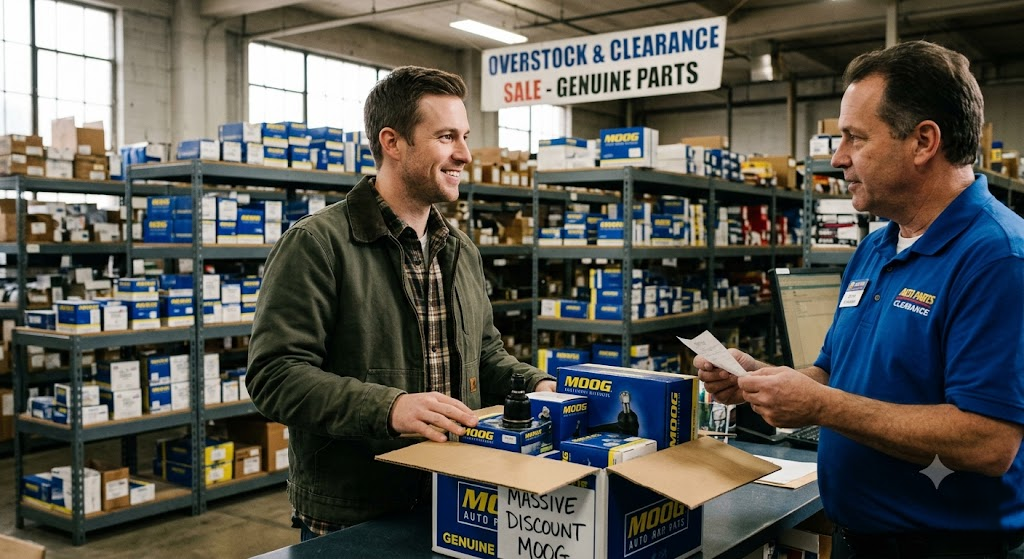
Before hunting for the lowest possible price point, it is vital to understand why MOOG commands a higher baseline cost than generic, white-box internet brands. In the automotive chassis world, labor is the true expense. Replacing a pressed-in lower ball joint can require three hours of wrestling with a heavy-duty C-clamp press, a torch, and a breaker bar. Saving $20 on a budget component that suffers premature boot failure and develops loose play within 12,000 miles is a classic example of false economy.
Genuine flagship MOOG parts incorporate several proprietary engineering upgrades that justify their baseline cost:
- Powdered-Metal Gusher Bearings: Traditional polymer bearings wear down smoothly until they suddenly catastrophically fail. MOOG’s powdered-metal design allows lubrication to flow directly through the bearing surface, reducing friction and actively flushing out microscopic debris.
- Greaseable Socket Designs: While modern automakers favor “sealed-for-life” components to cut factory assembly costs, MOOG intentionally integrates grease zerks (fittings) into their heavy-duty line. This allows owners to flush fresh grease into the joint during regular oil changes.
- Heat-Treated Studs: MOOG ball studs undergo specialized induction heat treatments to match or exceed the structural fatigue strength of the original vehicle hardware.
- Belleville Washer Preload: An internal spring-steel washer absorbs impact loads and keeps the bearing package tight as the metal surfaces naturally experience micro-wear over time.
When hunting for a MOOG discount, your goal is to acquire this specific tier of engineering at a generic-brand price point—never to settle for a downgraded part.
The Secret Product Line Distinction: Problem Solver vs. R-Series
One of the most common mistakes budget-conscious shoppers make is accidentally purchasing the wrong tier of MOOG hardware. Federal-Mogul (now operating under DRiV Incorporated) manufactures two distinct lines of MOOG chassis parts. Knowing how to spot the difference is the first step in true price optimization.
The Problem Solver Line (Premium): These are the legendary, professional-grade parts. You can identify them by part numbers that typically begin with standard prefixes such as K (for ball joints and sway bar links), ES or EV (for tie rod ends), and CK (for complete control arm assemblies). These feature the greaseable zerks, the gusher bearings, and the upgraded elastomer bushings.
The R-Series Line (Economy/OE Replacement): Identified by part numbers starting with RK (for control arms) or packaged under baseline economy branding. The R-Series is engineered to be a direct, standard Original Equipment equivalent. It is generally non-greaseable, utilizes standard rubber bushings, and lacks the over-engineered internal upgrades of the flagship line.
If you see an online vendor advertising a MOOG lower control arm for $48 while another lists it for $115, look closely at the part number prefix. You haven’t necessarily discovered a 60% discount; you are likely comparing an RK-Series part to a CK-Series part. True victory in aftermarket shopping is snagging the CK or K-series component at an RK-series price.
The Top 4 Digital Arenas for Deep MOOG Discounts
Once you have gathered your exact target part numbers directly from the official MOOG online digital lookup tool, it is time to shop the digital ecosystem. Do not rely on a single marketplace; price variances across these four major retail channels fluctuate daily.
1. RockAuto: The Baseline King
For pure, unpadded part discounting, RockAuto remains the undisputed champion of the American DIY community. Their warehouse aggregator model strips away brick-and-mortar overhead, customer service phone desks, and commercial storefronts, passing the wholesale margin directly to the consumer. MOOG components on RockAuto routinely sit 30% to 50% below standard neighborhood auto parts store pricing.
The Pro Hack: Pay strict attention to the small “Truck Icon” in the RockAuto checkout cart. Because RockAuto ships from dozens of disparate regional supply depots, ordering four MOOG components that trigger three separate warehouse shipping fees will instantly neutralize your discount. Experiment with swapping equivalent MOOG part numbers (such as comparing left vs. right side inventory availability) until every item in your cart displays the exact same warehouse letter designation.
2. Advance Auto Parts: The “Digital Stack” Strategy
If your vehicle is currently torn apart on jack stands and you need parts today, Advance Auto Parts offers the most effective digital-to-physical discount loophole in the country.
The Pro Hack: Never walk up to the retail counter and order at sticker price. Stand in the parking lot, open their mobile website, place the MOOG parts into your digital shopping cart, and apply their widely available front-page promotional banner codes (which frequently offer 15% to 20% off online orders). Select “In-Store Pickup.” You can walk inside 20 minutes later, collect your freshly discounted MOOG boxes, and retain a localized commercial receipt for frictionless future warranty claims.
3. Amazon: Automated Algorithms and “Warehouse Deals”
Amazon functions as an automated, volatile stock market for automotive replacement hardware. Algorithmic pricing robots automatically drop MOOG SKU prices when third-party logistics fulfillment centers experience localized overstock.
The Pro Hack: Run your exact MOOG part number through a historical price tracker like Keepa or CamelCamelCamel to verify if the current price sits in a valley or a peak. Furthermore, search the exact part number followed by the phrase “Amazon Warehouse.” Returned, cosmetically box-damaged MOOG components—which are mechanically pristine inside—are routinely offloaded into the Amazon Warehouse inventory stream at 35% to 45% off retail just to clear warehouse bin space.
4. Summit Racing Equipment
While traditionally viewed strictly as a high-performance drag racing and hot-rod supplier, Summit Racing maintains a massive, deeply stocked inventory of standard passenger car and truck MOOG replacement chassis hardware.
The Pro Hack: Summit enforces a rigid, highly reliable free-shipping threshold (typically on domestic orders exceeding $109). If you are rebuilding an entire front-end steering assembly, buying your MOOG tie rods, ball joints, and idler arms in a single batch from Summit frequently results in a lower net out-of-pocket total than aggregator sites once heavy freight shipping fees are calculated.
Unlocking the Corporate Layer: DRiV Manufacturer Rebates
Most consumers view the digital checkout screen as the final financial step. However, MOOG’s corporate parent company, DRiV, frequently launches nationwide manufacturer mail-in and digital redemption rebates that stack directly on top of your retailer’s already discounted price.
Typically deployed during the peak Spring and Fall DIY vehicle maintenance windows (March through May, and September through November), these promotions usually operate on a tiered, spend-to-get structure:
- Spend $100 on qualifying MOOG products, receive a $15 prepaid digital Visa card.
- Spend $250, receive a $50 prepaid card.
- Spend $400 or more, claim a $100 rebate.
To capitalize on this corporate margin, visit the official DRiV Rebate Center portal before finalizing any online purchase. Verify that your chosen digital merchant is officially categorized as an “Authorized Aftermarket Retailer” within the promotion’s fine print. Save your digital PDF invoices, and crucially, cut the physical cardboard UPC barcodes directly off the MOOG boxes. Taking a smartphone photograph of the barcode sitting on the box will trigger an automated third-party rejection; redemption centers strictly require the physical cardboard cutout mailed in or scanned flat alongside an itemized invoice.
The Hidden Danger: Spotting Counterfeit MOOG Hardware
Whenever an automotive brand achieves a high-margin, trusted reputation, a shadow industry of offshore counterfeiters inevitably emerges. When hunting for steep discounts on peer-to-peer marketplaces like eBay or unverified third-party storefronts, your exposure to counterfeit MOOG chassis gear multiplies. Installing forged steering geometry is an extreme highway safety hazard.
Inspect your shipments immediately upon arrival for these telltale counterfeiting red flags:
- Packaging Typography: Authentic MOOG cardboard utilizes a distinct, highly saturated yellow and royal blue palette. Counterfeits often rely on washed-out, slightly greenish-tinted yellow cardboard, fuzzy barcode printing, or slightly skewed brand logos.
- Housing Engraving: Real MOOG Problem Solver ball joints and tie rod housings feature crisp, computerized laser-etched part numbers, logos, and lot trace codes stamped directly into the forged steel. Counterfeits frequently exhibit blank housings or crude, uneven dot-matrix acid etching.
- Dust Boot Chemistry: Genuine MOOG boots are molded from thick, dense polychloroprene (Neoprene) or engineered polyurethane built to withstand road salt, ozone, and constant thermal cycling. Counterfeits utilize stiff, shiny, cheap petroleum rubber that emits a strong chemical odor and will split open within six months of highway driving.
- The Hardware Pack: MOOG packages high-grade, Grade 8 equivalent castle nuts, fresh cotter pins, and hardened zerk fittings inside a heavy-duty, branded sealed poly-bag. If your component arrives with a generic, unbranded zip-top bag containing soft, unplated silver hardware, initiate a return immediately.
Maximizing the Investment: The Lifecycle Approach
Scoring a 45% discount on a MOOG chassis component represents only half of the economic battle; properly commissioning the part ensures you capture its full lifecycle value.
Once your genuine components are unpacked on the workbench, inspect the grease ports. Many DIY enthusiasts mistakenly assume premium chassis parts arrive fully packed with grease from the factory. In reality, components are shipped containing only a light coating of assembly preservative to prevent warehouse shelf-corrosion. Once the part is safely torqued into the vehicle’s steering knuckle, attach a manual grease gun packed with a premium NLGI #2 lithium-complex synthetic grease. Pump the fitting slowly until you observe the polyurethane boot gently swell and purge a tiny, clean seal of lubricant from its base.
By taking the time to cross-reference product prefixes, stacking digital storefront coupon codes with corporate manufacturer rebates, and rigorously vetting part authenticity before installation, you transform an expensive vehicle repair into an exercise in smart automotive economics. You gain the peace of mind of professional-grade chassis geometry holding your tires to the asphalt, all while keeping your maintenance budget firmly in the green.