 salehunter.net
 Upgrading your home’s exterior lighting doesn’t have to drain your wallet or your monthly energy budget. As homeowners increasingly prioritize both security and sustainability, the demand for outdoor solar lighting has skyrocketed. However, savvy shoppers know that you do not need to pay full retail price to achieve a well-lit, secure perimeter around your property. By timing your purchases and knowing exactly what to look for, hunting for a solar motion sensor light clearance sale can yield premium lighting solutions at a fraction of the cost.
Whether you are looking to illuminate a dark driveway, secure your backyard, or simply add some convenience to your front porch steps, solar-powered motion lights offer a plug-and-play solution. Because they draw their power directly from the sun, they require no complicated hardwiring, no expensive electricians, and absolutely zero additions to your monthly utility bill. In this comprehensive guide, we will explore how to navigate clearance sales, what technical specifications you should never compromise on, and how to properly install your new lights to maximize both their lifespan and their performance.
Understanding the Retail Cycle: When Do Clearance Sales Happen?
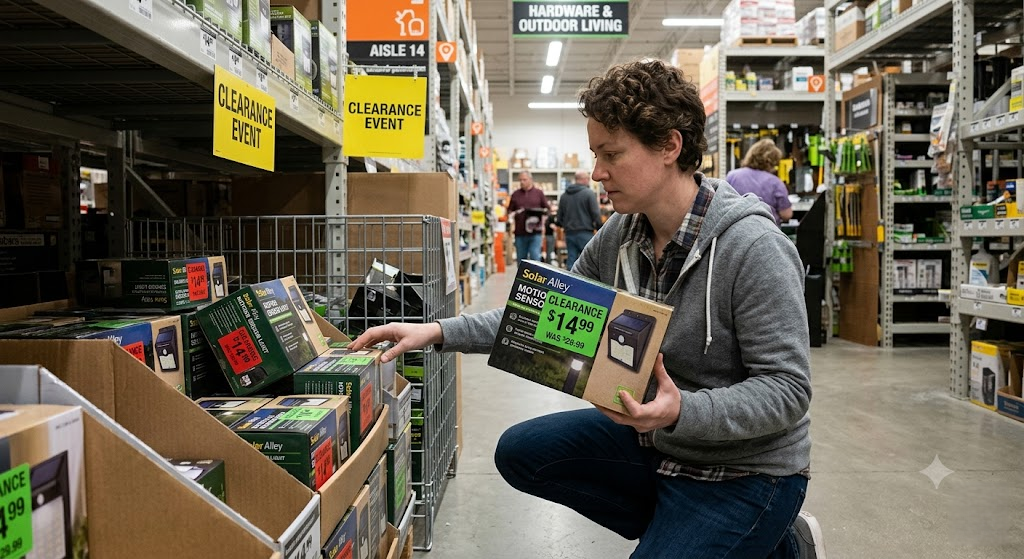
To score the best deals on outdoor solar lighting, you need to think like a retail merchandiser. Big-box hardware stores and major online retailers do not put items on clearance randomly; they follow a predictable seasonal schedule. Understanding this rhythm is your golden ticket to massive savings.
The Post-Summer Shift
The most lucrative time to find a solar motion sensor light on clearance is late summer to early fall. Retailers typically stock up heavily on outdoor living and landscaping products in the spring. By the time August and September roll around, they are desperate to clear out this inventory to make room for holiday decorations, snow blowers, and winter gear. During this transitional period, you can often find premium solar lights slashed by 40% to 70%.
Post-Holiday and Spring Redesigns
Another excellent time to look for clearance items is in late January. While not traditionally an outdoor lighting season, many stores liquidate whatever remaining stock they have before the new year’s spring catalog arrives. Manufacturers frequently update their models—changing the casing design slightly or upgrading the LED chips—which forces retailers to put the perfectly good “older” models on deep discount.
Don’t Buy Junk: Key Specs to Check on the Clearance Rack
A low price tag is only a good deal if the product actually works and lasts. When browsing the clearance aisle or filtering online closeout sales, it is incredibly easy to be swayed by a cheap price tag on a subpar product. Always flip the box over and check for these critical specifications before adding the light to your cart.
Lumen Output and LED Quality
Lumens measure the total quantity of visible light emitted by a source. For a motion sensor security light, brightness is paramount. A light with 100 lumens might be fine for a decorative pathway, but it will do practically nothing to deter an intruder or light up a large driveway. For security purposes, look for clearance models that offer a minimum of 800 to 1,000 lumens. Furthermore, pay attention to the type of LEDs. COB (Chip on Board) LEDs generally provide a denser, brighter light array than older SMD (Surface Mounted Device) LEDs.
Battery Capacity and Chemistry
The solar panel collects the energy, but the battery stores it. A fantastic solar panel is useless if paired with a weak battery that dies by 10 PM. Check the box for the battery’s milliampere-hour (mAh) rating. A quality outdoor security light should have at least a 2200mAh battery. Additionally, look for Lithium-Ion (Li-ion) or Lithium Iron Phosphate (LiFePO4) batteries. These chemistries withstand extreme temperature fluctuations much better than outdated Nickel-Metal Hydride (NiMH) batteries, which are often found in the cheapest clearance bin models.
IP Waterproof Rating
Since these lights will live outdoors 365 days a year, they must be able to survive rain, sleet, and snow. The Ingress Protection (IP) rating tells you exactly how weatherproof a unit is. Never buy an outdoor solar light with a rating lower than IP65. An IP65 rating guarantees that the light is completely dust-tight and protected against low-pressure water jets from any direction. If you live in an area with extreme weather or heavy rainstorms, aim for an IP67-rated unit.
Sensor Range and Detection Angle
The passive infrared (PIR) sensor is the brain of your security light. It detects the heat signatures of moving objects. A high-quality PIR sensor should have a detection angle of at least 120 degrees and a range of 25 to 40 feet. If the clearance box doesn’t list the detection range, proceed with caution, as you might end up with a light that only turns on when you are two feet away from it.
The Double Meaning of “Clearance”: Installation and Placement
In the world of solar lighting, “clearance” doesn’t just mean a sale; it also refers to the physical space and positioning required to make the light function optimally. Proper installation clearance is the most common stumbling block for DIYers.
Solar Panel Sky Clearance
The number one reason solar motion lights fail to perform is inadequate sunlight exposure. Your light needs “clearance” from obstructions. When choosing a mounting location, look up. Are there heavy tree branches, deep roof overhangs, or tall neighboring buildings that will cast a shadow over the panel during peak daylight hours? Most solar security lights require between 6 and 8 hours of direct, unshaded sunlight to fully charge their batteries. If you want to place a light in a naturally shady area (like under an eave), look for a clearance deal on a “split” or “separated” model, where the solar panel is connected to the light fixture by a long cord.
Optimal Mounting Height
Height clearance is critical for the motion sensor to work correctly. If you mount the light too low, the sensor’s field of view is truncated, and it may be easily triggered by small animals like neighborhood cats, or worse, easily tampered with by an intruder. If you mount it too high, the sensor might not detect human-sized movement at the ground level. The sweet spot for most standard residential solar motion sensor lights is a mounting height between 6 and 10 feet off the ground.
Smart Shopping Strategies: Where to Find the Best Sales
Now that you know what makes a high-quality solar light and how to install it, where exactly do you find these elusive clearance deals in the US market?
- The Endcaps of Big Box Stores: Next time you are at The Home Depot, Lowe’s, or Menards, skip the main lighting aisle. Head to the back of the store or check the yellow-tagged endcaps (the displays at the end of the aisles). This is where managers typically dump discontinued or overstock outdoor items.
- Amazon Warehouse and Renewed: You don’t have to wait for Prime Day to get a deal. Search for your desired solar lights and look at the “Used & New” purchasing options. Amazon Warehouse constantly sells open-box returns. Because these lights are incredibly durable, an “acceptable” or “good” condition rating usually just means the cardboard box was dented in transit, but the light itself is perfectly fine and often 50% off.
- Direct Manufacturer Websites: Companies that specialize in solar lighting often have a dedicated “Sale” or “Clearance” tab on their direct-to-consumer websites. By buying directly from the manufacturer, you cut out the retail middleman and can take advantage of older models being phased out.
- Discount Club Stores: Costco and Sam’s Club are famous for their seasonal rotations. In late summer, they drastically reduce the prices of their multi-pack solar motion lights. If you see a price ending in .97 at Costco, it is officially on manager clearance and won’t get any cheaper.
Avoiding the Pitfalls of Clearance Shopping
While the thrill of the hunt is exciting, clearance shopping comes with its own set of risks. Here are a few things to keep an eye out for to ensure your deal doesn’t turn into a dud.
Check the Return Policy
Many brick-and-mortar stores have strict “All Sales Final” policies on deep-discount clearance items. Before handing over your credit card, ask the cashier if the item can be returned if it turns out to be defective. Solar lights sit in boxes for months; sometimes batteries degrade simply from lack of use. You want to make sure you have at least 14 to 30 days to return a dead-on-arrival unit.
Inspect Open Box Items
If the tape on the box is broken, open it up right there in the store. Check that all the pieces are included. The most commonly missing items in returned solar lights are the mounting brackets and the specific screws/wall anchors needed to hang them. While you can usually rig something up with your own hardware, missing proprietary brackets can make the light un-mountable.
Maintenance Tips to Protect Your Investment
Once you’ve scored a fantastic deal and properly installed your lights with the correct spatial clearance, a little bit of maintenance will ensure they last for years.
First, keep the solar panels clean. Over time, dust, pollen, bird droppings, and hard water stains can build up on the plastic casing over the solar cells. A dirty panel can lose up to 30% of its charging efficiency. Make it a habit to wipe down the panels with a damp microfiber cloth every few months. Avoid using harsh chemical cleaners, as they can cloud the protective plastic.
Second, understand battery degradation. Even the best Lithium-Ion batteries have a finite lifespan, usually around 1,000 to 2,000 charge cycles (roughly 3 to 5 years). If you notice your clearance light isn’t staying on as long as it used to, don’t throw the whole unit away. Most high-quality lights have a battery compartment accessible by a few small Phillips-head screws. Replacing the rechargeable battery is a cheap, five-minute fix that breathes new life into your security setup.
Final Thoughts on Solar Security Savings
Securing your home and illuminating your property shouldn’t require taking out a second mortgage. By understanding the retail seasons, you can leverage solar motion sensor light clearance sales to build a robust, eco-friendly security network around your home. Remember to prioritize essential specifications like high lumen output, reliable battery chemistry, and strong weatherproofing over merely finding the absolute lowest price. Couple your smart purchasing with proper physical installation clearance, and you will enjoy brilliant, reliable, and cost-free lighting for years to come.