 salehunter.net
 Walking onto a fabrication floor and seeing a manual leverage bender collecting dust is a familiar sight for seasoned mechanics and builders. There usually comes a tipping point in every fabricator’s journey where brute force and long cheater bars no longer cut it. Whether you are ramping up production for custom off-road roll cages, fabricating industrial handrails, or bending thick-walled schedule 40 pipe for structural supports, upgrading your equipment is inevitable. Finding the right hydraulic pipe bender for sale isn’t just about spending capital; it is about investing in precision, repeatability, and saving massive amounts of physical labor.
However, navigating the industrial machinery market can feel overwhelming. Manufacturers and distributors throw around terms like tonnage, center line radius, and rotary draw, often assuming the buyer already knows exactly what they need. Buying the wrong machine can lead to crushed tubing, wrinkled inside radii, and thousands of dollars wasted. This playbook is designed to strip away the marketing jargon and give you the raw, actionable intel you need before pulling the trigger on a hydraulic bender.
The Golden Rule: Understand Pipe vs. Tube Before Shopping
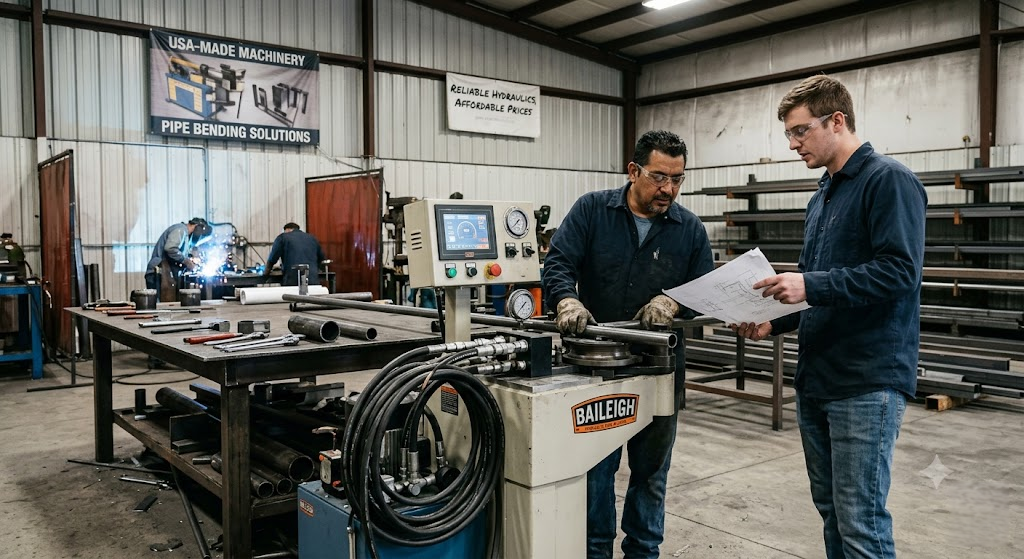
Before you even type a search query looking for equipment sales, you need to firmly establish what materials you are actually working with. The terms “pipe” and “tube” are used interchangeably by laymen, but in the structural and fluid transfer world, they are completely different animals.
Pipe is measured by its nominal inside diameter (ID) and its wall thickness is referred to as a “schedule” (like Schedule 40 or Schedule 80). It is primarily designed to transport fluids and gases, meaning the outside diameter can vary slightly. Tube, on the other hand, is measured by its exact outside diameter (OD) and its wall thickness is measured in standard gauges or precise thousandths of an inch (like .120″ wall). Tubing is typically used for structural applications, such as automotive chassis, motorcycle frames, and aerospace components.
Why does this matter when browsing a hydraulic pipe bender sale? Because the dies—the machined metal blocks that actually shape the metal—are engineered specifically for one or the other. If you buy a heavy-duty bender equipped only with nominal pipe dies, and you try to bend 1.5-inch DOM (Drawn Over Mandrel) steel tubing, you will almost certainly crush or flatten the material. Always verify exactly what dies are included with the machine and whether the manufacturer offers aftermarket die sets for your specific materials.
Ram-Style vs. Rotary Draw: Choosing Your Mechanism
When you start looking at machines on the market, you will quickly notice a massive price discrepancy. You might see one hydraulic unit retailing for a few hundred dollars, while another base model starts at three thousand. This price gap usually comes down to the bending mechanism itself.
- Ram-Style Benders: These are the affordable workhorses often found in general maintenance shops and plumbing outfits. A hydraulic cylinder pushes a radiused die directly into the center of the pipe, forcing it between two stationary outer blocks. They are excellent for thick-walled pipe and simple bends where aesthetic perfection isn’t strictly required. However, because they stretch the outside of the material without adequately supporting the inside, they are notorious for kinking thin-walled tubing. If you are building a dune buggy roll cage, a ram bender is usually the wrong tool for the job.
- Rotary Draw Benders: This is the gold standard for structural fabrication. In this setup, the tube is clamped fast to a main bending die, which then rotates, drawing the material around it while a follower die supports the back half of the tube. Powered by a hydraulic cylinder ratcheting the die or turning a planetary gear, rotary draw machines create beautiful, kink-free bends even on thin-walled stainless steel and aluminum. If your end product requires tight tolerances and flawless aesthetics, this is the machine you need to look for.
Crucial Specifications to Scrutinize
Once you have decided on the style of bender, it is time to look at the numbers. Spec sheets can be deceptive, so you need to know exactly which metrics dictate real-world performance on the shop floor.
Tonnage and Bending Capacity
Hydraulic power is measured in tons of force. A standard entry-level ram bender might offer 12 to 16 tons of force, which is generally plenty for standard mild steel pipe up to two inches in diameter. However, tonnage isn’t the only factor; frame rigidity matters just as much. A 20-ton hydraulic ram bolted to a flimsy frame will simply twist the machine apart before it successfully bends 2-inch chromoly steel. Look for solid steel construction, heavily reinforced pivot points, and a wide stance.
Maximum Degree of Bend
How far do you need to push the material? Many cheaper models max out at a 90-degree bend. If you are fabricating U-bolts, custom exhaust loops, or intricate handrail returns, you will absolutely need a machine capable of full 180-degree bends. Keep in mind that metal possesses a characteristic called “springback.” When you bend a steel tube to exactly 90 degrees and release the hydraulic pressure, it might spring back to 87 degrees. Therefore, a bender needs to physically push slightly past your target angle. A high-quality hydraulic bender should allow for at least 110 degrees on a single push, or up to 200 degrees on a full sweep.
Center Line Radius (CLR)
The Center Line Radius dictates how tight the curve of your bend will be. Different applications demand different radii. Tight CLR dies require much more hydraulic force and are harder on the material, increasing the risk of wall thinning or cracking. When negotiating a purchase, check the availability and cost of various CLR die sets. A cheap bender becomes wildly expensive if proprietary die sets cost a small fortune to acquire later.
The Power Delivery: Manual, Air, or Electric Hydraulics?
The “hydraulic” part of the equation also requires some decision-making. How do you want to deliver the fluid pressure to the cylinder?
- Manual-Hydraulic: These use a traditional hand pump, much like a standard floor jack. They are highly portable, require no external power, and give you incredible tactile feedback as the metal yields. The downside? They are painfully slow and will give you a serious upper-body workout if you are doing production runs.
- Air-Hydraulic: This is a massive leap forward for small shops. These pumps hook up to your standard air compressor and use pneumatic pressure to drive the hydraulic fluid. You operate them with a simple foot pedal, leaving both hands free to hold the material, check angles, and secure pins. They are relatively inexpensive and drastically speed up the fabrication process.
- Electric-Hydraulic: The ultimate luxury in pipe bending. Powered by 110v or 220v electric motors, these dedicated pumps deliver smooth, consistent, and rapid pressure at the push of a button or pedal. They are generally much quieter than air-over-hydraulic systems and offer the best cycle times for high-volume production. When looking at high-end industrial sales, electric hydraulics are the standard.
Navigating the Used Market: Red Flags and Hidden Gems
Finding a quality hydraulic pipe bender for sale doesn’t always mean buying brand new. The secondary market—including machinery auctions, liquidation sales, and online classifieds—is flooded with perfectly capable equipment. Heavy steel fabrication tools take decades to truly wear out, provided they are maintained. However, buying used carries distinct risks.
First, inspect the hydraulic cylinder for leaks. A light film of oil on the ram is normal, but actively dripping fluid indicates blown seals. While ram rebuilds are generally cheap and easy, a heavily scored or pitted chrome cylinder rod means the entire ram needs replacing, which heavily impacts the value of the machine. Second, check the frame for stress fractures or signs of aftermarket welding. If a previous owner tried to bend material beyond the machine’s rated capacity, they may have stretched or cracked the main pivot arms.
Finally, and perhaps most importantly, inspect the dies. Die sets are often the most expensive component of the entire setup. Look for deep gouges, galling, or severe wear on the radius. If a machine is being sold at a seemingly unbelievable discount, it is usually because it is missing its most valuable dies, and the seller knows how expensive they are to replace.
The Financial Math: ROI on Your Purchase
For independent contractors and small business owners, buying a hydraulic bender is an exercise in Return on Investment (ROI). If you are currently outsourcing your bending work to a larger machine shop, calculate your monthly expenditures. Consider not just the invoice costs, but the time lost in transit and the delays in your project timelines.
Bringing fabrication in-house gives you total control over your production schedule. A quality air-over-hydraulic rotary draw bender with a good set of dies might run between $2,000 and $4,000. If you are paying a local shop $300 a week for custom bends, the machine literally pays for itself in a matter of months. Furthermore, having the capability on hand allows for rapid prototyping. You can test a complex three-plane bend on scrap tubing in twenty minutes, adjust your calculations, and produce the final piece the same afternoon.
Maintenance Best Practices for Longevity
Once you secure your purchase, protecting that investment is paramount. Hydraulic benders are robust, but they are not maintenance-free. The dies must be kept meticulously clean. A single piece of hard mill scale or metallic grit caught between the tubing and the die will drag along the material, leaving a deep, ugly gouge across your finished part. Wipe down your dies before every session and use appropriate bending lubricants (not just standard WD-40) to reduce friction and prevent galling.
Hydraulic fluid should be checked regularly and swapped according to the manufacturer’s intervals to prevent moisture buildup, which can rust the internal valves of your pump. Keep the cylinder retracted when the machine is not in use to protect the chrome rod from dust, accidental impacts, and shop humidity.
Making the Final Decision
Hunting down the ideal hydraulic pipe bender requires patience and a clear understanding of your shop’s specific needs. Avoid the temptation to buy massive over-capacity if you exclusively work with thin-wall aluminum, but similarly, do not under-buy if you foresee structural steel projects in your future. Focus on the core mechanics, demand high-quality dies, choose the right power delivery for your workflow, and always calculate the long-term value over the initial sticker price. By applying these metrics, you can confidently navigate the industrial market and secure a machine that will reliably shape steel for decades to come.