
Premium Glass Beads for Jewelry Making on Sale: Crafting High-Quality Pieces on a Budget
 salehunter.net
 There is a specific kind of magic that happens when you spill a fresh strand of glass beads onto your work mat. The way the light catches the facets, the satisfying weight of the material in your hand, and the endless color combinations all contribute to the deeply tactile joy of jewelry making. Whether you are stringing together a simple summer anklet or weaving an intricate, multi-tiered statement necklace, the materials you choose form the foundation of your artistry. But as any seasoned artisan knows, sourcing high-quality materials can quickly become an expensive endeavor. That is exactly why finding a legitimate glass beads for jewelry making sale is like striking gold for crafters and small business owners alike.
Shopping for jewelry supplies during clearance events, seasonal sales, or wholesale blowouts allows you to stretch your creative budget without compromising on the integrity of your finished pieces. Glass, unlike lightweight acrylic or plastic, offers a premium feel, historical resonance, and a visual depth that elevates handmade jewelry into heirloom-quality wearable art. Navigating these sales, however, requires a bit of savvy. You need to know exactly what you are looking at, how to spot true value, and which bead varieties will yield the highest return on your investment.
The Historical Allure and Enduring Popularity of Glass Beads
Before diving into the mechanics of shopping a glass beads for jewelry making sale, it helps to understand exactly what makes this material so highly coveted. Glassmaking is an ancient art form, with the earliest known glass beads tracing back to ancient Egypt and Mesopotamia around 3,500 B.C. These early artisans discovered that by mixing silica (sand) with an alkali and heating it to extreme temperatures, they could create a mesmerizing, gem-like substance.
Perhaps the most famous chapter in the history of glass beads belongs to Venice, Italy. In 1291, the Venetian Republic ordered all glassmakers to move their foundries to the nearby island of Murano. While the official reason was to protect the wooden structures of Venice from the risk of fire, the ulterior motive was to isolate the artisans and fiercely guard the secrets of their highly lucrative glassmaking techniques. For centuries, Murano glass beads were traded globally, sometimes even used as a form of currency. Today, when you incorporate glass into your designs, you are participating in a lineage of craftsmanship that spans millennia.
Modern consumers still inherently recognize this value. A necklace crafted with heavy, cold-to-the-touch glass beads simply feels more luxurious than its plastic counterpart. By strategically purchasing your supplies during major sales, you can offer your customers this premium experience at highly competitive price points.
Key Varieties to Target During a Sale
Not all glass is created equal, and a massive clearance event is the perfect opportunity to diversify your inventory. When browsing a glass beads for jewelry making sale, keep your eyes peeled for these specific, highly sought-after varieties:
Czech Glass Beads
The Bohemian region of what is now the Czech Republic has been a global epicenter for glass manufacturing since the Middle Ages. Czech glass beads are globally renowned for their incredible uniformity, rich colors, and affordability. During a sale, look specifically for fire-polished Czech beads. These beads are first faceted by machine and then briefly passed through an open flame. This subtle melting of the glass surface softens the harsh edges of the facets, resulting in a brilliant, soft gleam that mimics precious gemstones. They are versatile, beautiful, and an absolute staple for any designer.
Lampwork Glass Beads
Lampworking is a painstaking technique where an artisan uses a torch to melt rods of glass, carefully winding the molten material around a steel mandrel to form a bead. Because they are handmade, no two lampwork beads are ever exactly identical. They often feature intricate internal designs, three-dimensional floral motifs, or swirling abstract patterns. Lampwork beads are traditionally quite expensive due to the labor involved, making them one of the best items to hunt for during a discount event. A single, exquisite lampwork bead acquired on sale can serve as the breathtaking focal point of a necklace that commands a high retail price.
Millefiori Beads
Translating literally to “a thousand flowers” in Italian, Millefiori beads are created using a specialized technique where multi-colored glass canes are fused together, stretched, and then sliced to reveal intricate, floral-like cross-sections. These slices are then applied to a molten glass core. They add a whimsical, vintage, and highly detailed element to bracelets and earrings. Stocking up on Millefiori during a wholesale sale gives your spring and summer jewelry lines a vibrant, artisanal edge.
Seed Beads and Delicas
If you practice bead weaving, loom work, or intricate embroidery, seed beads are your paint and canvas. Japanese manufacturers, such as Miyuki and Toho, are famous for producing glass seed beads with laser-like precision. Miyuki Delicas, in particular, are perfectly cylindrical, allowing them to snap together like tiny, glittering bricks in peyote stitch patterns. Because bead weavers use thousands of seed beads for a single project, finding bulk bags of glass seed beads on sale is essential for keeping overhead costs manageable.
Understanding Finishes and Treatments
As you scroll through pages of a glass beads for jewelry making sale, you will likely encounter a myriad of complex terms describing the exterior finishes of the beads. Understanding these treatments will help you make informed purchasing decisions and avoid unpleasant surprises when your package arrives.
- AB (Aurora Borealis): A half-coat iridescent finish invented in the 1950s in a collaboration between Swarovski and Christian Dior. It adds a rainbow-like, metallic sheen to the glass that reflects ambient light beautifully.
- Picasso: A speckled, earthy finish typically applied to the edges or facets of a bead. It mimics the look of natural stone or ancient, excavated pottery, providing a gorgeous rustic aesthetic.
- Color-Lined: These are clear glass beads that feature a vibrant color applied strictly to the inside of the bead hole. They offer a deep, jewel-like effect. However, be cautious: if the hole is lined with a cheap dye, it may rub off on the stringing wire over time.
- Matte or Frosted: Instead of a high-gloss shine, these beads are treated (often etched with acid or tumbled) to create a soft, velvety, non-reflective surface. Matte glass beads pair exceptionally well with high-shine metallic spacers for a modern contrast.
Strategic Shopping: How to Maximize a Bead Sale
Approaching a sale without a strategy can quickly lead to an overflowing shopping cart filled with impulse buys that never quite make it into a finished design. To truly benefit from a glass beads for jewelry making sale, you need to adopt the mindset of a professional buyer.
1. Calculate the Cost Per Bead (CPB)
When comparing prices, do not just look at the overall price tag of the strand or bag. A $5 strand might seem like a steal, but if it only holds 10 large beads, you are paying 50 cents per bead. Conversely, an $8 strand holding 50 smaller beads equates to just 16 cents per bead. Knowing your CPB is crucial if you are selling your finished jewelry, as it dictates your profit margins and wholesale pricing.
2. Look for “Destash” and Clearance Sections
Many major online bead retailers have hidden clearance or “destash” categories where they liquidate overstock, discontinued colors, or seasonal items from the previous year. You can often find premium Czech and Murano glass heavily discounted simply because the supplier needs warehouse space. Be aware that these items are usually final sale, so review the millimeter sizing and hole diameter carefully before purchasing.
3. Beware of “Dyed” vs. “Solid” Glass
One of the pitfalls of buying cheap glass beads is encountering dyed glass. True colored glass is created by adding metallic oxides (like cobalt for blue, or copper for turquoise) to the molten silica during the manufacturing process, meaning the color is permanent and goes all the way through the bead. Cheaper alternatives are simply clear glass beads painted with a topical dye. Over time, friction, sweat, and perfume will cause this surface dye to chip and fade. Always check the product description during a sale. Look for phrases like “solid color glass” and steer clear of items vaguely labeled as “color-coated” unless you are fully aware of their limitations.
4. Anticipate Seasonal Trends
The best time to buy supplies for your holiday collections is during mid-summer sales, and the best time to buy bright, tropical glass beads is in the dead of winter. Retailers heavily discount off-season merchandise. By planning your jewelry collections six months in advance, you can take full advantage of these massive price drops.
Turning Discounted Beads into Premium Profits
If you run a small handmade business on platforms like Etsy or Shopify, how you position the jewelry made from your sale-sourced glass is incredibly important. You never want to market your items as “made from cheap sale beads.” Instead, focus on the intrinsic quality of the glass itself.
When writing your product descriptions, highlight the materials. Describe the “fire-polished facets of Bohemian glass” or the “hand-torched intricacies of artisanal lampwork.” Pair your discounted glass beads with higher-end findings, such as sterling silver ear wires, 14k gold-filled clasps, or natural leather cords. This technique, known as high-low styling, significantly raises the perceived value of the piece. The customer sees the premium clasp and the heavy glass and assumes a high overall cost of production, allowing you to charge a premium retail price while privately enjoying the wide profit margins afforded by your savvy sale shopping.
Proper Storage and Organization
Finally, a successful haul from a glass beads for jewelry making sale requires proper storage. Glass is durable, but it can chip or scratch if large, heavy beads are allowed to violently clink together in transit or storage. Once your sale order arrives, immediately remove the beads from their temporary plastic shipping bags.
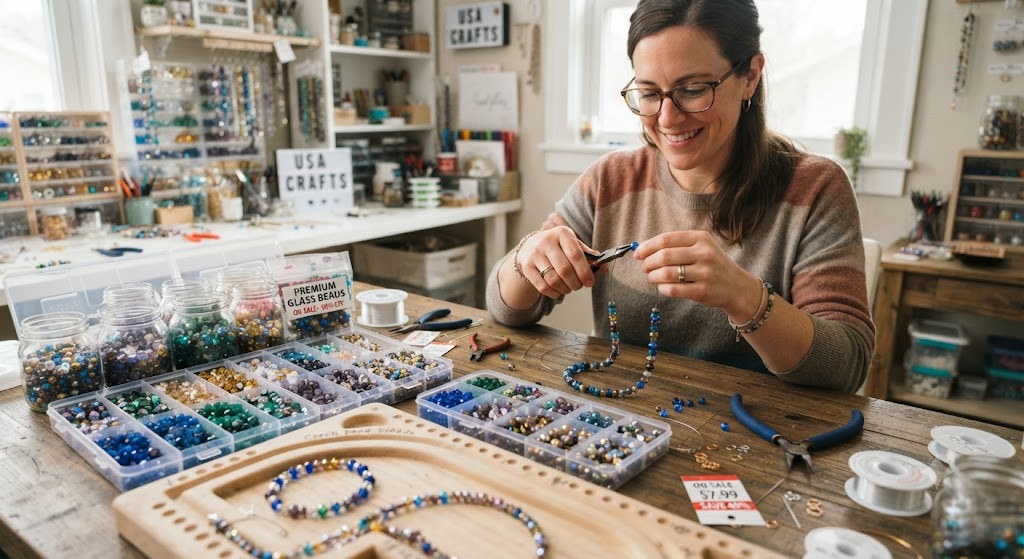
Invest in hard-plastic, compartmentalized storage trays. Brands like Elizabeth Ward offer excellent tray systems that keep bead varieties separated and visible. Organize your new glass beads by color family rather than by shape or size. When you are in the middle of the creative process and searching for the perfect shade of seafoam green to complete a pair of earrings, having all your green glass consolidated in one area will save you immense amounts of time and frustration. Additionally, keep your beads out of direct, prolonged sunlight, as UV rays can theoretically degrade certain chemical finishes over long periods.
By understanding the history, the manufacturing techniques, and the complex finishes of glass, you elevate yourself from a casual crafter to an informed artisan. Approaching the next big clearance event with a strategic eye for quality and cost-per-bead analysis ensures that your studio remains fully stocked with premium materials, keeping your creativity flowing and your small business thriving without breaking the bank.


