

 salehunter.net
 There is a distinct, stomach-sinking feeling known only to people who wire things for a living or as a serious DIYer: you squeeze the handles of a bargain-bin crimper, hear a mushy thud instead of a crisp mechanical click, and watch a $4.00 specialized Deutsch connector turn into a mangled piece of modern art.
When hunting for a crimping tool discount, the objective is never simply spending the least amount of money possible. The true goal is capturing professional-grade mechanical advantage at a hobbyist price point. Whether you are terminating Cat6A Ethernet lines for a home server rack, building a custom wiring harness for a project car, or swaging 4/0 battery lugs for an off-grid solar array, a sub-par tool will siphon away your savings through ruined terminals, wasted hours, and phantom electrical gremlins.
Fortunately, the American retail ecosystem is practically built on cyclical overstock, B2B distributor clearances, and quiet brand wars. If you know how the tool supply chain operates, you can regularly shave 20% to 50% off top-tier crimping gear.
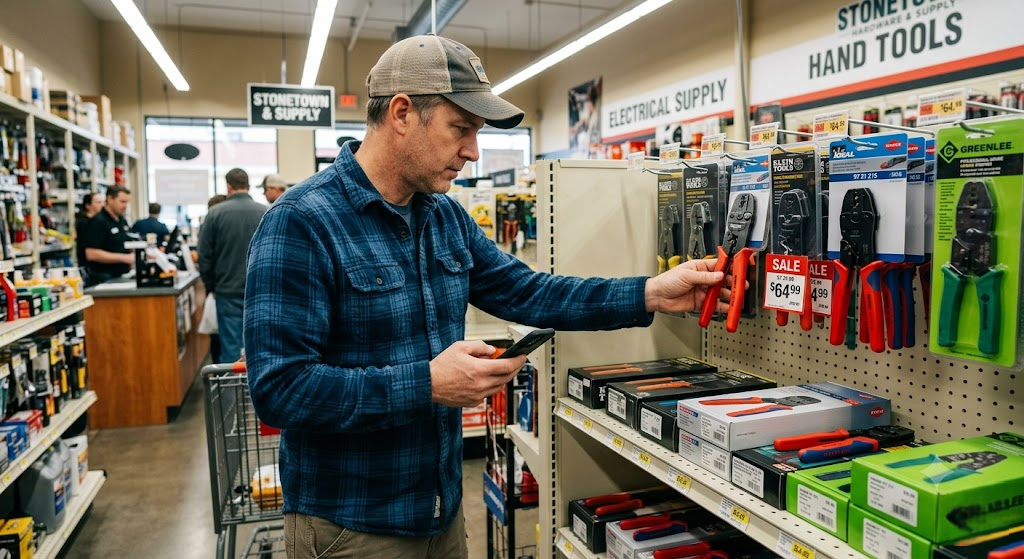
The Physics of the Squeeze: Why “Cheap” Actually Costs More
To understand why hunting for a discounted good tool beats buying a retail-priced bad tool, you have to look at the metallurgy of a proper crimp. In electrical engineering, a successful crimp achieves what is known as a “cold weld.”
When you compress a copper terminal around stranded wire, the tool must exert enough pounds per square inch (PSI) to actually deform the metals past their yield point. The copper strands and the terminal barrel crush together so tightly that all oxygen is forced out of the joint, creating a gas-tight seal. If oxygen gets inside that connection, oxidation begins. Over a period of two to five years, that invisible oxide layer increases electrical resistance, creates a localized hotspot, and eventually leads to a melted connector or an electrical fire.
Cheap, stamped-steel crimpers flex under high pressure. When the frame of the tool bows by even half a millimeter during the stroke, the dies fail to reach the exact geometry required for a gas-tight seal. Therefore, scoring a $45 discount on a high-leverage, drop-forged ratcheting tool isn’t just a win for your wallet—it is a baseline requirement for safety.
Decoding the Tool Tiers: Where the Real Discounts Hide
The tool market is heavily stratified. Knowing which tier you are looking at dictates your discount strategy.
Tier 1: The Premium Titans (Klein, Knipex, Greenlee, Paladin)
These are the buy-it-for-life tools found in union electricians’ bags. Retail prices range from $80 to $300+. You will almost never see a flat “30% off” banner ad for a Knipex PreciForce on standard retail sites. Discounts here happen through authorized distributor overstock or seasonal promotional bundles (such as buying a Klein crimper and getting a free voltage tester or a pouch of 100 modular plugs).
Tier 2: The OEM Challengers (IWISS, iCrimp, Platinum Tools)
This is the sweet spot for 90% of buyers. Here is a lesser-known industry secret: many Tier 2 brands operate the exact same computerized CNC machines that cut the precision dies for Tier 1 brands. Brands like IWISS dominate online marketplaces by selling what is functionally an $85 ratcheting frame for $32. When these go on seasonal flash sales, you are acquiring commercial-grade die tolerances for the price of a couple of fast-food lunches.
Tier 3: The White-Label Gamble
These are the unbranded orange-or-blue handled tools flooding major e-commerce search results for $11.99. Do not waste a discount code on these. Their ratcheting pawls are made of powdered metal that shears off after fifty cycles, and their die markings are routinely stamped off-center.
The US Retail Calendar: When to Pull the Trigger
If you need a tool today, you pay the “impulse tax.” If you can time your purchase to the traditional American retail cycle, the price drops become predictable.
- The Spring “Pro Reset” (March – April): Big-box home improvement giants like Home Depot and Lowe’s reset their seasonal floor layouts in early spring. To clear pegboard space for incoming summer landscaping gear, electrical department managers frequently place slow-moving specialty electrical tools—including coax and coaxial compression crimpers—on yellow-tag clearance.
- Father’s Day Promo Windows (Late May – June): This is the single biggest promotional quarter for American hand tool brands. Rather than discounting the raw tool, brands like Klein Tools release “Special Edition Gift Sets.” You will routinely find a $65 ratcheting modular crimper packaged with a $30 wire stripper sold together for $59.99.
- Prime Day & Black Friday Crossovers (July & November): While consumer electronics grab the headlines, digital algorithm trackers show that specialized hand tools experience their steepest raw-percentage drops during these 48-hour windows. Digital storefronts use niche tools as “cart builders” to qualify buyers for free shipping thresholds.
- End-of-Fiscal-Year B2B Dump (December – January): Industrial supply houses (think Grainger, Fastenal, or MSC Industrial) pay inventory taxes on whatever sits on their shelves on December 31st. In mid-January, their digital “Clearance/Overstock” tabs are quietly updated with commercial hydraulic crimpers and specialized solar (MC4) crimping kits discounted by up to 60% just to get the SKU off the books.
5 Advanced Strategies to Stack Your Savings
Finding a sale price is beginner level; combining multiple pricing inefficiencies is how professional shop managers outfit their workbenches.
1. Raid the “Open Box” Counter at Supply Houses
Skip the consumer aisles and walk into a dedicated electrical wholesale distributor (such as Graybar, CES, or Platt Electric). Ask the counter rep if they have an “abandoned will-call” or “re-stocked return” shelf. Contractors frequently order specialized $200 hex-crimp tools for a specific telecom job, finish the job, and return the tool, or cancel the order after it arrives at the branch. Because the box has been opened, the branch cannot sell it as new inventory and will routinely write it down by 30% to 40% to clear the counter.
2. Exploit the “Kit Illusion”
Retailers know that consumers compare the price of Tool A against Tool B. To break comparison shopping, manufacturers create bundled kits. Mathematically, the standalone crimper might sit stubbornly at $49.00 all year. However, a “Network Installation Kit” containing that exact same $49 crimper, a punch-down tool, ten RJ45 pass-through connectors, and a nylon carrying case will get flagged for an automated 25% discount, dropping the entire package to $41.00. You get three extra tools and save eight dollars purely because of how warehouse inventory algorithms treat bundle SKUs.
3. Set Parameter-Based Price Trackers
Never rely on a website’s “Sale” badge; many third-party sellers artificially inflate the “Was” price the day before a discount goes live. Utilize historical tracking extensions (like CamelCamelCamel or Keepa for Amazon US). Set your desired price drop at 22% below the 90-day average. When an automated warehouse rebalancing algorithm drops the price at 3:15 AM on a Tuesday to balance regional inventory, your tracker will ping your phone before the algorithm corrects itself.
4. Leverage Manufacturer “Trade-Up” Programs
Several high-end utility brands run perpetual or semi-annual trade-in promotions. Greenlee and Ridgid, for example, have historically offered $50 to $100 trade-in rebates on commercial battery-powered or ratcheting crimpers when you send in any old, broken competitor tool. You can literally buy a broken $5 antique crimper at a neighborhood garage sale and trade it in for a crisp $75 manufacturer discount on an industrial standard unit.
5. Use the Harbor Freight “Inside Track” Loophole for Heavy Gauge
If you are crimping large 2 AWG to 4/0 battery cables, hydraulic crimpers are the gold standard, but standard retail models cost upward of $180. Harbor Freight’s hydraulic wire crimper is widely recognized by automotive electricians as an incredible baseline unit—with one caveat: the metric dies it comes with are slightly loose for standard American Wire Gauge (AWG). By joining their membership program during a “30% off any single item under $100” weekend, you can buy the hydraulic unit for roughly $48. You then spend $12 on Amazon for a set of aftermarket true-AWG aftermarket dies. You now own a precision 10-ton hydraulic crimping setup for sixty bucks.
Feature Triage: What to Sacrifice for a Lower Price
When you find a discounted tool, you need to know instantly if the manufacturer cut the price by cutting vital mechanics. Here is your definitive checklist of what you can compromise on—and what is untouchable.
- NEVER Compromise on the Ratchet Mechanism: If the tool relies purely on your hand grip to dictate when the crimp is “done,” pass on it regardless of the discount. A ratcheting tool locks shut and refuses to release until the exact pre-calibrated pressure has been applied to the terminal. This eliminates human error.
- SAFE to Compromise on Handle Material: High-end tools boast multi-component, dual-density ergonomic grips that resist hydraulic fluid and sweat. If you are a hobbyist using the tool twice a month, basic dipped-molded vinyl handles will feel slightly harder on your palms but will drop the production cost of the tool by 15%.
- NEVER Compromise on Parallel Clamping (for Data Cables): For RJ45 Ethernet connectors, the die must press straight down like an elevator. Cheap scissor-style pivot crimpers push down at an angle, which consistently crushes the plastic divider on pins 1 and 8 of the modular plug.
- SAFE to Compromise on Quick-Change Dies: Tools that let you swap out coaxial dies for heat-shrink dies with the push of a thumb-button command a massive price premium. Tools that require you to turn two standard 2.5mm Allen screws to change the die plate take 45 seconds longer to swap, but routinely sell at a 35% discount compared to their quick-change cousins.
The Summary Cheat-Sheet for Your Next Search
The next time you open a browser tab to hunt down a deal on wire termination gear, keep this hierarchy at the front of your mind:
First, identify the exact terminal you are working with (open barrel, insulated nylon, RJ45 pass-through, or ferrules). Second, ignore any listing that doesn’t explicitly state the tool is EDM-cut (Electrical Discharge Machining) or strictly ratcheted. Third, cross-reference the SKU against industrial supply clearance pages rather than relying purely on standard consumer shopping feeds.
A legitimate crimping tool discount is out there waiting for you; you just have to stop looking for cheap tools, and start looking for misplaced professional inventory.