
 salehunter.net
 Every bass, walleye, and pike angler knows the exact, gut-sinking feeling: your line goes taut, your rod loads up, you give a confident hookset, and snap. You just permanently donated a fourteen-dollar balsa wood masterpiece to a submerged cedar stump. Fishing is inherently an exercise in losing gear, but replacing that gear shouldn’t require a second mortgage.
Lauri Rapala hand-carved his first cork-and-tinfoil lure in Finland back in 1936 because hungry pike wouldn’t bite static bait. Today, Rapala remains the undisputed titan of the hard-bait fishing world. Each traditional balsa lure is still hand-tuned and individually tank-tested before it gets sealed inside that iconic cardboard-and-plastic box. That rigorous quality control is precisely why retail prices for a single Shad Rap, X-Rap, or DT-Series crankbait routinely hover between $10 and $16 at major sporting goods stores.
But here is the open secret of the modern tackle industry: you should almost never pay full Manufacturer’s Suggested Retail Price (MSRP) for a Rapala lure. Because the brand manufactures millions of units across hundreds of colorways, global retail supply chains are constantly caught in a state of overstock. If you understand how tackle distribution cycles operate, you can consistently source premium Rapala baits at 30% to 60% below retail value.

1. The “Discontinued Colorway” Arbitrage
Tackle manufacturers operate much like high-street apparel brands. Every winter, Rapala introduces a fresh slate of heavily marketed color patterns—think Live River Shad or Ghost Green—while quietly retiring roughly 10% to 15% of their existing catalog colors to clear warehouse shelf space.
When corporate officially axes a pattern like Bleeding Olive Flash or Hot Mustard, major wholesale distributors are forced to liquidate their remaining stock to make room for incoming spring freight. It is vital to remember that these are not defective baits; they possess the exact same internal weight transfer systems, rattle chamber acoustics, and diving lip geometry as the full-price lures hanging right next to them.
The Strategy: Set a recurring reminder to scan the digital clearance sections of major online tackle hubs like Tackle Warehouse, FishUSA, and Omnia Fishing specifically during the months of November and December. Filter strictly by brand and sort by “Price: Low to High.” You will routinely find top-tier crankbaits like the DT-6 or the RipStop marked down from $11.99 to $5.49 simply because the belly foil features a slightly different shade of orange than the upcoming catalog year dictates. Largemouth bass do not read the annual Rapala product catalog; they react to displacement and flash.
2. Exploit the Big-Box “Seasonal Reset” Calendar
Brick-and-mortar giants like Bass Pro Shops, Cabela’s, Scheels, and Dick’s Sporting Goods do not view fishing tackle as a permanent fixture; they view it as square footage that must generate maximum revenue per quarter. When the seasons change, floor managers are strictly graded on how fast they can flip an aisle.
Understanding the retail sporting goods calendar unlocks massive physical in-store discounts:
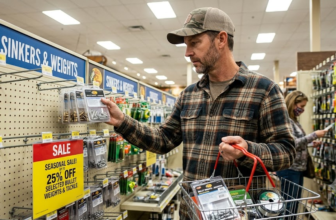
- The Late Summer Purge (August 15 – September 15): This is the single finest window for open-water Rapala discounts. Stores aggressively mark down deep-diving crankbaits, topwater poppers (like the Skitter Pop), and jerkbaits to physically clear the aisles for archery gear, camo apparel, and waterfowl decoys. Look for yellow or red clearance stickers pushed to the very bottom shelves or hidden on back-wall endcaps.
- The Post-Holiday Inventory Freeze (January 2 – January 20): Retailers pay local taxes on inventory held on their books at the close of their fiscal year. To shrink their taxable footprint, store managers are given blanket authorization to slash slow-moving hard baits.
- The Spring Trade-In Events (February – March): Bass Pro Shops and Cabela’s host their massive annual “Spring Fishing Classic.” While the standard print flyers advertise a modest 10% off, the real discount lives in the rod-and-reel trade-in vouchers handed out at the door, which can frequently be stacked with store-wide tackle manufacturer coupons.
3. The Hidden Mechanics of Walmart Endcaps
Walmart is the single largest distributor of fishing tackle in the United States, but their automated inventory replenishment system is notoriously rigid. When corporate software determines that a specific regional store location needs to reset its sporting goods planogram, the system flags entire blocks of Rapala SKUs for immediate markdown to get them out of the building.
Unlike dedicated local bait shops, Walmart department employees rarely consolidate clearance items into neat, clearly labeled dump bins. Instead, discounted Original Floaters, Husky Jerks, and CountDowns get shoved behind full-priced Catfish dough bait, or left hanging on standard pegs with tiny, unassuming yellow “Rollback” adhesive tags.
To beat local resellers to these scores, download the standard Walmart smartphone app and use the built-in barcode scanner directly in the aisle. Quite often, an X-Rap Slashbait hanging on a peg labeled $11.44 will scan on your screen for $3.00 because corporate initiated a system-wide price drop that the overnight stocking crew hasn’t gotten around to physically tagging yet.
4. Buying “Lots” on the Secondary Market
If your objective is raw volume—such as outfitting a new bass boat or building a dedicated walleye trolling box from scratch—buying retail at any price point is an inefficient strategy. Your lowest cost-per-unit metric lives in the secondary market via eBay, Facebook Marketplace, and estate liquidations.
When searching online peer-to-peer marketplaces, never search for individual lure models. Instead, utilize broad search modifiers to hunt for bulk liquidations:
- Targeted search strings:
Rapala lot,bulk Rapala crankbaits, orvintage Rapala collection. - The “Retiring Angler” Phenomenon: Every season, thousands of lifelong fishermen either age out of the sport, transition to saltwater, or upgrade their tournament setups. When they list their gear, they rarely take the time to photograph 50 individual hard baits. They photograph an entire open Plano 3700 utility box crammed with Rapalas and sell the entire package for a flat price of $45 to $75. When you break down the math on these listings, your actual cost frequently drops to $2.00 to $3.50 per lure.
How to Spot Counterfeit Rapalas Online
Because Rapala carries immense brand equity, overseas counterfeiters flood platforms like eBay and Amazon with cheap plastic replicas. Before pulling the trigger on a bulk online lot, inspect the listing photos for three definitive hallmarks of authenticity:
First, inspect the clear plastic diving bill. Every modern, authentic Rapala features the word “Rapala” along with the specific model designation (e.g., “Shad Rap” or “SR-7”) cleanly engraved or molded directly into the face of the lip. If the lip is completely smooth and blank, it is a generic import blank.
Second, check the belly seam on wooden models. True balsa Rapalas—like the Original Floater or the CountDown—feature a distinct, razor-straight longitudinal seam running down the belly where the external foil wrap meets. Counterfeits use a single-piece shrink-wrapped photo print that looks muddy underneath the clearcoat.
Third, examine the hardware. Rapala owns VMC Hooks. Genuine factory Rapalas come equipped with premium, chemically sharpened VMC black nickel or bronze treble hooks. If the trebles look like thick, shiny, bright-silver tin wire with blunt points, pass on the listing immediately.
5. Overlooked Digital Overstock Outlets
Beyond traditional e-commerce giants, a handful of niche internet retailers operate strictly on an inventory liquidation model. They buy up canceled distributor warehouse orders and bankrupt tackle shop assets. Bookmarking these three digital storefronts will yield reliable, year-round savings:
- Outlet Bait & Tackle: Widely considered the premier fishing liquidation site in North America. They purchase factory overruns in pallet quantities. While you will rarely find the current year’s ICAST award-winning lures here, you will consistently find proven fish-catchers like the DT-10 or the BX Brat sold in multi-packs that shake out to roughly 40% below retail.
- Karl’s Bait & Tackle (Mystery Tackle Box): While famous for their monthly mystery subscription boxes, Karl’s operates a standalone public web store. By enrolling in their free or low-cost trial club memberships, the “Member Pricing” tier unlocks Rapala inventory at a permanent 20% to 25% discount.
- Sierra (formerly Sierra Trading Post): Owned by the parent company of TJ Maxx and Marshalls, Sierra operates a massive outdoor recreation discount site. During the spring shift, they take on massive quantities of domestic and European Rapala overstock, routinely dumping them at a flat $4.99 or $5.99 per package regardless of the original MSRP.
6. The Direct Rapala VIP & Holiday Playbook
Most consumers treat official manufacturer websites strictly as digital catalogs, assuming the parent brand will never undercut its own retail distribution partners. While that holds true during the heat of the summer fishing season, Rapala.com operates two glaring exceptions to the rule.
The first is the **Welcome Incentive**. When you visit Rapala’s official web portal for the first time, open your browser in Private or Incognito mode. A pop-up modal will trigger offering a 10% to 15% discount code in exchange for joining their email newsletter or SMS notification list. Unlike standard retail coupons that exclude premium brands, this code is generated by the factory and applies to site-wide merchandise, including brand-new lure releases.
The second is the celebrated **”12 Days of Rapala”** event running annually throughout the month of December. For twelve consecutive days, the direct-to-consumer site launches flash promotions on specific lure families. Day three might feature 40% off all Scatter Raps; Day eight might introduce buy-one-get-one pricing on their entire saltwater collection. By pairing these 24-hour promotional windows with the site’s free shipping thresholds (typically triggering at $50), an individual angler can purchase directly from the brand at a lower net cost than independent bait shops pay at wholesale.
The Target Price Matrix
To truly maximize your fishing budget, you must train yourself to abandon impulse purchasing at the boat ramp marina. The smart angler buys tackle when the retail supply chain is bleeding excess inventory, not the night before a morning launch. Use this baseline target price matrix to determine whether a “sale” is actually worth your hard-earned dollars:
- Original Floaters (F07 / F09): Target Purchase Price: $5.50 – $6.50 (MSRP: $10.49)
- Shad Rap (SR06 / SR07): Target Purchase Price: $6.00 – $7.00 (MSRP: $11.99)
- DT Series Crankbaits (DT6 / DT10): Target Purchase Price: $6.50 – $7.25 (MSRP: $10.99)
- X-Rap Jerkbaits (XR08 / XR10): Target Purchase Price: $7.50 – $8.50 (MSRP: $13.99)
- Jigging Raps (Ice & Open Water): Target Purchase Price: $4.50 – $5.50 (MSRP: $9.49)
When you stock your tackle trays using discipline, patience, and seasonal retail awareness, your boat stays fully armed for any bite—and snapping an X-Rap off on an underwater dock pylon suddenly feels like a minor cost of doing business rather than a ruined weekend.