Cracking the Code on Amazon Warehouse Deals: How to Score Open-Box Discounts Up to 50% Off
 salehunter.net
 Every single year, American shoppers send back an estimated $740 billion worth of retail merchandise. In the e-commerce world, this creates a massive logistical headache: what happens to the coffee maker that someone opened, looked at, decided didn’t match their kitchen backsplash, and shipped back? It can’t legally be sold as “Brand New” anymore, even if the plug has never touched a wall outlet.
Enter Amazon Warehouse—recently quietly rebranded across much of the platform as Amazon Resale.
For the average shopper, this section of the site is an afterthought. For seasoned bargain hunters, flippers, and budget-conscious homeowners, it is the single most lucrative digital garage sale on the internet. However, navigating it requires shedding standard consumer habits. Buying open-box merchandise from a trillion-dollar retailer is part science, part art, and part calculated gamble.
If you want to stop paying retail markup and start exploiting the return economy, this is your field guide to doing it safely.
Understanding the Rebrand: Warehouse vs. Amazon Resale
First, a quick point of navigation for modern shoppers. If you type “Amazon Warehouse” into the search bar today, you will likely be redirected to a landing page titled Amazon Resale.
Do not let the corporate facelift fool you; the underlying mechanics haven’t changed. Amazon shifted the nomenclature largely for psychological reasons. Retail data showed that mainstream consumers associated the word “Warehouse” with dusty, forklift-damaged cardboard boxes sitting in a damp facility. “Resale,” on the other hand, taps into the booming, trendy circular economy popularized by platforms like Poshmark, Back Market, and ThredUp. Whether the sticker on your box says Warehouse or Resale, the sourcing, grading, and pricing algorithms remain identical.
Decoding the 4-Tier Grading System
When an item is returned to an Amazon fulfillment center, an employee has roughly 30 to 60 seconds to inspect it, test basic functionality, grade its condition, slap a barcode on it, and put it back into inventory. Because this process is built on hyper-fast human judgment, the grading system is notoriously inconsistent—which is actually the buyer’s greatest advantage.
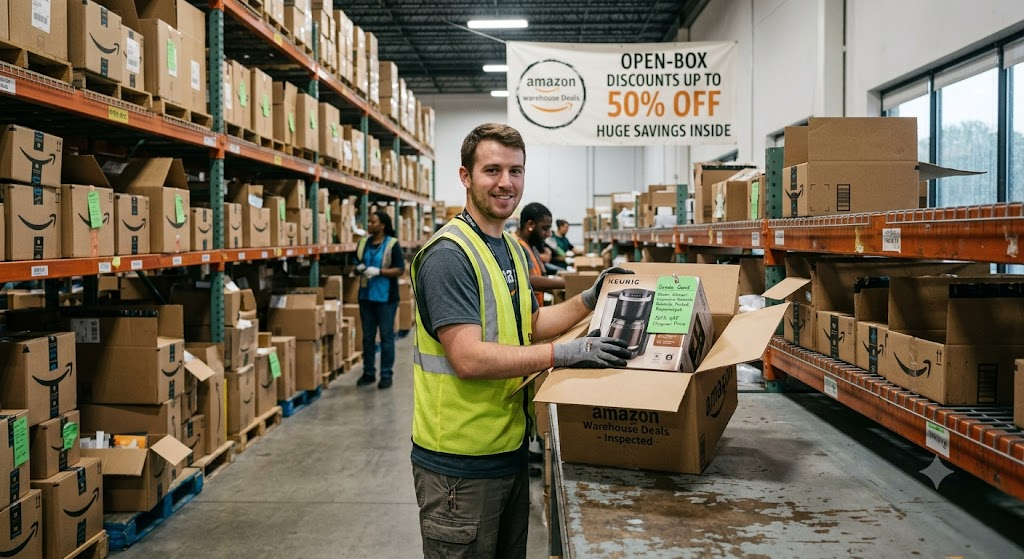
Amazon divides its open-box inventory into four distinct tiers:
- Used – Like New: In theory, this item is in perfect working condition. The original packaging might be unsealed, or the item was repackaged in a standard brown Amazon box. All original accessories are present. The Reality: 90% of the time, this is an item a customer bought, suffered instant buyer’s remorse over, and returned without ever turning on.
- Used – Very Good: The item has seen limited use and remains in great working condition. It may show minor cosmetic imperfections (a small scuff on the side of a toaster, for example). The packaging is likely damaged, or it may be missing non-essential accessories.
- Used – Good: The item shows consistent wear from use but continues to function properly. It may arrive with damaged packaging or get repackaged entirely. It is frequently missing valuable accessories—such as the proprietary USB cable, an assembly wrench, or the instruction manual.
- Used – Acceptable: The wild card of the platform. The item is fairly worn, heavily scratched, or bears clear signs of previous ownership. Packaging is almost certainly compromised. The Reality: Because warehouse graders are terrified of over-promising, they frequently grade brand-new items with severely crushed exterior retail boxes as “Acceptable.” This tier offers the steepest discounts, sometimes hitting 60% off MSRP.
The 4 Golden Rules of Warehouse Shopping
You cannot shop the Resale section the way you shop standard Prime listings. To protect your wallet and your sanity, adhere to four rigid rules:
1. Target the “Stacking Windows”
The standard discount on a Warehouse item sits between 15% and 25% off the new price. That is decent, but not always worth the loss of a fresh unboxing experience. The true magic happens twice a year: during Amazon Prime Day (July) and the Black Friday/Cyber Monday corridor (November).
During these events, Amazon quietly activates an automatic, site-wide 20% to 30% discount at checkout on thousands of already-discounted Warehouse items. A high-end Ninja blender that retails new for $200 might sit in the Warehouse at $140. When that seasonal 25% checkout promotion hits, your final price drops to $105. You are suddenly buying current-generation technology at roughly half price.
2. Never Trust the Default Buy Box
When you click on a standard product listing, Amazon’s algorithm automatically presents you with the “New” price in the right-hand Buy Box. Even if a pristine Warehouse deal exists for $40 less, Amazon will bury it.
To find it, look directly under the “Add to Cart” button for a tiny hyperlinked text that reads: “Other Sellers on Amazon” or “Save with Used – Like New.” You must manually expand this drawer to see the Resale inventory tied to that specific SKU.
3. Weaponize Keepa’s “Used” Graph
Most savvy internet shoppers use browser extensions like Keepa or CamelCamelCamel to verify if a “New” sale price is actually a bargain. However, 95% of users don’t realize that Keepa tracks Amazon Warehouse pricing independently.
When looking at a Keepa chart, go into the sub-settings and toggle the checkmark for “Amazon Warehouse.” This will populate a black or dark-blue line on the graph showing the historical open-box price of that item. You will quickly discover that Warehouse algorithms fluctuate wildly based on regional inventory levels; an item that sits at $80 today might routinely dip to $52 every third Tuesday of the month. Set a custom Keepa alert specifically for the Used price threshold.
4. Master the LPN Barcode
When your Warehouse package arrives, inspect the exterior packaging for a white or yellow sticker bearing a barcode that begins with the letters LPN (License Plate Number).
This is Amazon’s internal tracking footprint for returned goods. If you open the box and find that the item is broken, missing vital components, or the victim of a fraudulent return (e.g., someone put an old iPad inside a new iPad box), take a clear photograph of that LPN sticker immediately. When you initiate a return or speak to customer service, quoting the exact LPN string proves to the representative that the inventory defect originated inside their fulfillment center, instantly fast-tracking your refund.
The Green Light List: What You Should Always Buy Here
Certain product categories are virtually bulletproof inside the Amazon Resale ecosystem. When shopping these sectors, you should almost always check the Used drawer first:
- Cast Iron & Stainless Steel Cookware: Brands like Lodge, All-Clad, and Le Creuset are over-engineered. A customer cannot realistically break a 12-inch cast iron skillet during a three-day trial run. If someone returns it because it was “too heavy,” you get a lifetime piece of kitchenware at a 30% markdown.
- Computer Monitors & Ergo Office Equipment: Monitors are returned in droves due to hyper-specific consumer pickiness—a single dead pixel in the far corner, a stand that didn’t fit a specific desk riser, or an HDMI cable format mismatch.
- Corded Power Tools: Heavy-duty tools from Makita, DeWalt, or Bosch are frequently bought by DIYers for a single weekend project (building a deck, tiling a bathroom) and promptly returned on Monday morning. The tool will have light concrete dust on the casing, but the motor will have 99.8% of its operational life remaining.
- Board Games & Hardcover Books: These items suffer massive retail depreciation the second the shrink-wrap is pierced, yet the physical utility remains 100% intact.
The Red Light List: High-Risk Zones to Avoid
Conversely, the speed of Amazon’s intake inspection makes certain categories a game of Russian Roulette. Keep your money in your pocket when browsing these items:
- Robotic Vacuums: Do not do this to yourself. You are highly likely to open a box containing a machine that spent two weeks mapping a stranger’s apartment, sucking up pet dander, spilled Cheerios, and human hair before being boxed back up without the dustbin being emptied.
- Internal Data Storage (SSDs, HDDs, RAM): The risk of subtle data corruption, bad sectors, or malicious hardware swapping is far too high. Dishonest bad actors frequently buy a 4TB solid-state drive, carefully open the casing, swap the internal board with a cheap 512GB drive, and return it for a full refund. An intake worker scanning a barcode will never catch this.
- Smart Home Hubs & Mesh Wi-Fi Systems: Devices like Eero routers, Ring doorbells, or Nest thermostats are frequently returned while still cryptographically “locked” to the previous owner’s cloud account. Getting a manufacturer’s customer service department to unbind a registered serial number belonging to a stranger is an exercise in profound frustration.
- Baby Safety Equipment: Car seats, crib mattresses, and baby monitors should never be purchased open-box. You cannot verify if a car seat has suffered micro-fractures from an unreported drop or minor transport impact.
The Great Warranty Catch (And How to Beat It)
This is the single biggest blindspot for consumers entering the Warehouse ecosystem: Most original manufacturer warranties are voided the moment an item is sold through Amazon Resale.
If you buy a brand-new Breville espresso machine and the boiler dies on day 340, Breville fixes it for free. If you buy that same machine through Amazon Warehouse labeled “Like New,” and it dies on day 45, Breville will ask for your receipt, see the “Used” designation, and politely deny your claim. Amazon’s standard 30-day return window is your only safety net.
The Workaround: Pay for high-ticket Warehouse electronics exclusively using a premier credit card that offers robust **Purchase Protection** or **Extended Warranty** benefits (such as the Chase Sapphire Preferred/Reserve or select American Express cards).
Before making the purchase, pull up your cardholder agreement PDF and check the fine print under “Exclusions.” While many basic credit cards explicitly exclude pre-owned or refurbished items from their extended warranty programs, premium tier cards often cover items as long as they were purchased from a verified commercial merchant with a formal store receipt.
Protecting Yourself Against the “Switcheroo”
We must address the dark underbelly of retail logistics: return fraud. Because Amazon processes millions of packages daily, bad actors exploit the system. They order a $400 Sony noise-canceling headphone, place their five-year-old, sweat-stained Sony headphones into the shiny new box, and drop it off at a Whole UPS return kiosk.
The intake worker sees a Sony box, checks that headphones are inside, and scans it into the “Used – Very Good” bin. Three days later, it arrives on your porch.
To ensure you are never left holding the bag for someone else’s felony, practice **The Continuous Unboxing Protocol** for any Warehouse item costing over $100:
- Set the unopened shipping box on your kitchen counter.
- Take out your smartphone and hit record on the video camera.
- Capture the unbroken Amazon Prime tape on video, then show the shipping label with your name clearly legible.
- Without stopping the recording, slice the tape, pull out the product box, open the retail packaging, and display the physical item and its serial number to the camera.
If you pull a brick, a broken model, or a bag of sand out of that box, you do not have to argue with a customer service chatbot in Delhi about whether you are trying to scam Amazon. You simply upload the 45-second continuous MP4 file to your support ticket. The refund is typically authorized within two hours.
The Final Verdict
Shopping Amazon Warehouse deals requires shifting your mindset from that of a passive consumer to that of an active inspector. You are trading the sterile perfection of factory shrink-wrap for a labor wage paid to yourself in the form of retained cash.
If you demand pristine cardboard boxes and zero friction, pay full retail. But if you are willing to spend forty seconds testing a plug, wiping down a scuffed chassis, or printing out a free UPS return label on the rare occasion a dud slips through the cracks, the Amazon Resale section is effectively an automatic, year-round pay raise.