
 salehunter.net
 Anyone who has spent a Saturday afternoon wrestling with a stubborn piece of oak or maple knows the golden rule of timber work: let the saw do the work. But if you find yourself pushing, leaning, and forcing your chainsaw through the wood, your saw is no longer doing the work—you are. A dull chainsaw is more than just a frustrating nuisance; it is a massive drain on your energy, a serious safety hazard, and a very quick way to burn out a perfectly good engine. If you are tired of constantly spending money on brand-new replacement chains or wasting hours trying to perfect your manual hand-filing technique, capitalizing on an electric chainsaw sharpener sale is an absolute game-changer for your tool shed or professional workshop.
Finding a high-quality electric sharpener at a discounted price does more than just save you money upfront. It drastically extends the lifespan of your cutting equipment, reduces fuel or battery consumption, and ensures every cut you make is smooth, safe, and efficient. In this comprehensive guide, we will dive deep into everything you need to know about navigating the market, choosing the right model, and maximizing your investment when these essential power tools go on sale.
The Telltale Signs You Need to Hit That Sale Now
How do you know it is time to stop procrastinating and finally buy an electric sharpener? Your chainsaw will actually communicate its needs to you if you know what to look for. Before you browse the latest clearance events, check for these undeniable symptoms of a dull chain:
- The Sawdust Test: A healthy, sharp chain produces large, thick wood chips. If your cutting area is covered in fine, powdery sawdust, your chain’s cutting teeth have lost their edge and are grinding the wood rather than slicing it.
- The Crooked Cut: If your chainsaw constantly pulls to the left or right, forcing you to fight the saw to keep your cut straight, your chain has likely worn unevenly. An electric sharpener can correct these uneven angles and restore balance.
- Physical Exhaustion: You should never have to force the bar into the log. A sharp chain naturally feeds itself into the wood. If you are sweating and straining to make a basic bucking cut, you are in desperate need of a sharpening session.
- Smoking and Burning: Even with a properly functioning bar oiler, a dull chain creates excess friction. This leads to smoking, burn marks on the wood, and dangerous overheating of your guide bar.
Why Choose Electric Over Manual Filing?
There is certainly a romanticized appeal to sitting on a stump in the woods with a round file and a guide, touching up your chain the old-fashioned way. Many seasoned lumberjacks swear by the hand file. However, for the vast majority of homeowners, farmers, and even modern professionals, time is money. Here is why upgrading during an electric chainsaw sharpener sale is the smarter choice:
Unmatched Precision and Consistency
The hardest part of manual filing is maintaining the exact same angle and depth on every single tooth. Chainsaw teeth are typically angled at 25, 30, or 35 degrees. If your left-side teeth are filed at 30 degrees and your right-side teeth end up at 25 degrees due to human error, your saw will cut crookedly. Electric sharpeners feature locking vises and adjustable angle guides. Once you lock in the desired angle, every single tooth is ground identically, restoring the chain to factory-perfect geometry.

Speed and Efficiency
Hand filing a heavily damaged or rocked-out 20-inch chain can easily take 30 to 40 minutes of tedious work. With a bench-mounted electric sharpener, you can complete the same chain in under 10 minutes. When you have a massive pile of firewood to process before winter, saving half an hour on maintenance means you get the job done faster and get back indoors sooner.
Rescuing Heavily Damaged Chains
If you accidentally hit a rock, a nail, or wire fencing hidden in a tree trunk, a manual file will barely make a dent in the severe damage. The cutters get severely rolled over and burred. A motorized grinding wheel can easily grind past the damaged steel and expose a fresh, razor-sharp edge, saving a chain that you might have otherwise thrown in the trash.
Key Features to Look for When Browsing Sales
Not all electric sharpeners are created equal. When you see a banner advertising a massive electric chainsaw sharpener sale, you need to look past the price tag and scrutinize the specifications. Here are the crucial features that distinguish a bargain from a waste of money:
1. Motor Power and RPM
A weak motor will bog down when the grinding wheel contacts the steel tooth, leading to uneven grinding and frustration. Look for a unit with a motor drawing at least 85 watts, though 200 to 300 watts is ideal for frequent, heavy-duty use. The RPM (revolutions per minute) should generally sit between 3,000 and 4,000. This speed is optimal for grinding away steel efficiently without instantly overheating and ruining the temper of the chain tooth.
2. Mounting Style
You will generally find two main categories of electric sharpeners on the market. Understanding the difference will dictate which sale you should jump on:
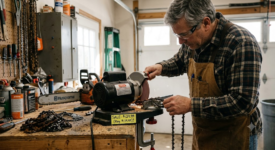
- Bench-Mounted / Wall-Mounted Sharpeners: These are the heavy-duty powerhouses of the sharpening world. They bolt permanently to your workbench. They offer the highest level of stability, the most powerful motors, and the best precision. If you do all your maintenance in a garage or shed, this is the style to buy.
- 12V Portable Handheld Sharpeners: These are compact, motorized rotary tools that come with a 12-volt adapter or alligator clips. You can attach them directly to your truck or tractor battery out in the woods. While they lack the rigid precision of a bench model, they are incredible for quick, on-the-job touch-ups when you are miles away from an outlet.
3. Chain Pitch Adjustability
Chainsaws come in various sizes, and their chains have different pitches (the distance between the drive links). Common pitches include 1/4″, .325″, 3/8″ Low Profile, 3/8″ standard, and .404″. A high-quality sharpener will accommodate all of these sizes. Make sure the model on sale includes different grinding wheels (usually 1/8″ for smaller chains and 3/16″ or 1/4″ for larger ones) and has a vise wide enough to clamp your specific chain.
4. Sturdy Construction Materials
Budget models often feature plastic housings and plastic clamping mechanisms. While these might be tempting when deeply discounted, they flex under pressure, ruining your sharpening angle. When shopping a sale, hunt for models that feature cast aluminum chassis and all-metal clamping vises. They cost a bit more, but the durability and accuracy they provide over a decade of use will easily pay for themselves.
Timing the Market: When to Find the Best Sales
If you want to keep your hard-earned dollars in your wallet, timing your purchase is key. Retailers discount outdoor power equipment cyclically based on the seasons. Here is when you should be keeping your eyes peeled for an electric chainsaw sharpener sale:
Late Winter to Early Spring Clearance
As retailers transition from winter heating supplies to spring gardening equipment, they often discount leftover winter gear. Chainsaws and their accessories, heavily associated with cutting winter firewood, frequently see price drops during this seasonal shift.
Father’s Day Promotions
June is arguably one of the best times of the year to buy tools. Hardware stores and online retailers aggressively push sales on power tools, garage equipment, and forestry gear. An electric sharpener is a classic Father’s Day gift, meaning you will often find premium models bundled with extra grinding wheels or offered at 20% to 30% off.
Black Friday and Cyber Monday
The traditional holiday shopping weekend in November is prime time for tool sales. Because this coincides with the start of prime firewood-burning season in the USA, retailers know that consumers are actively looking for chainsaw accessories. Look out for “lightning deals” on major e-commerce platforms during these dates.
Pro Tips for Using Your New Electric Sharpener
Once you have taken advantage of a great sale and unboxed your new machine, using it correctly is the next hurdle. Many first-time users make mistakes that actually damage their chains. Follow these best practices to ensure a perfect edge every time:
Respect the Temper
The most common mistake beginners make is pulling the grinding wheel down too hard and holding it against the tooth for too long. This creates excessive heat, turning the steel blue. Blued steel means the temper (hardness) has been drawn out of the metal. That tooth will now dull almost instantly when it hits wood. Instead, use quick, light, repetitive taps. Touch the wheel to the tooth for just a split second, release, and repeat two or three times until the edge is bright and sharp.
Mark Your Starting Point
It is incredibly easy to lose track of where you started on a loop of chain, leading you to sharpen the same teeth twice. Before you begin, find the chain’s master link. If your chain doesn’t have a distinctly colored master link, take a bright permanent marker or a dab of bright fingernail polish and mark the top of the first tooth you sharpen. When you see that colored tooth come back around the vise, you know you have completed that side of the chain.
Don’t Forget the Depth Gauges
The cutting teeth are only half of the equation. In front of every cutter is a small fin of metal called the depth gauge (or raker). This gauge determines how deep the cutter bites into the wood. As you grind the cutters back, they get lower, meaning you must also lower the depth gauges. While some advanced electric sharpeners have a setting to grind rakers, most people use a simple flat file and a depth gauge tool to manually lower them after machine-sharpening the cutters. If you skip this step, your freshly sharpened saw will create fine dust and refuse to bite into the log.
The Hidden Economics of Buying on Sale
Let’s talk numbers. A high-quality replacement chain for a standard 18-inch to 20-inch chainsaw can cost anywhere from $20 to $35 depending on the brand and specifications. If you cut heavily, you might burn through three or four chains a season if you don’t know how to sharpen them. Alternatively, taking your dull chains to a local hardware store or small engine mechanic for professional sharpening usually costs about $10 to $15 per chain.
Now, consider finding a robust, high-quality bench-mounted electric sharpener on sale for $90 to $150. If you sharpen your own chains just ten times, the machine has completely paid for itself. From that point on, every sharpening session keeps money in your pocket. Furthermore, because you own the machine, you are more likely to sharpen your chains frequently. Touching up a chain before it gets severely dull extends the life of the chain itself, allowing you to get dozens of sharpening cycles out of a single loop of steel.
Conclusion: Sharp Tools for Safe Work
At the end of the day, forestry work, property maintenance, and firewood processing are inherently hazardous activities. Your best defense against kickback, fatigue, and equipment failure is a well-maintained, fiercely sharp cutting tool. Hunting for an electric chainsaw sharpener sale isn’t just about scoring a cheap price on a neat gadget; it is an investment in your personal safety, the longevity of your expensive chainsaw, and the value of your own time. Keep an eye on seasonal discounts, understand the features that matter most to your specific workload, and prepare to experience the unparalleled satisfaction of watching your chainsaw melt through heavy timber like a hot knife through butter.