

 salehunter.net
 Every watch enthusiast remembers the exact moment they fell down the horological rabbit hole. Perhaps it was the sweeping seconds hand of an automatic movement, the intricate dance of a tourbillon, or the rugged charm of a vintage diver. But alongside the discovery of these mechanical marvels comes a stark realization: building a watch collection can be an incredibly expensive passion. However, the sticker price displayed in a brightly lit boutique is rarely the final word. The world of watch discounts is vast, nuanced, and highly lucrative for those who know where to look and how to negotiate.
Whether you are hunting for an accessible everyday beater or saving up for a luxury Swiss grail piece, understanding the underlying economics of watch retail is your most powerful tool. This article dives deep into the realities of watch pricing, uncovers the secrets of the gray market, explores strategic negotiation tactics, and equips you with everything you need to score authentic watch discounts without compromising on quality or peace of mind.
Demystifying Watch Retail Pricing: MSRP vs. Reality
To understand how to get a discount, you first must understand how a watch is priced. The Manufacturer’s Suggested Retail Price (MSRP) is the official price set by the brand. When you walk into an Authorized Dealer (AD) or a brand boutique, the MSRP is the number on the tag. However, the actual wholesale cost of that watch—the price the dealer paid the manufacturer—is typically 35% to 50% less than the MSRP.
This gross margin is designed to cover the dealer’s overhead: prime real estate rent, highly trained staff, marketing, and a healthy profit. Because this margin exists, there is almost always room for negotiation, depending on the brand, the specific model’s popularity, and the dealer’s current inventory levels. A watch that has been sitting in the display case for eight months costs the dealer money in tied-up capital. They are often highly motivated to move that piece to make room for newer, faster-selling inventory.
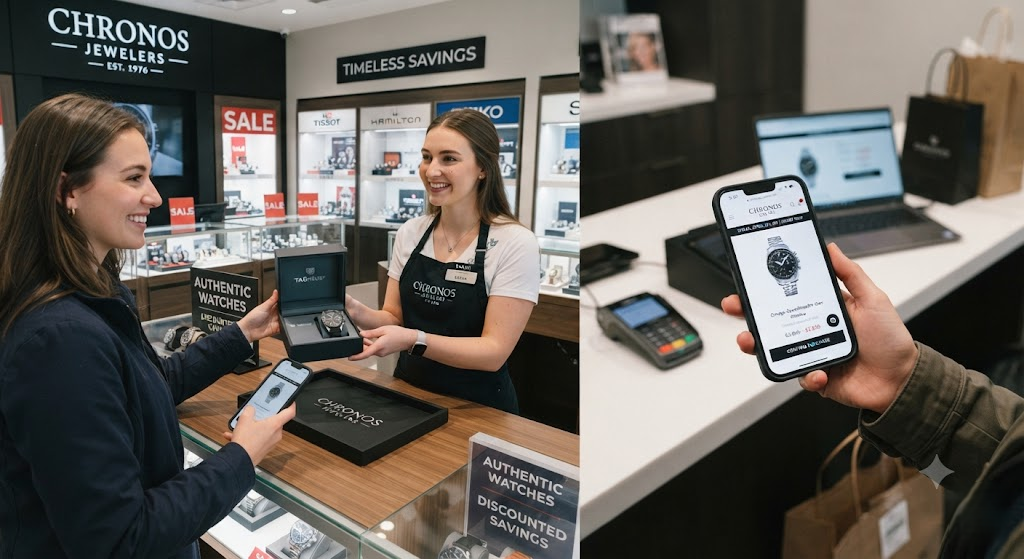
The Authorized Dealer (AD) Negotiation Playbook
Many first-time buyers feel intimidated walking into a luxury watch retailer. The security guards, the velvet trays, and the complimentary champagne can make the environment feel hostile to bargaining. But Authorized Dealers are independent businesses, and making a sale is their primary objective.
Here is how you can successfully navigate an AD to secure a substantial discount:
- Build a Genuine Relationship: Don’t walk in and immediately ask, “What is your best price?” Show genuine interest in the timepieces. Talk to the sales associate about the movement, the history of the brand, and your passion for watches. Dealers are much more likely to offer favorable pricing to a respected enthusiast than a cold walk-in demanding a deal.
- Leverage the “Bundle” Strategy: If you are planning to buy a watch and some jewelry for a partner, or perhaps two watches at once, your negotiating power skyrockets. Dealers will heavily discount multiple items to secure a high-value invoice.
- Offer to Pay via Wire or Cash: Credit card processing fees eat into a dealer’s profit margin (often taking 2% to 3% of the total transaction). By offering to pay via bank wire transfer or cash, you save the dealer money—savings they can pass directly on to you in the form of a discount.
- Target Discontinued or “New Old Stock” (NOS) Models: Following major watch fairs like Watches and Wonders, brands announce new models. The previous generation models instantly become harder for ADs to sell at full retail. Asking specifically for discontinued stock is a prime way to trigger a 15% to 25% discount.
Navigating the Gray Market: Massive Discounts with Caveats
If you have ever searched for a watch online, you have likely encountered the gray market. Websites like Jomashop, Ashford, and AuthenticWatches offer brand-new luxury timepieces at staggering discounts, often 20% to 50% below MSRP. But how is this possible, and is it safe?
How the Gray Market Gets Its Inventory
The gray market is not a black market; the watches are 100% authentic and legally acquired. Authorized dealers are required by brands to purchase a certain amount of inventory each year to keep their AD status. Often, they are forced to buy less popular models to get the highly desirable ones. To liquidate this excess, hard-to-sell inventory, ADs quietly sell massive batches of watches to gray market distributors at cost or a slight loss. The gray market dealer then sells them to the public at a heavily discounted rate.
The Catch: The Manufacturer’s Warranty
When you buy from the gray market, you are getting an authentic, brand-new watch. However, because you are not buying from an Authorized Dealer, the manufacturer will usually not honor the factory warranty. Instead, gray market dealers provide their own in-house warranties.
For a durable, mass-produced watch featuring a standard ETA or Sellita movement, the gray market is a no-brainer. The savings far outweigh the risk of needing factory service. However, for a highly complex in-house movement or a high-end luxury piece with perpetual calendars or chronographs, the lack of a factory warranty is a significant risk that must be weighed against the upfront discount.
Global Arbitrage: Exploiting Currency Exchange Rates
In the digital age, your watch shopping is not limited to your local zip code. One of the most effective, lesser-known methods for securing incredible watch deals is geographical arbitrage—leveraging favorable currency exchange rates and international tax refund policies.
For example, the Japanese Domestic Market (JDM) is a goldmine for watch collectors. Brands like Seiko, Grand Seiko, Citizen, and Orient release models exclusively in Japan. Furthermore, when the US Dollar is exceptionally strong against the Japanese Yen, purchasing directly from Japanese dealers (via platforms like Chrono24 or specialized proxies like Buyee) translates to massive savings. Even after factoring in import duties and shipping, buyers can routinely save 20% to 30% compared to buying the equivalent model locally.
Similarly, purchasing watches while traveling abroad in Europe offers the VAT (Value Added Tax) refund advantage. If you buy a luxury watch in Switzerland, France, or Germany, you can claim back the VAT at the airport upon departure, effectively creating a 10% to 15% discount on the retail price, before you even attempt to negotiate with the boutique.
The Pre-Owned Ecosystem: Where Depreciation is Your Best Friend
Much like a new car being driven off the lot, the vast majority of watches lose a percentage of their value the moment you size the bracelet and walk out of the store. For the savvy consumer, this depreciation is the ultimate discount mechanism. The pre-owned market is where true horological value lives.
Platforms like Chrono24, eBay (specifically listings with their Authenticity Guarantee), and highly moderated forums like Reddit’s r/Watchexchange or WatchUSeek are bustling hubs of enthusiast-to-enthusiast commerce. Buying a watch that is one or two years old, complete with its original box and papers, can save you anywhere from 30% to 50% off retail.
When navigating the pre-owned space, the golden rule is always: Buy the seller, not just the watch.
- Review their feedback history meticulously.
- Ask for highly specific photos (e.g., “Take a photo of the watch set to 10:10 next to today’s newspaper”).
- Ensure the transaction is done via a protected payment method, never a non-refundable wire transfer for an unknown private seller.
- Look for listings that include the “Full Set” (original box, warranty card, hang tags, and extra links). A full set holds its value much better if you decide to sell the watch later.
Brand-Specific Discount Behaviors
It is vital to understand that the rules of watch discounts apply differently across the spectrum of brands. Approaching a Rolex boutique with the same negotiating tactics you would use at a Seiko dealer will only result in a polite refusal.
The “Un-Discountables”
Brands like Rolex, Patek Philippe, and Audemars Piguet operate in a sphere of artificial scarcity. Demand vastly outstrips supply for their steel sports models. You will not get a discount on a Rolex Submariner at an AD. In fact, you will likely be placed on a waiting list for years just for the privilege of paying full retail. For these brands, the “discount” is merely getting the watch at MSRP, as their pre-owned prices often soar well above retail value.
High-Value Mid-Tier Luxury
This is the sweet spot for negotiation. Brands like Omega, Breitling, TAG Heuer, Panerai, and Zenith make incredible timepieces, but they produce them in high volumes. Because supply meets or exceeds demand, ADs are highly motivated to move inventory. It is incredibly common to secure 10% to 20% discounts on these brands at authorized retail locations, and up to 35% off on the gray market.
Everyday Excellence
For accessible luxury and daily wearers—think Seiko, Citizen, Casio, Tissot, and Hamilton—discounts are a continuous, year-round event. These brands heavily participate in seasonal retail events. Amazon Prime Day, Black Friday, and Cyber Monday routinely feature 30% to 50% discounts on these marques. For these brands, paying full MSRP is generally unnecessary if you have a modicum of patience.
Red Flags: Guarding Against the “Too Good to Be True”
The pursuit of a deep discount can unfortunately blind buyers to obvious scams and counterfeit operations. The counterfeit watch industry has evolved far beyond cheap knock-offs sold on street corners; modern “super clones” can fool even seasoned enthusiasts at first glance.
When hunting for deals, strictly enforce these protective measures:
- Verify the Serial Number: Ask the seller for the serial number and cross-reference it with stolen watch registries like The Watch Register.
- Beware of Unusually Low Prices: If a pre-owned Omega Speedmaster usually sells for $4,500 across the market, and someone is offering it for $2,000, it is a scam. Period. There are no secret, magical deals that defy the global market baseline.
- Scrutinize the Details: Super clones often fail under macro photography. Look at the finishing of the hands, the depth of the dial text, and the alignment of the bezel. Better yet, insist on a professional authentication process if purchasing from a private seller.
- Suspicious Payment Requests: If an online seller insists on cryptocurrency, Western Union, or “Friends and Family” PayPal transfers, walk away immediately. You lose all buyer protection with these methods.
The Seasonality of Watch Buying
Finally, timing is everything. The watch retail sector operates on predictable seasonal cycles. Avoid purchasing timepieces in the weeks leading up to Christmas, Valentine’s Day, or Father’s Day. Retailers know that buyers during these windows are emotionally driven and operating on strict deadlines; therefore, they offer fewer discounts.
Instead, aim for late January and February. Retailers are facing the post-holiday slump, attempting to hit fresh first-quarter sales targets, and are much more amenable to negotiation. Additionally, late summer (August) is traditionally a slow retail month globally, making it a prime time to walk into an AD and make a strong, discounted offer.
Patience is the ultimate currency in watch collecting. By understanding dealer margins, safely utilizing the gray and pre-owned markets, playing the global currency exchange, and timing your purchases correctly, you can build a breathtaking collection while keeping a substantial amount of money in your pocket. The thrill of the hunt is not just in finding the perfect watch, but in knowing you secured it at an unbeatable price.