

 salehunter.net
 Have you ever looked up at a massive, aging oak tree leaning ominously close to your roof and thought, “That is going to cost an absolute fortune to take down”? If so, you are definitely not alone. For most American homeowners, tree removal is an unexpected, highly stressful, and incredibly expensive necessity. Depending on the height, location, and condition of the tree, professional removal can easily range from a few hundred dollars to well over three thousand dollars per tree.
But before you empty your savings account or attempt a highly dangerous DIY job with a rented chainsaw, take a deep breath. There is a silver lining. The tree care industry is highly competitive, and knowing how the business operates can help you secure a significant tree removal discount. From seasonal timing tricks to leveraging neighborhood dynamics, there are proven, completely legitimate ways to slash your tree removal bill.
Understanding Why Tree Removal Costs So Much
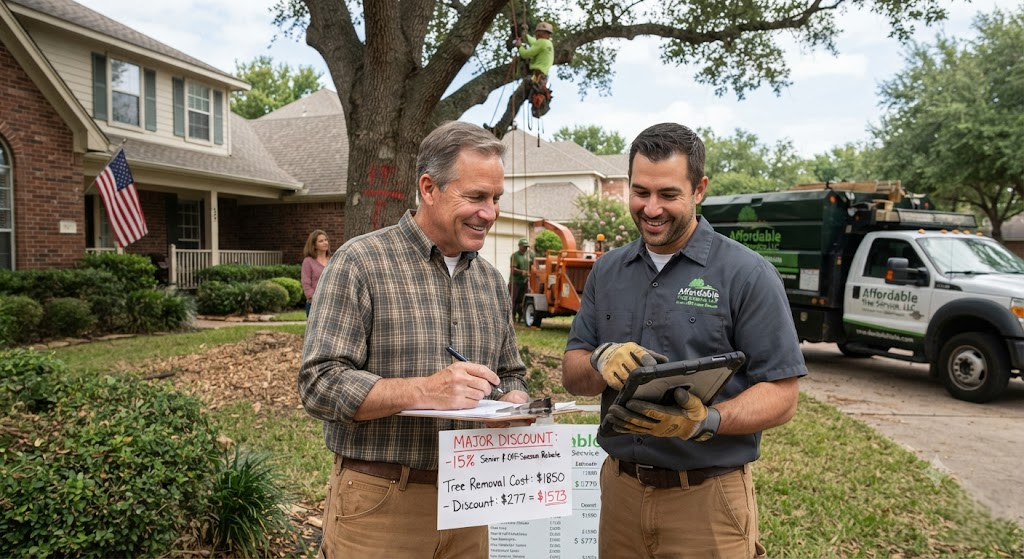
To effectively negotiate a discount, you first need to understand what you are paying for. Arboriculture is a high-risk profession. Tree service companies carry massive insurance policies, utilize expensive heavy machinery like bucket trucks and wood chippers, and employ highly trained specialists. When a company quotes you $1,500 to remove a pine tree, they are factoring in the risk to their crew, the proximity of the tree to your home or power lines, the time it will take, and the sheer volume of debris they have to haul away.
When you seek a tree removal discount, you are essentially looking for ways to reduce the risk, time, or labor required for the company, or you are capitalizing on their need to keep their crews busy during slow periods. Let’s explore exactly how you can do that.
The Dormant Season Secret: Timing is Everything
If there is one industry secret every homeowner should know, it is this: tree services have an off-season. In most parts of the United States, spring and summer are incredibly busy for arborists. Storms bring down branches, homeowners want their yards looking perfect for barbecues, and the phones ring off the hook.
However, when late fall and winter arrive, business slows down drastically. This period, known as the dormant season, is the absolute best time to hunt for a tree removal discount. Because companies need to keep their expensive equipment running and their crews paid, many will offer “winter rates” that can be 15% to 25% cheaper than their peak summer pricing.
Furthermore, winter tree removal is actually easier for the crew. Without a thick canopy of leaves, the tree is lighter, branches are easier to access, and the overall volume of debris is significantly reduced. The frozen ground also means their heavy equipment is less likely to tear up your lawn, saving you money on spring landscaping repairs. If your tree is dead or diseased but not in immediate danger of falling on your house tomorrow, wait until January or February to make the call.
Standard Discounts You Should Always Ask For
Sometimes, getting a lower price is as simple as opening your mouth and asking. Many reputable tree service companies have standard discount programs built into their pricing models, but they might not advertise them aggressively. When you request a quote, always inquire if you qualify for any of the following:
- Senior Citizen Discounts: Usually ranging from 5% to 10%, many companies offer lower rates for homeowners over the age of 65.
- Military and First Responder Discounts: Active duty military, veterans, police officers, firefighters, and EMTs can often secure a 10% discount just by showing their ID.
- Cash Discounts: Credit card processing companies charge businesses a fee of 2% to 4% per transaction. If you offer to pay in crisp cash, many tree services will pass those savings directly on to you.
The “Leave the Wood” Hack
One of the most labor-intensive parts of tree removal is the cleanup. Chopping the trunk into manageable pieces, running branches through the wood chipper, and hauling tons of heavy wood to a disposal site takes time and money. You can score a massive tree removal discount by volunteering to handle the aftermath yourself.
The Cut and Drop Method
If you have a large property, you can ask for a “cut and drop” service. In this scenario, the arborist safely cuts the tree down so it lands harmlessly in your yard, and then they immediately drive away. They do not chop it up, they do not haul away the brush, and they do not grind the stump. This removes the danger of felling a massive tree yourself but leaves the manual labor to you. A cut-and-drop service can slash your quote by 40% to 50%.
Keep the Firewood
Even if you want the brush chipped and hauled away, tell the company you want to keep the main trunk for firewood. The crew will cut the trunk into 16-inch rounds and leave them in a pile for you to split later. Because they do not have to pay disposal fees or spend time loading heavy logs into their trucks, they will often reduce the total price. As a bonus, you get a winter’s worth of free heating fuel.
Group Purchasing: The Neighborhood Discount
Tree service companies lose a lot of time and money just driving their heavy equipment from one side of town to the other. You can use this logistical headache to your advantage by teaming up with your neighbors.
Take a walk down your street. Does your neighbor next door have a dead ash tree? Does the house across the street need some heavy pruning done? Talk to them and approach a tree service company together. If a crew can park their bucket truck and wood chipper on your street and spend the entire day knocking out three or four jobs in the exact same location, their profit margins soar. In exchange for this convenience and guaranteed work, arborists are almost always willing to offer a “neighborhood tree removal discount” of 10% to 20% for everyone involved.
The Hidden Freebies: Utility Companies and Municipalities
Before you pay a single dime for tree removal, you must look up. Is the tree in question growing into or hovering ominously over a power line? If so, you might not need a discount; you might be able to get the entire job done for free.
Utility companies in the USA are legally obligated to keep power lines clear of vegetation to prevent widespread blackouts and fires. If a tree on your property is threatening a primary transmission line, call your local power company. They will usually send their own contracted tree crews to prune or completely remove the tree at absolutely zero cost to you.
A quick warning: Utility crews are focused entirely on safety and line clearance, not the aesthetic beauty of your yard. If they just prune the tree, it might look a bit aggressive. But if they remove it entirely, you just saved yourself thousands of dollars.
Additionally, check with your city’s public works department. If a hazardous tree is located on the easement (the strip of grass between your sidewalk and the street), it may actually be city property, making it the local government’s financial responsibility to remove it.
How to Negotiate Like a Pro
Negotiating can feel uncomfortable, but in the tree care industry, quotes are almost always flexible. The key is to be polite, flexible, and well-informed. Here is the best strategy to negotiate a lower price:
- Get Three to Five Quotes: Never accept the first estimate you receive. Prices can vary wildly between companies based on their current workload. Getting multiple quotes gives you a baseline for what the job should actually cost.
- Leverage Competitor Pricing: If Company A is highly reputable but quoted you $2,000, and Company B quoted you $1,600, call Company A back. Say, “I really want to work with you because of your great reviews, but I have a quote here for $1,600. Is there any way you can get closer to that number?” Often, they will meet you in the middle.
- Offer Flexible Scheduling: Say to the estimator, “I am not in a rush. If I let you fit me into your schedule whenever you have a cancellation or a gap between jobs in my area, can you offer a discount?” Companies love having a backlog of flexible jobs they can use to fill empty schedule slots.
Beware the “Too Good to Be True” Discount
While saving money is the goal, you must remain vigilant. The tree care industry attracts a lot of fly-by-night operators who offer prices that seem unbelievably low. If a guy knocks on your door with a chainsaw in the back of his pickup truck and offers to take down your 60-foot oak for $300, close the door.
These ultra-cheap operators almost never carry liability insurance or worker’s compensation. If they drop a massive limb on your roof, or if one of their uninsured workers falls out of the tree and breaks a leg on your property, you and your homeowner’s insurance policy can be held legally and financially responsible.
A legitimate tree removal discount should come from a fully licensed, bonded, and insured arborist. Always ask to see a physical copy of their Certificate of Insurance (COI) and call the insurance agency listed on the document to verify that the policy is currently active before any work begins. Paying slightly more for an insured professional is infinitely cheaper than paying for a rebuilt roof or a major lawsuit.
Tax Deductions and Insurance Claims: The Post-Removal Discount
Finally, what happens if the tree has already fallen? If a healthy tree is knocked down by an “Act of God” like a hurricane, tornado, or severe ice storm, your homeowner’s insurance policy will likely cover the cost of removing the tree from your house or driveway, minus your deductible.
Furthermore, the IRS sometimes allows for a “casualty loss” deduction on your taxes if your property value decreases due to a sudden, unexpected, and unusual event (like a freak storm destroying your prized, century-old landscaping trees). While tax laws change frequently and you should absolutely consult a CPA, keeping meticulous records and before-and-after photos of the storm damage can sometimes result in a nice tax break come April, serving as a retroactive tree removal discount.
Final Thoughts on Saving Your Money
Dealing with a massive, dying, or dangerous tree is stressful enough without the added burden of financial panic. By being strategic, you can significantly lessen the blow to your wallet. Remember to wait for the winter dormant season if you can, offer to handle the wood cleanup yourself, talk to your neighbors about a group rate, and always, always check for powerline interference before paying out of pocket.
Tree removal will never be cheap, but with a little bit of patience and smart negotiation, it doesn’t have to break the bank. Arm yourself with this knowledge, confidently request your tree removal discount, and reclaim both your yard and your peace of mind.


