

 salehunter.net
 The Nvidia GeForce RTX 4080 represents a massive leap in graphical processing power, delivering incredible frame rates for 4K gaming, advanced ray tracing, and top-tier rendering capabilities. However, since its initial launch, the term “RTX 4080 clearance” has taken on a critical double meaning in the PC building community. First, there is the literal physical clearance—these graphics cards are absolute behemoths that require careful chassis planning. Second, with the release of the RTX 4080 Super, the original RTX 4080 has entered an era of retail inventory clearance, creating unique buying opportunities for savvy builders.
Whether you are trying to figure out if this massive GPU will physically fit inside your current mid-tower case, or you are hunting down the best retail liquidation sales to upgrade your rig on a budget, this article covers every angle. We will dive deep into exact millimeter measurements, the notorious 12VHPWR cable bend radius, vertical mounting solutions, and how to navigate the current retail market to find the best RTX 4080 clearance deals.
The Physical Behemoth: Understanding RTX 4080 Dimensions
When we talk about physical RTX 4080 clearance, we are not just talking about length. We are talking about length, width, and thickness (slot size). Unlike previous generations where only flagship halo products like the Titan or the “Ti” series received oversized coolers, nearly every RTX 4080 on the market uses the same massive cooler design designed for the hotter RTX 4090. This means you are dealing with cooler over-engineering on a massive scale.
To ensure proper clearance, you must measure your PC case against the specific AIB (Add-In Board) partner model you intend to buy, as dimensions vary wildly between manufacturers.
Length: The Hard Drive Cage Killer
The length of the GPU is usually the first clearance hurdle builders encounter. If a card is too long, it will crash directly into front-mounted radiators, intake fans, or drive cages. Here is a breakdown of what to expect:
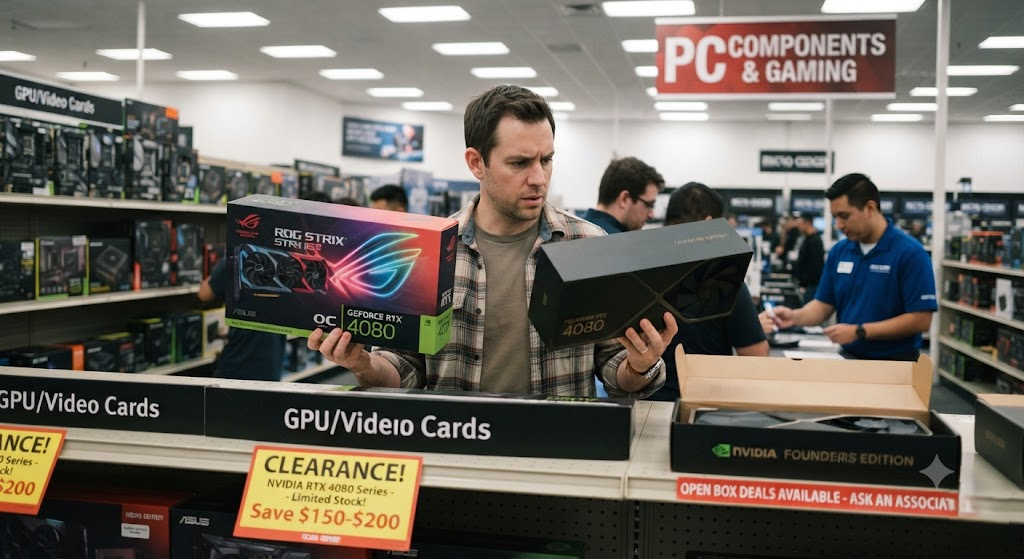
- Nvidia Founders Edition (FE): Measuring in at 304mm (12 inches) in length, the FE is actually one of the most compact versions of the RTX 4080 available. It fits relatively easily into most modern mid-tower ATX cases.
- ASUS ROG Strix: This premium model stretches out to a staggering 357.6mm. If you have a front-mounted AIO liquid cooler, there is a very high chance the ROG Strix will not clear the radiator in a standard mid-tower.
- MSI Suprim X: Coming in at 336mm, it sits comfortably in the middle but still requires careful measurement, especially in compact ATX cases like the Fractal Design Meshify C.
- Gigabyte AORUS Master: Another massive card, measuring roughly 357mm, requiring a spacious main chamber to avoid clearance conflicts.
Width and Slot Thickness: The Motherboard Hogs
Modern RTX 4080 cards range from 3-slot to 3.5-slot designs. The Founders Edition is a clean 3-slot (61mm thick), while cards like the Gigabyte AORUS push closer to 4 slots (75mm). This thickness can completely block access to your motherboard’s lower PCIe slots, rendering capture cards, dedicated sound cards, or additional M.2 expansion cards useless. Furthermore, if you are building in a Micro-ATX case, a 3.5-slot card might sit completely flush against the power supply shroud, choking off airflow to the GPU fans and causing severe thermal throttling.
The Hidden Threat: 12VHPWR Cable Bend Radius Clearance
Perhaps the most overlooked aspect of RTX 4080 clearance is the width of the card combined with the power cable. The RTX 40-series utilizes the 16-pin 12VHPWR connector. Because of the incredible amount of wattage passing through these tiny pins, the cable must be seated flawlessly. If the cable is bent too sharply near the connector head, it can cause uneven contact, increased resistance, and—in well-documented extreme cases—melting.
Nvidia and cable manufacturers like CableMod recommend leaving a minimum of 35mm of straight clearance horizontally from the GPU before bending the cable down toward the power supply. This creates a massive clearance issue for your case’s side panel.
Consider this math: If you buy an ASUS TUF RTX 4080 (150mm wide) and add the mandatory 35mm cable bend radius clearance, you need a minimum of 185mm of clearance from the motherboard tray to the glass side panel. Many popular mid-tower cases only offer 165mm to 170mm of CPU cooler clearance (which dictates total width). If you try to force the glass panel shut, you will crush the 12VHPWR adapter, risking catastrophic hardware failure.
Solutions for Cable Clearance Issues
- ATX 3.0 Power Supplies: Using a native ATX 3.0 PSU with a dedicated 12VHPWR cable (rather than the bulky 4-to-1 adapter dongle included in the GPU box) provides a much more flexible and manageable cable run.
- Right-Angle Adapters: Several brands offer 90-degree or 180-degree cable adapters that route the power cable flush along the side or back of the GPU PCB, completely eliminating side-panel clearance issues. Just ensure you buy from reputable brands with updated revisions to ensure safety.
- Vertical Mounting: Using a PCIe 4.0 riser cable to mount the GPU vertically completely changes the clearance dynamic. The power cable will face the roof of the case rather than the side panel, eliminating the bend radius issue entirely. However, you must ensure your case has enough vertical clearance so the GPU fans aren’t pressed against the side glass.
Top PC Cases with Guaranteed RTX 4080 Clearance
If you are building a new system from scratch and want to guarantee that you will not run into clearance headaches, selecting the right chassis is paramount. Here are some top-tier cases that swallow the RTX 4080 without a second thought:
Lian Li O11 Dynamic EVO
A staple in the custom PC community, the O11 Dynamic EVO boasts an incredibly wide main chamber. Because the power supply is hidden behind the motherboard tray, the main compartment is exclusively reserved for components. It easily clears the longest AIB RTX 4080s, and the extra width ensures you won’t crush your power cables against the glass.
Fractal Design Torrent
If air cooling is your priority, the Fractal Torrent is an airflow masterpiece. It is a large case that supports up to 423mm of GPU length (with front fans installed). Even the largest ASUS ROG Strix or Gigabyte AORUS models will fit in the Torrent with plenty of room to spare, all while receiving direct, unimpeded airflow from the massive 180mm front intake fans.
Corsair 5000D Airflow
While the smaller 4000D can technically fit some RTX 4080 models, it gets cramped quickly, especially with front radiators. The step-up 5000D Airflow offers a much more forgiving interior. With a maximum GPU length of 400mm, it provides the perfect balance of footprint and internal clearance, ensuring your build process is frustration-free.
The Financial Angle: RTX 4080 Inventory Clearance
Now that we have covered the physical space required to house this GPU, let’s pivot to the second, highly relevant definition of the term: retail clearance. The GPU market is notoriously volatile, and product life cycles move at breakneck speeds. In January 2024, Nvidia launched the RTX 4080 Super, effectively replacing the original RTX 4080.
The RTX 4080 Super was introduced with an aggressive MSRP of $999, which completely disrupted the market for the original RTX 4080, which carried an initial MSRP of $1,199. Because the Super variant offers roughly 2% to 5% better performance for $200 less, retailers were instantly put in a difficult position regarding their existing, standard RTX 4080 inventory. This has triggered a wave of RTX 4080 clearance sales across the United States.
Where to Find the Best Clearance Deals
Retailers are desperate to free up shelf space for the Super variants and the upcoming next-generation architectures. If you know where to look, you can find original RTX 4080 models heavily discounted.
- Micro Center: Famous for their in-store only deals, Micro Center is aggressively pricing their remaining original RTX 4080 stock. Their open-box section is particularly lucrative, often dropping the price of premium AIB models well below the $900 mark.
- Best Buy Clearance: Best Buy frequently pushes older inventory into their clearance and refurbished pipelines. Keep a close eye on their online “Outlet” section for drastic price cuts on Founders Edition cards and standard models from Gigabyte and MSI.
- Newegg Shell Shockers and Fantastech Sales: Online mega-retailer Newegg regularly uses promotional flash sales to liquidate discontinued inventory. Adding original RTX 4080s to your wishlist and enabling price alerts can notify you the minute a clearance liquidation begins.
- B&H Photo Video: Often overlooked by standard PC builders, B&H holds massive inventory and is known to quietly drop prices on discontinued hardware to avoid paying warehousing taxes on dead stock.
Is an RTX 4080 on Clearance Worth It?
When you spot a heavy discount on an original RTX 4080, you have to weigh it against the newer RTX 4080 Super. The reality is that the silicon inside both cards is nearly identical. The original RTX 4080 uses the AD103 GPU die with 9,728 CUDA cores, while the 4080 Super uses a fully unlocked AD103 die with 10,240 CUDA cores. In real-world 4K gaming, this translates to a barely perceptible difference of 2 to 4 frames per second.
Therefore, the purchasing decision comes down entirely to price clearance. If you can find a brand new, original RTX 4080 on clearance for $850 to $900, it is an absolute steal and a much better value than buying an RTX 4080 Super at the $999 MSRP. You are getting 98% of the performance for significantly less money. The original 4080 still boasts the exact same 16GB of GDDR6X VRAM, the same dual NVENC encoders for streaming, and the same DLSS 3 Frame Generation capabilities.
However, if the clearance price of the original 4080 is only discounted to $970 or $980, the savings are not deep enough to justify passing on the newer Super model. When shopping clearance, set a hard mental price ceiling of $900. If the price falls below that line, pull the trigger.
Strategies for Upgrading Successfully
Successfully navigating an RTX 4080 upgrade requires a holistic approach that bridges both the physical and financial aspects of clearance. Here is a step-by-step strategy for American buyers looking to make the leap:
1. Measure Twice, Buy Once: Before you even begin hunting for inventory sales, open your PC case with a tape measure. Measure the distance from the back expansion slots to your front intake fans or radiator. Then, measure the distance from the motherboard tray to your glass side panel. Write these two numbers down in millimeters.
2. Check Your Power Supply: Ensure your power supply is rated for at least 850W, though 1000W is recommended for spikes. Furthermore, check physical PSU clearance. Some smaller cases have cramped basements, and managing the stiff cables of an ATX 3.0 power supply under the shroud can be just as difficult as fitting the GPU itself.
3. Set Up Deal Trackers: Utilize tools like CamelCamelCamel (for Amazon), Honey, and the build-a-pc-sales subreddit. Set specific keyword alerts for “RTX 4080” and filter out the word “Super.” This will notify you immediately when a major retailer executes a silent clearance price drop.
4. Don’t Fear the Open Box: Retailers like Best Buy and Micro Center thoroughly test open-box returns. An open-box original RTX 4080 on clearance usually still carries the full manufacturer warranty. Because these cards are so large, many open-box returns are simply from users who bought the card, realized they lacked the physical clearance in their case, and returned it the next day unused.
Final Thoughts
The concept of RTX 4080 clearance encapsulates the modern PC building experience perfectly: balancing immense physical hardware constraints with volatile market pricing. On the physical side, the sheer scale of the card demands respect. By carefully mapping out your chassis dimensions, accounting for the critical 12VHPWR cable bend radius, and considering vertical mounting options, you can avoid the heartbreak of an incompatible build.
On the financial side, the introduction of the Super series has created a golden window for budget-conscious high-end builders. Retailers are actively trying to clear their warehouses of original RTX 4080 stock. By remaining patient, tracking price trends, and knowing exactly what physical dimensions your case can support, you can capitalize on these clearance sales to secure one of the most powerful graphics cards on the planet at a fraction of its original cost.


