
 salehunter.net
 Let’s be honest: nobody looks at a $239 fleece jacket and thinks, “What an absolute steal.” When you shop for premium outdoor apparel, Patagonia sits firmly in the buy-once-cry-once territory. The brand has built a global reputation on three pillars: bulletproof durability, minimalist aesthetics, and an uncompromising commitment to environmental ethics.
However, that ethical footprint comes with a high retail price tag. Because Patagonia actively campaigns against fast fashion and overconsumption—famously taking out a full-page Black Friday ad in The New York Times telling people “Don’t Buy This Jacket”—they do not rely on the desperate, endless markdown cycles used by traditional mall brands.
Yet, Patagonia sales do happen. They are structured, highly predictable, and fiercely competitive. If you know the cadence of the outdoor retail calendar, understand the brand’s inventory distribution, and know which retail partners hold the surplus, you can routinely outfit yourself in world-class gear for 30% to 50% off retail.
The Philosophy Behind the Price Tag
To master the Patagonia sale, you first have to understand why the gear is priced high to begin with. You aren’t just paying for the Fitz Roy mountain logo on the left chest. You are paying for:
- Fair Trade Certified sewing: A premium goes directly to the factory workers who assemble the garments.
- Recycled raw materials: Over 90% of Patagonia’s line utilizes recycled polyester, nylon, or wool, which requires more complex supply chains than virgin petroleum-based synthetics.
- The Ironclad Guarantee: A lifetime commitment to repair, replace, or refund any item that fails due to manufacturing defects.
When you buy a discounted piece of Patagonia clothing, you are purchasing those exact same ethical standards and lifelong warranties—just at the price point of a standard, mid-tier department store brand.
The Official Patagonia Sale Schedule: Marking Your Calendar
If you visit Patagonia.com on a random Tuesday in October hoping to find a site-wide banner offering 40% off, you will leave empty-handed. The direct-to-consumer website strictly adheres to a bi-annual seasonal clearance model.
1. The Winter Sale (Late January through February)
This is the holy grail for serious cold-weather outdoor enthusiasts. As the retail industry pivots toward spring shipments, Patagonia clears out its heavy winter inventory. This is the precise moment to hunt for Down Sweaters, Macro Puff parkas, insulated ski shells, and heavy technical base layers. Discounts reliably hit 30% to 40% off.
2. The Summer Sale (August)
Roughly six months later, the cycle repeats for warm-weather gear. The August sale is your prime window to snag Baggies shorts, Capilene Cool sun hoodies, trail running gear, and lightweight rain shells. Once an item sells out during the August push, it is generally retired until the following spring—or discontinued forever.
3. The Year-Round “Web Specials” Section
Tucked quietly in the navigation menu of Patagonia’s digital storefront is a link labeled Web Specials. This is the brand’s digital outlet rack. It operates 365 days a year, populated by overstock sizes, discontinued colorways, and past-season iterations of classic items.
Pro-Tip for Web Specials: Inventory drops happen quietly. While the company doesn’t publish an official restocking schedule, veteran bargain hunters know to check the Web Specials page early on Tuesday and Thursday mornings. When a popular item like the Nano Puff drops into Web Specials in a standard size (Medium or Large), it frequently sells out within two to three hours.
The Myth of the Patagonia Black Friday Sale
If you are saving your money for the fourth Friday in November expecting a massive Patagonia blowout, pivot your strategy immediately. Patagonia does not participate in traditional Black Friday sales.
In fact, the brand historically uses Black Friday as a platform for environmental activism. In 2016, they donated 100% of their global Black Friday sales ($10 million) directly to grassroots environmental groups. In recent years, their Thanksgiving weekend marketing has exclusively pointed shoppers toward used gear, repair guides, or local community clothing swaps. Do not hold out for Cyber Monday; the price on that Black Hole Duffel will remain exactly the same as it was on November 1st.
Authorized Retailers: The Secret Backdoor to Discounts
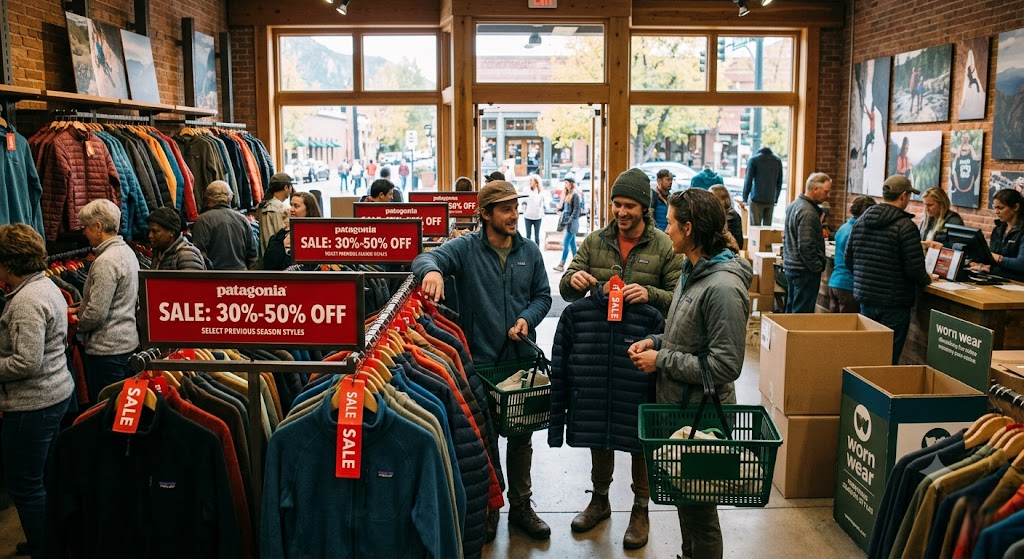
Because Patagonia’s first-party website runs such a tight ship, the most consistent way to find a Patagonia sale is to look outside of Patagonia. Major third-party outdoor retailers buy Patagonia inventory in massive bulk six to nine months in advance. When the weather doesn’t cooperate with a retailer’s sales projections—for instance, an unusually warm winter in the Northeast—those retailers are left holding massive amounts of Patagonia outerwear that they are contractually obligated to clear out to make room for new brand shipments.
Keep your eyes locked on these four retail giants:
REI Co-op
REI is arguably the largest third-party vendor of Patagonia gear in the United States. While Patagonia items are frequently excluded from REI’s famous 20%-off member coupons, they are heavily featured in REI’s seasonal clearance events. The REI Anniversary Sale (May) and the Gear Up Get Out Sale (November) regularly feature select Patagonia colorways at 30% off. Furthermore, keeping an eye on the digital REI Outlet will routinely reveal last year’s Patagonia fleeces at steep discounts.
Backcountry & Moosejaw
These dedicated online outdoor retailers operate in hyper-competitive e-commerce spaces. Both routinely run “Semi-Annual” and “End of Season” clearance events that mirror Patagonia’s own schedule, but they frequently bundle these items with free two-day shipping or loyalty reward credits (like Backcountry’s Expedition Perks) that Patagonia’s main site does not offer.
Steep & Cheap
Owned and operated by Backcountry, Steep & Cheap is an outlet site designed to quietly liquidate overstock outdoor gear without diluting the flagship retail brand’s image. You can routinely find Patagonia technical flannel, boardshorts, and trail pants here at 40% to 55% off retail. The catch? Inventory fluctuates by the minute, and shipping is rarely free.
Patagonia Worn Wear: The Smartest “Sale” Most People Ignore
If you strictly demand brand-new clothing with factory tags attached, skip this section. If you simply want the world’s best outdoor gear at the lowest possible price point, open a new tab and type in WornWear.com.
Launched as an antidote to the throwaway economy, Worn Wear is Patagonia’s official hub for pre-owned, traded-in, and factory-repaired gear. Customers trade in their used Patagonia garments for store credit; Patagonia takes those garments, cleans them using industrial-grade CO2 processes, fixes any broken zippers or tears, and lists them online.
Why Worn Wear beats a standard retail sale:
- The Price Point: A pristine, lightly worn Better Sweater that costs $149 new generally sits on Worn Wear for $65 to $80.
- The “Recrafted” Line: This is a lesser-known corner of the site where Patagonia seamstresses take un-repairable garments, cut the salvageable fabric panels out, and stitch them together with panels from other ruined jackets. The result is a 100% unique, color-blocked piece of functional art that nobody else on the hiking trail will own.
- Vintage Hunting: It is the easiest way to acquire classic Patagonia pieces from the late 90s and early 2000s, including original Snap-T fleeces with retro geometric patterns.
Top 5 Iconic Patagonia Items to Target During a Sale
When a sale hits, paralysis by analysis can cause you to miss out on your sizing. Have a prioritized wishlist ready. These five items represent the absolute peak of the brand’s engineering and offer the highest utility per dollar spent:
1. The Nano Puff Jacket
The undisputed king of synthetic mid-layers. Utilizing PrimaLoft Gold Eco insulation, it traps heat even when soaking wet, compresses down to the size of a standard Nalgene bottle, and weighs almost nothing. Retail sits around $239; target sale price is $165 or lower.
2. The Better Sweater Quarter-Zip
The unofficial uniform of both mountain town baristas and Silicon Valley software engineers. It features a sweater-knit face with a moisture-wicking fleece interior. It is virtually indestructible. Retail is $149; target sale price is $99 to $105.
3. The Torrentshell 3L Rain Jacket
For years, budget rain jackets relied on 2.5-layer construction that eventually delaminated and peeled into white flakes against your skin. Patagonia upgraded the Torrentshell to a true 3-layer H2No Performance Standard shell, making it compete with Gore-Tex jackets double its price. Retail is $179; target sale price is $125.
4. The 5-Inch Baggies Shorts
Constructed from rugged NetPlus 100% post-consumer recycled nylon made from recycled fishing nets. They work as swim trunks, running shorts, gym wear, and casual lounging gear. Retail is $65; target sale price is $42 to $45.
5. The Black Hole Duffel (55L or 70L)
Made from weather-resistant TPU-film laminate ripstop polyester. These bags get tossed onto tarmac, strapped to pack mules, and dragged through mud without showing scuffs. Because luggage doesn’t follow seasonal clothing fashion trends, Black Hole discounts are rare—if you ever see one marked down by 20% or more, buy it instantly.
Insider Strategies for Scoring the Best Size and Color
Understanding the “Colorway Tax” is the single most important psychological shift a Patagonia shopper can make.
Patagonia divides its garments into two visual tiers: Core Colors (usually Black, Forge Grey, Navy Blue, and Classic Tan) and Seasonal Colors (think Mango Splash, Pitch Blue, Sunder Red, or High-visibility Neon Green). Core colors carry over from year to year; therefore, retailers have zero incentive to put a Men’s Large Black Nano Puff on sale. It will sell at $239 in December just as easily as it will in July.
The massive 40% discounts are almost exclusively reserved for the Seasonal Colors that the brand is officially retiring. If you are willing to wear a forest green jacket with a contrasting purple zipper instead of plain matte black, you will save roughly $85 on the exact same insulation and stitching.
Additional buying tactics:
- Utilize local brick-and-mortar store pickup: During the online February and August clearance events, the central warehouse often runs out of standard sizes rapidly. However, Patagonia’s website allows you to check local inventory. Frequently, a physical store in Austin, Chicago, or Boston will have three leftover sale items sitting on a back clearance rack that the national website shoppers can’t grab. Buy online, select store pickup, and let the retail staff grab it for you.
- Set automated price drop alerts: Use browser extensions like Honey or CamelCamelCamel (for Amazon-affiliated outdoor storefronts) to track specific product SKUs. Set the threshold to notify you the second a specific jacket drops below 25% off.
Does the Ironclad Guarantee Apply to Sale Items?
There is a lingering misconception among shoppers that buying an item on clearance or through an outlet forfeits the manufacturer warranty. With Patagonia, this is unequivocally false.
Whether you bought a jacket at full price on Fifth Avenue, scored it for 45% off on Steep & Cheap, or bought it heavily patched on Worn Wear, Patagonia stands behind the physical integrity of the fabric. If the toggle on your discounted rain jacket snaps five years from now, you can walk into any Patagonia retail store, hand it to an associate, and they will either ship it to their Reno repair center for a free fix or issue you a merchandise credit based on the item’s last known retail value.
The Bottom Line
Chasing a Patagonia sale requires shedding the instant-gratification mindset of modern digital shopping. You cannot force a deal on the exact day the first autumn chill hits the air. Instead, view your outdoor wardrobe as a long-term infrastructure project. Buy your heavy down parka when the snow is melting in February; buy your quick-drying river shorts when the leaves start turning brown in August. When you align your wallet with the natural rhythm of the outdoor industry’s clearance cycle, you get to enjoy the pinnacle of functional, sustainable gear for the price of ordinary clothing.