
LED Rechargeable Camping Lantern Sale: How to Score the Best Gear Without Getting Burned
 salehunter.net
 There is a very specific kind of campsite heartbreak that happens roughly forty-five minutes after the sun dips below the tree line. You reach into your gear bin, pull out the brand-new lighting rig you grabbed during a flash sale, hit the power button, and are greeted by a lukewarm, sickly yellow flicker that dies before you can even locate the zipper on your tent. We have all been there. In the rush to capitalize on a deeply discounted price tag, it is dangerously easy to buy a piece of e-waste wrapped in rugged-looking olive drab plastic.
The market for portable outdoor illumination has undergone a massive tectonic shift over the last decade. The heavy, D-cell battery hogs and the fragile, mantle-burning propane lanterns of our childhoods have been largely retired, replaced by high-density Lithium-ion cells and surface-mounted LED diodes. But because the barrier to entry for manufacturing these electronic devices has plummeted, the internet is currently flooded with cheap, white-labeled generic units disguised as high-end expedition gear. When you type “camping lantern led rechargeable sale” into a search bar, you aren’t just browsing; you are walking into a digital bazaar of inflated specifications, deceptive marketing, and hidden battery degradation.
To actually win at seasonal outdoor gear sales—whether you are shopping the major spring retail blowouts, Prime Day, or direct-to-consumer holiday clearances—you have to look past the red, crossed-out MSRP tag. You need to understand the practical physics of modern portable lighting. This guide will dismantle the marketing jargon, reveal the hidden traps of discounted outdoor electronics, and give you the exact buyer’s checklist needed to separate a genuine bargain from a campsite paperweight.
Why Rechargeable LED is the Undisputed King of the Campsite
Before diving into how to shop a clearance event, it is worth establishing why you should strictly filter out dual-fuel or disposable battery lanterns in the first place. The practical math is hard to argue with: a standard retail pack of four quality D-batteries costs roughly $8 to $10. If a traditional incandescent or early-generation LED lantern runs through two sets of batteries over a weeklong national park road trip, you have just spent $20 on disposable power. Over three summers of regular weekend camping, the replacement batteries alone will cost more than a top-tier rechargeable unit.
Beyond the long-term cost savings, modern rechargeable LED lanterns offer three distinct tactical advantages in the backcountry:
- The Power Bank Pivot: Almost every quality rechargeable lantern manufactured today doubles as an emergency power bank via an integrated USB-A or USB-C output. If your smartphone dies while you are relying on downloaded offline topographic maps, your campsite lantern suddenly becomes a critical survival lifeline.
- Tent-Safe Operation: Unlike propane, white gas, or kerosene units, LEDs generate near-zero forward heat and emit zero carbon monoxide. This makes them 100% safe to hang from the ceiling loop inside a sealed, four-person backpacking tent during a rainstorm.
- Granular Dimming Curves: Traditional fuel lanterns operated on a frustrating binary: blindingly bright or completely extinguished. Modern digital step-circuits allow you to drop an LED lantern down to a 5-lumen “moonlight mode,” giving you a soft interior nightlight that can run continuously for 180 hours on a single charge.
Decoding the Specs: What the Sale Page Won’t Tell You
When browsing an online sale page, the human eye naturally gravitates toward two prominent numbers: the percentage of the price discount and the maximum lumen count. Retail algorithm designers know this, which is precisely why those two specific metrics are the most heavily manipulated across e-commerce platforms. To shop smart, you have to read between the spec-sheet lines.
1. The Lumen Lie and the ANSI FL1 Standard
If you see a lantern advertised on a sale page for $21.99 claiming “6,000 Lumens of Blinding 360-Degree Brightness,” close the tab immediately. For real-world context, a standard high-beam halogen car headlight sits at roughly 1,200 to 1,500 lumens. A compact plastic camping lantern generating a true, sustained 6,000 lumens would generate enough thermal energy to melt its own polycarbonate chassis within three minutes.
Legitimate outdoor lighting manufacturers test and rate their gear against the ANSI/NEMA FL1 Standard—a rigorous set of testing protocols established by the flashlight industry. However, here is the lesser-known insider loophole: the FL1 standard measures total lumen output exactly 30 seconds after the device is turned on. Many budget overseas manufacturers explicitly program their lanterns to hit a massive, unsustainable peak output at the 30-second mark to legally claim the high number on the box. Two minutes later, the internal thermal regulation circuit throttles the output down by 65% to prevent the battery from catching fire. When shopping a sale, look for brands that publish an honest “runtime decay curve” graph rather than just a single, boastful peak lumen number.
2. Battery Chemistry: The Cold Weather Killer
Most consumer rechargeable lanterns run on standard Lithium-ion (Li-ion) pouch cells or 18650 cylindrical batteries. While these are fantastic for warm July camping trips, standard Li-ion chemistry suffers severe voltage sag when the ambient temperature drops. At 32°F (0°C), a standard Lithium-ion battery loses roughly 20% to 30% of its functional runtime capacity. At 15°F (-9°C) during a late-autumn hunting trip, it can easily lose up to half of its juice.
If you are shopping a sale specifically to build out a winter overlanding rig or an emergency home blackout kit, scrutinize the spec sheet for LiFePO4 (Lithium Iron Phosphate) battery cells, or look for lanterns featuring internal thermal insulation around the battery bay. If a discounted product listing completely omits the battery chemistry and vaguely states “Includes high-capacity 5000mAh battery,” assume it utilizes the cheapest available grade of standard Li-ion.
3. Color Temperature and the CRI Factor
Have you ever turned on an LED lantern at a pristine forest campsite and suddenly felt like you were standing inside a sterile hospital corridor or a 24-hour gas station restroom? That jarring sensation is caused by the wrong Color Temperature, measured in Kelvin (K). Budget LED manufacturers almost exclusively buy diodes rated at 6000K to 6500K (harsh cool white). They do this because blue-spectrum light registers higher on cheap factory light meters, allowing them to claim higher lumen outputs while using cheaper diodes.
For a comfortable outdoor living space, you want a warm color temperature between 2700K and 3500K. Warm amber light naturally mimics the relaxing wavelength of a wood campfire, preserves your natural night vision when stepping away from the table, and—crucially—attracts significantly fewer flying swarms of insects than blue-spectrum light. Furthermore, check the listing for the CRI (Color Rendering Index). A low CRI below 70 will make your camp dinner look like gray, unappetizing sludge. Look for a CRI of 80 or higher to ensure natural color depth.
4. The IPX Waterproofing Trap
Never trust marketing buzzwords like “Weatherproof,” “Storm-resistant,” or “Water-repellent” in a sale headline; those terms carry zero legal or standardized engineering weight. Look strictly at the IP (Ingress Protection) code.
- IPX4: Resistant to splashing water from any direction. This will survive a damp morning fog or a passing light drizzle, but the internal circuitry will likely short out if left exposed on a picnic table during a heavy mountain thunderstorm.
- IPX6: Engineered to resist high-pressure, heavy jets of water. Completely safe for sustained, driving downpours.
- IPX7: Can be fully submerged in up to 1 meter of water for 30 minutes. This is the gold standard for serious outdoor gear. If an IPX7 lantern gets knocked off a kayak or dropped into a muddy creek, you simply wipe it off and turn it back on.
The Anatomy of a Fake Sale: Three Red Flags
When digital storefronts launch major holiday promotional banners, bad actors work overtime to capture impulse buyers. Keep your guard up against these three ubiquitous discount traps:
The Outdated Micro-USB Clearout
This is the single most prevalent trick in modern online inventory management. A reputable gear brand or a massive third-party distributor discovers four forgotten pallets of 2021-model camping lanterns sitting in the dark corner of a distribution center. They slash the price by 55%, slap a “Mega Holiday Deal” graphic over the main image, and push it to the front page. The catch? Those units rely on obsolete Micro-USB charging ports. More importantly, the internal Lithium batteries have been sitting in an unmonitored state of discharge for three to four years. Even if the lantern arrives brand new inside sealed retail shrink-wrap, its battery has already permanently degraded via internal chemical passivation. If the lantern does not charge via modern USB-C, do not buy it, no matter how cheap the sale price gets.
The “Anchor Price” Inflation Scam
Many third-party sellers on massive marketplace platforms utilize automated repricing software to artificially jack up a product’s “base list price” seventy-two hours before a major site-wide sale event. A basic camping lantern that normally sells year-round for $28.99 will suddenly display a crossed-out list price of “Originally $79.99 — Now 63% Off at $29.50!” Before checking out, always run the product page URL through a reputable historical price-tracking tool to verify that the “discount” is attached to historical reality rather than an algorithmic illusion.
The Mini-Solar Panel Placebo
You will frequently encounter sale listings for rechargeable lanterns featuring a postage-stamp-sized, 2-inch by 2-inch solar panel affixed to the top cap, marketed heavily as an “Infinite Off-Grid Power Generator.” Do the basic surface-area physics: a solar cell of that physical footprint generates roughly 0.1 to 0.15 watts of power in direct, cloudless noon sunlight. To fully recharge a standard 5000mAh internal lantern battery via that micro-panel, the unit would need to sit in direct, unshaded sunlight for roughly 110 to 130 hours. It is an aesthetic marketing gimmick designed solely to justify a $15 price markup. Treat any built-in mini solar panel as an emergency trickle-charger to keep the battery from dying completely, never as a primary charging methodology.
Smart Spending: What You Should Expect to Pay on Sale
To help you benchmark your seasonal shopping budget, here is a realistic breakdown of what genuine, fair sale pricing looks like across the three primary gear tiers in the United States outdoor retail ecosystem:
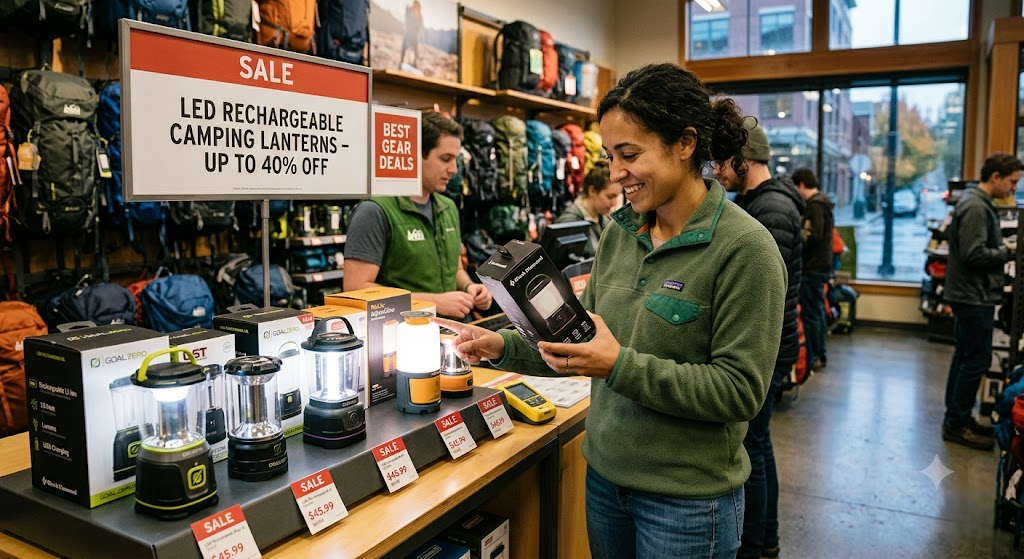
- The Ultralight / Backpacker Tier ($18 – $28 on sale): At this price point, expect a compact, collapsible silicone globe or a minimalist pack-strap unit weighing under 4.5 ounces. Maximum real output should sit around 150 to 220 lumens. You are paying strictly for weight reduction, packability, and durability—not massive area illumination.
- The Standard Campsite / Family Tier ($35 – $55 on sale): This represents the functional sweet spot for 85% of recreational campers. Expect 400 to 650 honest lumens, an internal 5000mAh to 7500mAh power bank, universal USB-C connectivity, dual color-temperature switching (warm and cool modes), and a minimum IPX6 water resistance rating.
- The Basecamp / Overland Hub Tier ($75 – $130 on sale): High-output telescoping area towers or heavy-duty multi-directional site hubs. Expect 1,000+ regulated lumens, massive 10,000mAh+ internal battery reserves, Bluetooth smartphone app integration for remote dimming, heavy magnetic mounting bases, and standardized brass tripod threading.
Post-Purchase Pro-Tip: Protecting Your Investment
Once your discounted lantern arrives on your doorstep, your role as an educated consumer isn’t quite finished. If you unbox the unit, charge it to 100%, use it for one weekend in July, and then toss it into a stiflingly hot garage storage tub until the following summer, you will severely cripple the battery before its second season. Lithium cells degrade at an accelerated rate when stored at maximum voltage in high ambient temperatures.
For long-term winter storage, intentionally run the lantern down until the battery indicator sits at roughly 50% capacity. Wipe down the exterior rubber gaskets with a tiny drop of silicone conditioner to prevent dry-rotting, store the unit inside a climate-controlled interior closet in your home, and set a calendar reminder to plug it into a wall charger for just fifteen minutes every four months. This simple routine keeps the internal chemistry active, ensuring that when you catch the next great gear sale, you are adding to an existing, reliable lighting arsenal rather than constantly replacing dead equipment.