
 salehunter.net
 We have all been there: staring at a 300-pound washing machine sitting in the bed of a pickup truck, mentally calculating the exact cost of a chiropractor visit versus the price of buying a neighbor a 12-pack of beer to help you lift it. When the realization finally hits that human backs were not designed for vertical freight, the immediate reflex is to open a tab and search for a hand truck sale.
However, buying a material handling tool purely because it has a yellow “20% OFF” sticker slapped across the frame is a fast track to broken toes and shattered drywall. The market is currently flooded with cheap, drop-shipped tubular steel dollies that look rugged on a smartphone screen but fold like a cheap lawn chair the moment you tilt a double-door refrigerator back against the axle.
Whether you are a warehouse manager trying to stretch a Q3 equipment budget, an independent contractor, or just a homeowner tired of carrying bags of mulch by hand, navigating a hand truck sale requires a bit of mechanical literacy. Here is how to separate commercial-grade bargains from bargain-bin hazards.
Beyond the Discount: The Physics of a Good Dolly
When browsing online sales or walking the center aisle of a big-box hardware store, your eyes will naturally gravitate toward the big number: the weight capacity. You will see budget hand trucks proudly boasting a “600 lb. Capacity.”
What the sale placard doesn’t tell you is the difference between **static load** and **dynamic load**.
A static load rating means that if you gently set 600 pounds of lead weights onto the toe plate while the truck is perfectly upright and stationary, the frame won’t snap. But the moment you pull back on the handles to break the center of gravity, tilt that weight at a 45-degree angle, and bounce it over a two-inch concrete garage threshold, the dynamic force exerted on the axle can instantly spike to 900 pounds or more.
When shopping any sale, use the 70% Rule: take the manufacturer’s advertised weight limit and multiply it by 0.7. That resulting number is your real-world, daily-abuse working limit. If you routinely need to move 500-pound wood stoves, do not buy a hand truck on sale rated for 500 pounds; hunt down a sale on an 800-pound unit.
Choosing Your Archetype: Don’t Buy the Wrong Tool
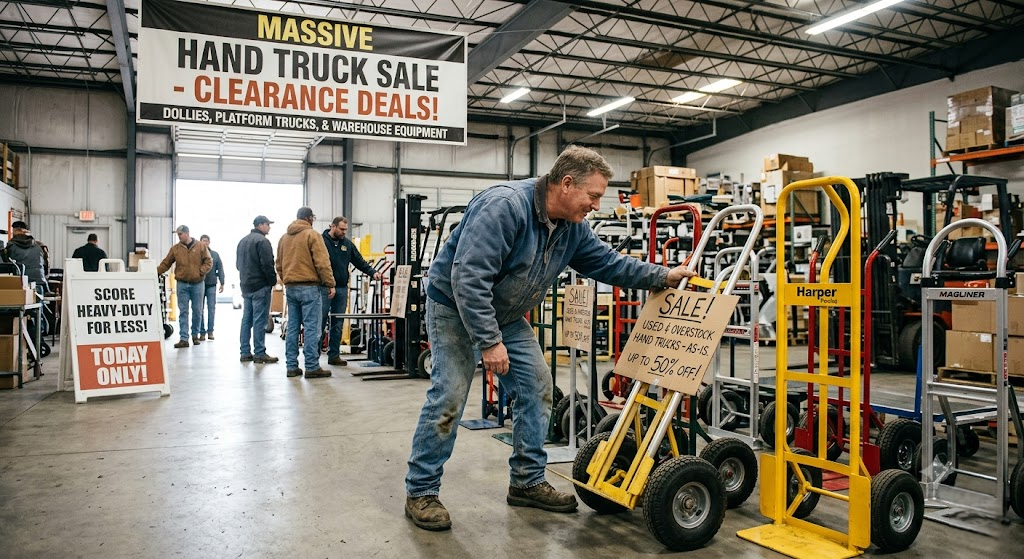
Retailers love to lump every two-wheeled cart into the same digital sale category. Before you look at the price tag, narrow your hunt to the four distinct geometry profiles:
1. The Standard Upright (The Daily Driver)
This is the classic L-shaped rig. It features two wheels, a fixed or folding nose plate, and a vertical ladder frame.
- Best for: Moving stacked moving boxes, standard parcels, water heaters, and trash cans.
- What to look for on sale: Look for extruded aluminum frames rather than steel. Aluminum cuts the dead-weight of the tool in half (usually around 22 to 28 lbs. versus 45+ lbs. for steel) while offering superior flex under load.
2. The 2-in-1 / 3-in-1 Convertible
Popularized by brands like Harper, Milwaukee, and Cosco, these units feature a release latch that allows the vertical frame to drop backward onto a secondary set of caster wheels, transforming the hand truck into a four-wheeled platform cart.
- Best for: Long warehouse corridors, office relocations, and catering setups.
- The Sale Trap: Pay hyper-specific attention to the locking slide-mechanism. On heavily discounted, off-brand convertibles, the spring-loaded release pins are often made of low-grade pot metal. If that pin shears while the cart is loaded as a platform, the entire payload will drop to the floor.
3. The Appliance Specialist
You will recognize these by the dual vertical fabric straps attached to a manual tightening ratchet on the back of the frame, alongside dual rubber “crawler belts” mounted to the rear rails.
- Best for: Refrigerators, gun safes, vending machines, and—crucially—navigating staircases.
- Pro Tip: Never buy an appliance dolly on sale if the stair-climber belts feel like hard, slick plastic. They must be made of high-friction, non-marking vulcanized rubber, or the cart will slide down wooden interior stairs like a sled.
4. The Compact Fold-and-Stow
These feature telescoping handles and flip-up wheels that allow the entire rig to compress down to the size of a large briefcase.
- Best for: Traveling trade show vendors, real estate stagers, and keeping in the trunk of a sedan.
- Reality Check: Treat the advertised weight capacities of folding dollies as pure fantasy. Even top-tier brands top out at real-world usefulness around 150 pounds due to the sheer number of mechanical pivot points.
The Great Tire Debate: Air, Foam, or Solid?
The single most common reason a consumer returns a sale-priced hand truck within 48 hours has nothing to do with the frame—it is the wheels. Retailers slash prices on hand trucks with cheap wheel assemblies because inventory managers know those tires degrade sitting in hot distribution warehouses.
- Pneumatic (Air-Filled): These offer the absolute best ride quality. They act as miniature shock absorbers, rolling over gravel, cracked asphalt, and extension cords effortlessly. However, buy them on sale in November, leave the dolly in a freezing Midwestern shed until March, and you *will* come back to two flat tires unseated from their rims.
- Flat-Free (Closed-Cell Polyurethane): This is the modern gold standard. They look and bounce somewhat like pneumatic tires, but they are solid foam inside. They cannot be punctured by construction site nails. Lesser-known drawback: If you leave a heavily loaded flat-free truck sitting parked in one spot for three weeks in a hot garage, the tires can develop permanent “flat spots.”
- Solid Molded Rubber/Thermoplastic: Usually found on the cheapest sale items. They roll exceptionally well on polished, glass-smooth warehouse concrete. On rough outdoor pavement, however, they vibrate violently, rattling your knuckles and shaking the contents of your boxes to pieces.
Timing the Market: When Do Dollies Actually Go On Sale?
Unlike televisions or mattresses, material handling equipment follows a very rigid, commercial retail cycle. If you want to maximize your purchasing power in the US market, time your search around these three windows:
The Spring Lawn & Garden Reset (March – April)
Big box retailers like Home Depot, Lowe’s, and Menards massively overhaul their outdoor garden centers in early spring. To push heavy items like concrete pavers, 50lb bags of fertilizer, and commercial planters, they place heavy-duty hand trucks on promotional end-caps. This is historically the best time of year to find $30 to $50 markdowns on name-brand convertible carts.
The “College Move-In” Blitz (Late July – August)
During the late-summer back-to-school push, retailers target parents prepping for dormitory moves. The sales during this window are heavily skewed toward lightweight, folding aluminum dollies and compact hand trucks. If you need an industrial 800lb appliance mover, skip this season; if you need a trunk-stowable cart for an apartment, this is your buyer’s market.
The Fiscal Year-End Surplus (November – December)
Industrial supply hubs—such as Uline, Global Industrial, and Northern Tool—often clear out bulky warehouse inventory ahead of tax season. While shipping costs from catalog suppliers can sting, their Q4 clearance events are the premier time to buy true, commercial-grade modular aluminum trucks (like Magliner or B&P Manufacturing) at 15% to 25% below list price.
Four Sneaky Compromises on “Budget” Hand Trucks
When you spot a hand truck marked down from $110 to $59.99, the manufacturer had to squeeze that $50 of savings out of the assembly line somewhere. Inspect the product photos—or the physical floor model—for these four dead giveaways of corner-cutting:
- The Blunt Toe-Plate: Quality hand trucks feature a skived (beveled) edge on the front of the nose plate, tapering down to nearly a razor edge so you can slide it under a heavy cardboard box sitting flush on the floor. Cheap sale units use a blunt, 1/8-inch stamped steel plate with a flat edge; when you push it against a heavy box, it just shoves the box across the floor instead of sliding underneath it.
- Cotter Pin Axles: Look at the center of the wheel. Does the wheel spin on a sealed, precision ball-bearing, or is it just a plastic hole riding on a steel rod held in place by a bent piece of wire (a cotter pin)? Cotter pin setups create metal-on-metal friction, scream when rolled, and eventually wallow out the wheel hub.
- The “Axle-to-Frame” Weld: On elite commercial dollies, the steel axle slides through a separate, bolted steel bracket attached to the frame. If you drop the truck off a tailgate and bend the axle, you buy a $12 replacement rod. On bargain hand trucks, the axle is welded directly to the primary upright tubes. Bend the axle once, and the entire tool goes into the recycling bin.
- Narrow Track Width: Measure the distance from the outside of the left tire to the outside of the right tire. Anything under 18 inches offers terrible lateral stability. When you are wheeling a tall, top-heavy load around a corner, a narrow-track cart will actively try to tip over sideways into your shins.
The Buy-It-For-Life Secret: Modularity
If you take away nothing else from your deal-hunting, let it be this: the best hand truck sale is the one you only have to take advantage of once in your life.
In the professional logistics world, nobody buys welded, single-piece steel hand trucks. They buy modular systems. Brands like Magliner design their trucks so that the handle, the frame ladder, the nose plate, the axle, and the stair climbers are all independent components held together by heavy-duty aircraft locknuts.
If you find a modular aluminum truck on sale for $180, and a fully welded steel “budget” truck on sale for $80, the $180 unit is infinitely cheaper over a ten-year timeline. When a warehouse worker backs a forklift into a modular truck and crushes the handle, you order a Part #30101 handle for $24, turn a wrench four times, and your truck is brand new again. When someone backs into the $80 welded truck, you are back on Google searching for another sale.
Quick Buyer’s Checklist
Before you hit “Add to Cart” or roll the cart to the cash register, run through this final five-second inspection:
- [ ] The Magnet Test: If the listing claims “Lightweight Aluminum,” stick a fridge magnet to the main uprights. If it sticks, it’s cheap thin-wall steel painted silver.
- [ ] Nose Plate Depth: Ensure the plate is at least 7.5 inches deep; anything less will not safely support standard file boxes or appliance bases.
- [ ] Handle Height: Stand upright next to it. The primary grip point should sit somewhere between your hip and your lower ribcage. If you have to stoop over to grip the handles while the cart is upright, you will destroy your lumbar spine the moment you pull back on a heavy load.
- [ ] Zerk Fittings: Check the wheel hubs. Do they have tiny metal nipples for a grease gun? Presence of Zerk fittings usually denotes a commercial-tier axle assembly meant to be maintained, rather than discarded.
A hand truck is fundamentally a lever. Archimedes famously noted that with a long enough lever and a place to stand, he could move the world. Do not compromise your posture, your safety, or your cargo just to save thirty bucks on a poorly welded fulcrum.