

 salehunter.net
 There is a specific moment of dread every car owner recognizes. You turn the key, expecting the gentle hum of your engine, and instead, you are greeted by a roar that sounds less like a well-tuned machine and more like a tractor in a canyon. Your muffler has failed. Suddenly, your daily commute turns into a headache-inducing ordeal, and you become the neighbor everyone glares at when you pull into the driveway at night.
The immediate reaction is panic—specifically, financial panic. Exhaust work has a reputation for being expensive. However, the automotive aftermarket has shifted dramatically in the last decade. The rise of the “discount muffler” isn’t just about cheap, tin-can parts anymore; it is a sprawling market of budget-friendly performance options, direct-fit OEM replacements, and clever DIY solutions. But navigating this landscape requires a bit of know-how. If you buy the cheapest steel tube you find online, you might end up with a part that rusts out in six months or sounds like a swarm of angry bees. This is your roadmap to fixing the noise without breaking the bank.
The Economics of Exhaust: Why Prices Vary So Wildly
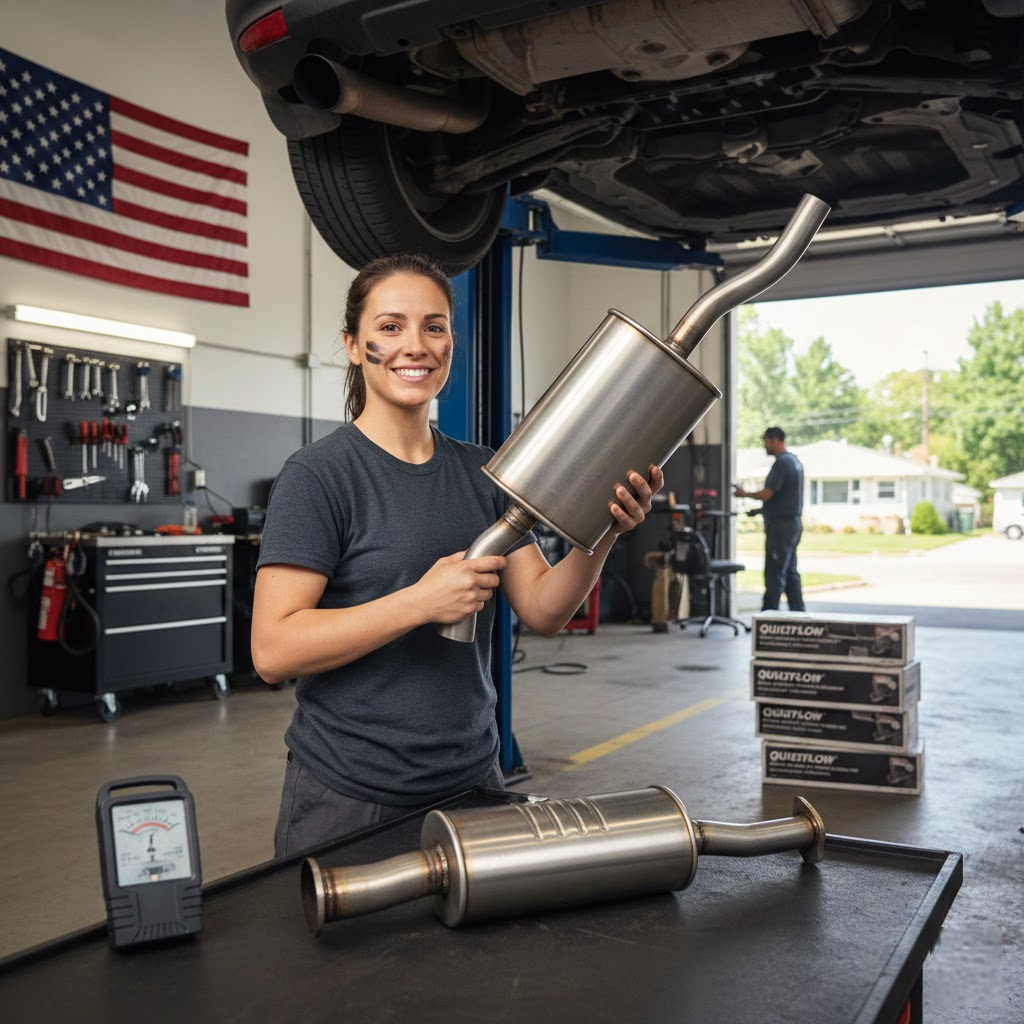
To find a true bargain, you first have to understand what you are paying for when you buy a premium muffler versus a discount one. The price difference usually comes down to two main factors: material science and internal architecture.
Most factory exhaust systems are made from 409 stainless steel. It’s magnetic and will develop surface rust, but it rarely rots through. Premium aftermarket options (like Borla or Corsa) often use 304 stainless steel, which is surgical grade, looks polished, and lasts forever. Discount mufflers, however, usually rely on aluminized steel. This is mild steel coated in aluminum-silicon alloy to resist corrosion.
Is aluminized steel bad? Not necessarily. If you live in Arizona or California, an aluminized discount muffler might last you ten years. If you live in the Rust Belt where salt is dumped on roads, that same muffler might have a lifespan of two to three years. When shopping for a discount muffler, checking the material spec is the single most important step. If you need longevity on a budget, look for “economy stainless” options offered by brands like Walker or AP Exhaust, which often sit in the pricing “sweet spot” between dirt cheap and premium.
Universal vs. Direct Fit: The Hidden Labor Costs
This is the trap where most budget-conscious drivers lose money. You see a “high-flow performance muffler” on eBay or Amazon for $28. It looks great in the picture. You buy it, thinking you scored the deal of the century. Then it arrives.
That $28 muffler is a “Universal Fit.” This means it has no hangers, no flanges, and the inlet/outlet diameters might be slightly off compared to your car’s mid-pipe. To install this, you (or a shop) will need to cut your old pipe, expand the metal, weld on new hangers to match your car’s chassis hooks, and weld the unit in place. If you are paying a shop, the labor to install a $28 universal muffler could easily run $150 to $200.
In contrast, a “Direct Fit” discount muffler might cost $70 or $80. However, it comes with the flanges welded on, the pipe bent to the exact shape of your undercarriage, and the hangers in the factory location. You can bolt this on in your driveway with a wrench and some penetrating oil. When calculating the “discount,” always factor in the installation method. Unless you own a welder and know how to use it, a Direct Fit unit is almost always cheaper in the long run.
The Sound Factor: Avoiding the “Drone”
One of the biggest complaints regarding budget exhaust parts is the sound quality. Cheap performance mufflers often use simple glass-packing—fiberglass stashed around a perforated tube—to dampen sound. Initially, this gives a deep, aggressive rumble. However, over time, the fiberglass breaks down and blows out, making the muffler louder.
More importantly, cheap mufflers rarely undergo the rigorous sound engineering that eliminates “drone.” Drone is that resonant, vibrating hum that occurs at steady highway speeds (usually around 2,500 RPM). It vibrates the cabin and makes conversation impossible.
If you are looking for a discount muffler for a daily driver, avoid the “race” or “aggressive” labels found on the cheapest units. Look for “Turbo” style mufflers (which use internal baffles to reverse sound waves) or “OEM Replacement” style. Brands like Thrush and Cherry Bomb offer very affordable turbo mufflers that provide a nice tone without the headache-inducing resonance of a straight-pipe design.
Where to Hunt for Deals and Promo Codes
Finding the hardware is easy; getting the lowest price requires strategy. The auto parts market is fiercely competitive, and retailers are constantly tossing out promo codes to win your business.
The Online Giants
Sites like RockAuto act as wholesale warehouses. They don’t offer free shipping often, and they don’t have “coupons” in the traditional sense, but their base prices are usually 40-50% lower than brick-and-mortar stores. They are excellent for finding “Economy” tier replacements from reputable brands like Walker SoundFX or Bosal.
Brick-and-Mortar Retailers (with Digital Perks)
Stores like AutoZone, Advance Auto Parts, and O’Reilly Auto Parts usually have higher sticker prices, but they are the kings of promo codes. If you order online for in-store pickup, you can almost always slash the price.
- Advance Auto Parts: They historically run a “percentage off” model. Look for codes similar to SAVINGS20 or SPEEDPERKS. A common rotating offer is 15% to 20% off orders over $100. If you are buying a muffler, a clamp, and a gasket, you will likely hit that threshold.
- AutoZone: Look for their “Next Order” coupons. often emailed after a small purchase. They frequently run “20% off $100+ Ship to Home” deals.
- Pep Boys: often has service coupons if you don’t want to do the work yourself, such as “$40 off Exhaust Service.”
Pro Tip: Always check the “clearance” or “open box” sections of Amazon Warehouse. Mufflers are heavy and often get returned because buyers picked the wrong size. The packaging might be destroyed, but a dented muffler works just as well as a pristine one, often for 50% off.
DIY Installation: Keeping the Savings in Your Pocket
You bought the discount muffler. Now, to keep it a “discount” experience, you need to install it yourself. Exhaust work intimidates people because of one thing: Rust.
Heat cycles and road moisture fuse bolts together. However, with the right approach, you can swap a muffler in an afternoon.
The “Liquid Wrench” Phase
Do not attempt to unbolt your old muffler dry. It will snap the bolt heads off, turning a one-hour job into a drilling nightmare. The night before you plan to work, crawl under the car and soak every nut and bolt in a high-quality penetrating oil (like PB Blaster or Kroil). WD-40 is not enough here. Soak it again in the morning.
The Tools
You don’t need a lift. A set of ramps or jack stands is essential for safety. Beyond that, a basic socket set and a “breaker bar” (a long handle that gives you leverage) are key. If you are dealing with a clamped-on muffler, you might need an exhaust pipe expander (loanable from most auto parts stores) to get the new pipe to slide over the old one.
If the bolts are truly seized, heat is your friend. A simple handheld propane torch (under $20) applied to the nut for 60 seconds can expand the metal enough to break the rust bond.
The “Band-Aid” Fixes: Are They Worth It?
Sometimes, even a discount muffler is out of the budget, or you just need the car to pass inspection next week. This brings us to exhaust repair tapes and putties.
Products like “Muffler Cement” or fiberglass wraps are marketed as permanent fixes. They are not. They are temporary patches. If you have a small hole in the muffler casing, these products can seal it for a few months. However, the pressure inside an exhaust system is immense. Eventually, the patch will blow out. Use these only as a stopgap measure while you save up for the replacement part, not as a long-term solution.
Performance on a Shoestring: The Flowmaster/Magnaflow Alternates
Many car enthusiasts want the “name brand” sound—the deep growl of a Flowmaster or the smooth tone of a Magnaflow—but can’t stomach the $150+ price tag for just the muffler box. The market is flooded with “knock-offs” or “style” mufflers.
Jones Exhaust and Summit Racing’s house brand often produce mufflers that are near-identical clones of the famous chambered mufflers. They use the same internal baffle technology and similar steel thickness but cost half as much because you aren’t paying for the marketing budget. If you want a specific sound, search forums for “Flowmaster 40 series alternative” or similar queries. You will often find part numbers for generic boxes that sound 95% the same.
When to Walk Away: Signs You Need a Professional
While I advocate for DIY and discount parts, there are scenarios where trying to save money will cost you more.
If your exhaust failure is at the manifold (where the engine meets the pipes) or involves the catalytic converter, be very careful. Snapping a bolt in the engine block is a catastrophic error. furthermore, catalytic converters are legally regulated items. “Discount” catalytic converters often lack the necessary precious metals to keep the Check Engine Light off for long. In these cases, spending more for a higher-quality part is actually the frugal move, as you won’t have to replace it again in six months.
Additionally, if your exhaust pipe is rusted so thin that it crumbles when you squeeze it, you cannot weld or clamp a new muffler to it. You need a whole new mid-pipe. At this point, taking it to a local, independent muffler shop (not a chain) is often the best route. Independent shops can bend pipe from scratch, which is often cheaper than buying pre-bent pipes online.
The Final Verdict on Discount Mufflers
The term “discount muffler” shouldn’t scare you. In fact, for a car that is 10 years old or more, putting a premium, lifetime-warranty exhaust system on it is often a waste of capital. The aftermarket world has matured, offering aluminized steel options that fit perfectly and sound decent for a fraction of the dealer cost.
Success lies in the details: checking the steel type, ensuring it is a “direct fit” to save on labor, and using penetrating oil liberally. Whether you are hunting for a generic 20% off code at AutoZone or scouring RockAuto for a closeout deal, the quiet ride you want is available for the price you can afford. Silence, it turns out, can be bought cheaply—if you know where to look.


