

 salehunter.net
 There is a distinct sound that resonates through almost every garage, workshop, and industrial facility across the United States: the brief, sharp hiss of a WD-40 aerosol can. For decades, that iconic blue and yellow can has been the undisputed king of problem-solving. Whether it is a stubbornly rusted bolt on a classic car restoration, a squeaky door hinge in a commercial office building, or a seized gear on a piece of heavy farming equipment, this legendary lubricant is the universal solvent of choice. However, for professionals, fleet managers, and industrial operators, relying on standard-sized aerosol cans is a logistical and financial bottleneck. If your team is emptying cans on a daily or weekly basis, making the transition to a WD 40 bulk buy is not just a smart idea—it is a critical operational upgrade that can save time, money, and significant frustration.
The Aerospace Origins of an Everyday Miracle
To truly appreciate the scale at which this product is used in commercial settings today, it helps to understand its origins. The name itself is steeped in aerospace history and scientific perseverance. Back in 1953, a small operation known as the Rocket Chemical Company set out to create a line of rust-prevention solvents and degreasers specifically designed for the aerospace industry. Their primary mission was to protect the outer skin of the Convair Atlas Missile from rust and corrosion, a critical task during the height of the Cold War.
It took the lead chemist, Norm Larsen, thirty-nine unsuccessful attempts to get the formula just right. On the fortieth attempt, he perfected the water displacement formula. Thus, “Water Displacement, 40th formula”—or WD-40—was officially born. What started as a highly specialized aerospace coating quickly caught the attention of the company’s employees, who began quietly sneaking it home to use on squeaky doors, rusted garden tools, and stiff bicycle chains. By 1958, the product made its official debut on consumer store shelves in San Diego, California. Fast forward to today, and the product has moved far beyond the single can; it is now an industrial staple purchased by the barrel.
The Financial Argument for Buying in Bulk
Let us break down the core reason why executing a WD 40 bulk buy makes exceptional business sense: the sheer economics of scale. When you purchase a standard aerosol can, you are not just paying for the liquid lubricant inside. You are paying a premium for the metal canister, the plastic cap, the specialized spray nozzle assembly, the pressurized propellant, and the manufacturing process required to safely combine all those components. Furthermore, aerosol cans are notorious for leaving a small, unusable percentage of the product trapped inside once the gaseous propellant runs out, meaning you rarely get to use 100 percent of what you paid for.
When you buy in bulk, you are rapidly stripping away all those unnecessary packaging and propellant costs. You are paying strictly for the proprietary chemical formula. For high-volume users, this shift in purchasing can translate to a cost reduction of up to fifty percent or more per fluid ounce. Over the course of a fiscal year, a large automotive repair shop, a manufacturing plant, or an agricultural operation can save thousands of dollars simply by switching their procurement strategy from cases of individual cans to bulk liquid containers.
Environmental Impact and Waste Reduction
Beyond the immediate financial savings, there is a compelling environmental and operational efficiency argument to be made for bulk purchasing. Managing waste is a significant part of running any industrial or automotive facility. Empty aerosol cans require specific disposal methods, and throwing dozens of them into the recycling or trash bin every week creates unnecessary waste volume.
By switching to bulk containers and utilizing reusable, manually pumped trigger sprayers, a facility can drastically reduce its footprint of metallic and plastic waste. Additionally, because bulk liquid is non-aerosolized, you are removing the volatile organic compound (VOC) propellants from your immediate work environment. This creates a slightly cleaner, more manageable workspace while aligning with modern sustainability and waste-reduction initiatives that many corporate facilities are now required to follow.
Choosing the Right Size for Your Operation
A WD 40 bulk buy is not a one-size-fits-all proposition. Depending on the scale of your operation, the product is available in several distinct industrial sizes, each tailored to specific usage rates and storage capabilities.
- The 1-Gallon Jug: This is the perfect entry point for serious DIYers, small engine mechanics, and independent automotive detailers. It is small enough to store easily on a standard garage shelf but holds enough liquid to refill a standard reusable spray bottle dozens of times. It is also the ideal size for small-scale parts soaking.
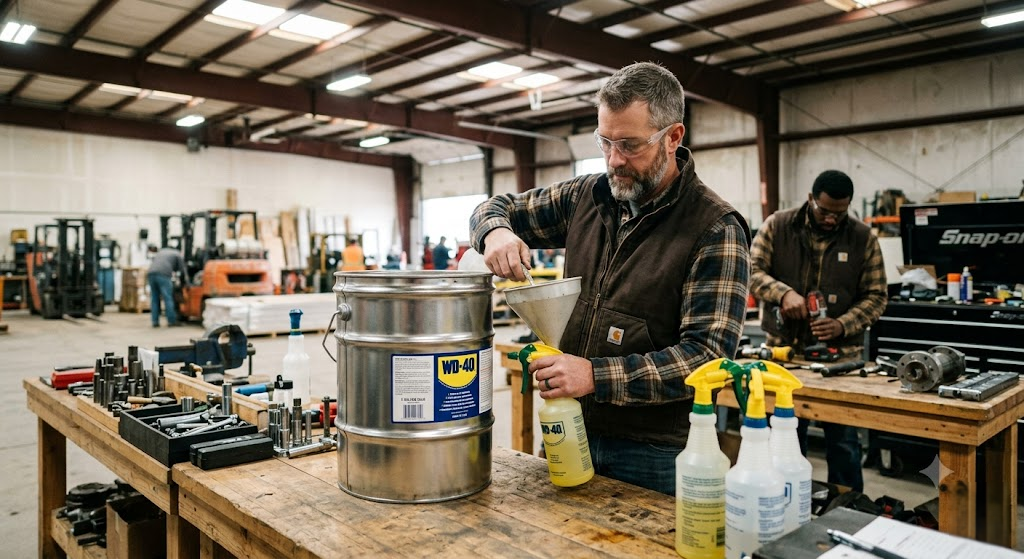
- The 5-Gallon Pail: The five-gallon option is the sweet spot for medium-sized operations. This includes local municipal maintenance garages, mid-sized agricultural farms, and machine shops. A five-gallon pail is large enough to handle heavy daily use but can still be moved by hand or poured using a specialized pail pump.
- The 55-Gallon Drum: Designed strictly for heavy industry, the fifty-five-gallon drum is the ultimate bulk investment. This size caters to massive commercial trucking fleets, heavy manufacturing assembly lines, aerospace maintenance facilities, and large-scale agricultural enterprises. Buying by the drum offers the absolute lowest cost per ounce and requires drum-handling equipment and heavy-duty transfer pumps to dispense the liquid effectively.
Application Methods: Life Without the Aerosol Can
One of the most common hesitations people have when considering a WD 40 bulk buy is figuring out how to apply the product without the familiar pressurized spray nozzle. Fortunately, moving to liquid bulk opens up far more versatile application methods that are often vastly superior to the standard aerosol spray.
Heavy-Duty Trigger Sprayers: The most common method of application is transferring the liquid into heavy-duty, reusable plastic spray bottles. It is crucial to use sprayers equipped with chemically resistant seals (such as Viton seals), as standard household spray bottles will quickly degrade and leak when exposed to petroleum-based solvents. These professional sprayers often offer adjustable nozzles, allowing you to switch between a fine mist and a highly targeted stream.
Pump-Up Sprayers: For covering large surface areas, such as the undercarriage of a fleet truck or the steel plow of a tractor, a pressurized pump-up sprayer (similar to a garden weed sprayer) is incredibly efficient. This allows a worker to coat a large piece of machinery in minutes, providing an even, comprehensive layer of rust protection.
Dip Tanks and Parts Washers: This is where bulk purchasing truly shines. When dealing with heavily rusted chains, seized gears, or corroded hand tools, spraying them is often not enough. With bulk liquid, you can fill a small dip tank or container and completely submerge the parts overnight. The prolonged soaking allows the proprietary formula to penetrate deep into the microscopic crevices of the rust, breaking the bonds and freeing the metal in a way that a surface spray simply cannot match.
Brush and Roller Application: In manufacturing and fabrication settings, raw steel often needs to be protected from flash rusting before it is painted or shipped. Workers can literally paint or roll bulk WD-40 onto flat steel stock, ensuring a uniform protective barrier against ambient humidity.
Top Commercial and Industrial Applications
While the average homeowner uses this product to fix a squeaky door, industrial applications are far more demanding. Having gallons of the product on hand allows facilities to tackle massive preventative maintenance tasks.
- Agricultural Winterization: Farmers use bulk liquid to thoroughly coat the metal components of combine harvesters, tractors, and plows before putting them into winter storage. This barrier displaces any lingering moisture and prevents rust from forming during the off-season. Additionally, spraying down shovels and snowplows prevents heavy, wet snow from sticking to the metal.
- Marine Environments: Saltwater is the ultimate enemy of metal. Marinas and commercial fishing operations use bulk quantities to wipe down engine compartments, pulleys, winches, and exposed hardware. The water-displacement properties are unparalleled in preventing salt corrosion on expensive marine equipment.
- Automotive Fleet Maintenance: Mechanics use bulk liquid for everything from penetrating seized suspension bolts to acting as a cutting fluid for drilling and tapping metal. It is also widely used to clean grease, grime, and road tar off commercial vehicle fleets without damaging the clear coat.
- Facilities Management: Maintenance teams in large factories or schools use bulk quantities not just for lubrication, but for cleaning. It is surprisingly effective at removing scuff marks from commercial flooring, dissolving stubborn adhesive residues left by tape or stickers, and cleaning hard water stains from stainless steel fixtures.
Safety and Storage Considerations
Upgrading to a WD 40 bulk buy brings with it a responsibility for proper storage and safety compliance. Because the liquid formula is a petroleum-based product, it is classified as a combustible liquid. It is imperative that it is stored in a cool, well-ventilated area away from direct sunlight, open flames, sparks, or intense heat sources.
For operations purchasing the 55-gallon drums, proper grounding and bonding cables must be used when transferring the liquid to smaller containers to prevent the buildup of static electricity, which could theoretically ignite the fumes. Additionally, Occupational Safety and Health Administration (OSHA) regulations require that any secondary containers (like reusable spray bottles) must be clearly labeled with the product name and associated hazard warnings. Ensuring that your facility maintains updated Safety Data Sheets (SDS) for bulk chemicals is a mandatory step in responsible workplace management.
The Final Verdict on Wholesale Lubrication
Streamlining a business often comes down to looking closely at the small, repetitive costs that slowly eat away at the bottom line. The constant cycle of purchasing, using, and throwing away individual aerosol cans is a perfect example of an operational inefficiency. Committing to a WD 40 bulk buy transforms a consumable office expense into a strategic industrial asset.
Whether you choose to start with a modest one-gallon jug for a specialized repair bay or dive straight into a fifty-five-gallon drum to service an entire municipal fleet, the benefits are immediate and undeniable. You will lower your cost per ounce, reduce your environmental waste footprint, and unlock highly effective application methods like prolonged parts soaking and broad-surface pump spraying. For anyone serious about mechanical maintenance, industrial manufacturing, or commercial fleet management, embracing the bulk buy is an essential step toward a smoother, more profitable operation.


