
Maximize Your Savings: How to Score an Energy Audit Discount and Slash Your Utility Bills
 salehunter.net
 If you have been watching your utility bills creep upward month after month, you are not alone. Across the United States, homeowners are feeling the pinch of rising electricity and natural gas prices. You might have tried turning off the lights, tweaking the thermostat, or adding a bit of weatherstripping around the front door. But if your home is secretly leaking air, lacking proper insulation, or running on inefficient, aging appliances, those minor tweaks are like putting a tiny bandage on a gaping wound. The most effective way to stop the bleeding is by scheduling a professional home energy assessment. But here is the best part: you probably do not have to pay full price for it. Thanks to a combination of federal legislation, state initiatives, and aggressive utility company rebates, securing an energy audit discount has never been easier or more lucrative.
In this article, we will break down exactly how you can find, stack, and maximize discounts on professional home energy audits. We will explore the hidden mechanisms behind utility rebates, how to leverage the latest federal tax credits, and why making this small upfront investment is the ultimate gateway to thousands of dollars in home improvement savings.
What Exactly is a Professional Home Energy Audit?
Before diving into the discounts, it is crucial to understand what you are actually buying. A true professional energy audit—often referred to as a comprehensive home energy assessment—is a far cry from a simple visual inspection by a contractor trying to sell you replacement windows. It is a rigorous, science-based evaluation of your home’s energy performance.
Certified auditors (typically credentialed by the Building Performance Institute or RESNET) use specialized diagnostic equipment to pinpoint exactly where and how your home is losing energy. A standard comprehensive audit includes:
- The Blower Door Test: The auditor installs a powerful fan in an exterior doorway, depressurizing the house. This forces outside air in through unsealed cracks and gaps, allowing the auditor to measure the exact rate of air leakage.
- Thermographic Imaging: Using an infrared camera, the auditor scans your walls, ceilings, and floors. This reveals hidden voids in your insulation, moisture issues, and specific cold spots that the naked eye cannot see.
- Combustion Safety Testing: A critical safety check for homes with gas or oil appliances (furnaces, water heaters, stoves) to ensure they are drafting properly and not leaking dangerous carbon monoxide into your living space.
- Duct Blaster Testing: If you have forced-air heating or cooling, this test measures how much conditioned air is leaking out of your ductwork before it ever reaches your vents.
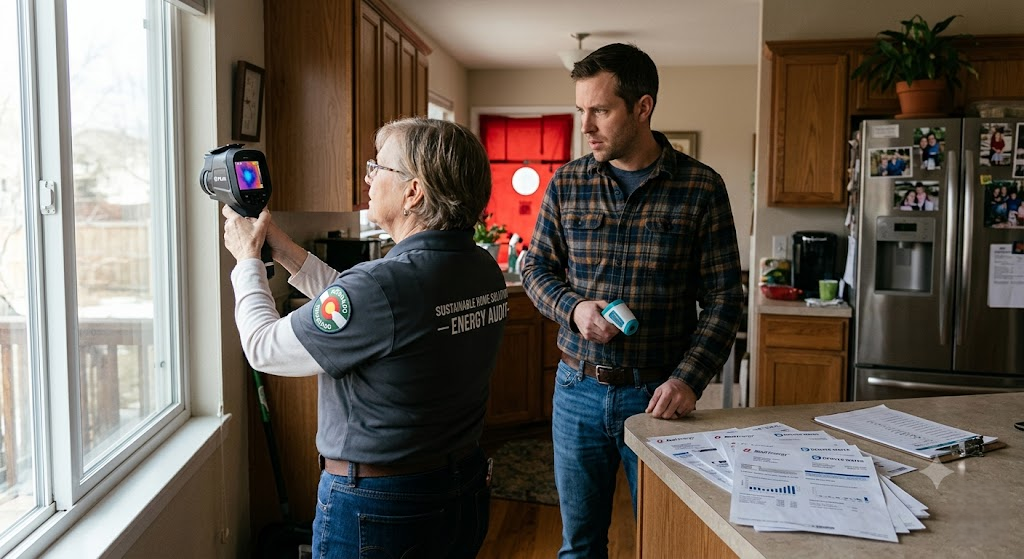
Without discounts, a comprehensive audit like this typically costs between $300 and $600, depending on the size of your home and your region. However, utilizing the right discount programs can drop that out-of-pocket expense to a fraction of the cost—sometimes even down to zero.
The Federal Solution: The Inflation Reduction Act Tax Credit
One of the most significant shifts in the home energy landscape came with the passage of the Inflation Reduction Act (IRA). While much of the media attention focused on electric vehicles and solar panels, the legislation included a massive boost for everyday homeowners looking to improve their property’s efficiency. Under Section 25C (the Energy Efficient Home Improvement Credit), the federal government essentially guarantees an energy audit discount for American taxpayers.
As of the current tax rules (which are locked in through 2032), you can claim a federal tax credit for 30% of the cost of a qualified home energy audit, up to a maximum credit of $150. If your audit costs $500, the government will effectively refund you $150 when you file your taxes, bringing your net cost down to $350.
How to Qualify for the Federal Credit
The IRS does not hand out this credit to just anyone with a clipboard and a flashlight. To ensure you actually get the discount, you must follow strict guidelines:
- Certification is Key: The energy auditor must be a Qualified Home Energy Auditor. They need to hold a certification from a program recognized by the Department of Energy (DOE), such as BPI (Building Performance Institute) or RESNET.
- Written Report: The auditor must provide you with a written report that identifies the most significant and cost-effective energy efficiency improvements for your specific home, complete with an estimate of the energy and cost savings.
- Tax Form 5695: To claim the discount, you will need to fill out IRS Form 5695 (Residential Energy Credits) when you do your annual tax return. Make sure you keep your invoice and the auditor’s written report in your tax files.
The Local Goldmine: Utility Company Rebates
While the federal tax credit is fantastic, the most immediate and often the largest energy audit discounts come directly from your local utility provider. You might be wondering: why would a power company pay to help me use less of the product they sell? The answer lies in grid management and state regulations.
During peak seasons—like a scorching July afternoon or a freezing January night—the power grid is pushed to its absolute limits. If a utility company cannot meet the demand, they are forced to buy emergency power on the open market at exorbitant rates, or worse, initiate rolling blackouts. Furthermore, many states have enacted strict Energy Efficiency Resource Standards (EERS), legally mandating that utility companies reduce overall energy consumption in their service territories.
To meet these legal mandates and prevent grid overload, utility companies would much rather pay a small bounty to help you insulate your attic than spend billions building a new power plant. This creates a massive financial opportunity for homeowners.
Types of Utility Discounts
Depending on where you live and who provides your power, utility-sponsored energy audit discounts usually fall into one of three categories:
- The Flat-Rate Copay: Many utilities subsidize the bulk of the cost, leaving you with a small flat fee. For instance, programs might allow you to get a $500 comprehensive audit for a flat out-of-pocket cost of $99 or $149.
- The Post-Audit Rebate: You pay the auditor the full price upfront, submit the receipt to your utility company, and they mail you a check for a set amount (e.g., a $250 rebate).
- The Free Assessment: Some utilities offer completely free walk-through assessments. While these might not always include the high-tech blower door tests, they are an excellent starting point and are usually performed by qualified technicians who will install free LED bulbs, smart power strips, and low-flow showerheads while they are there.
State-Sponsored Powerhouses: Regional Energy Programs
Beyond the federal government and your specific utility company, many states have created their own independent energy efficiency organizations. These non-profit or state-run entities pool funds (often gathered via a tiny surcharge on everyone’s utility bills) to offer massive discounts on energy audits and subsequent upgrades.
One of the most famous examples is the Mass Save program in Massachusetts. Residents in qualifying utility territories can receive a comprehensive home energy assessment at absolutely no cost. Even better, the program offers 75% to 100% off the cost of approved insulation upgrades recommended during the audit.
Similarly, New York’s NYSERDA (New York State Energy Research and Development Authority) offers free or highly discounted energy audits based on household income. Other states, like Maryland, New Jersey, and California, have robust, heavily subsidized programs designed to eliminate the financial barrier to entry for energy audits.
To find out if your state has a dedicated energy office or program, you can check the Database of State Incentives for Renewables & Efficiency (DSIRE), a comprehensive, free tool managed by the NC Clean Energy Technology Center. Simply input your zip code to see a list of every audit discount, rebate, and tax credit available in your specific jurisdiction.
Assistance for Low-Income Households
Energy burden—the percentage of gross household income spent on energy costs—disproportionately affects low-income families. Recognizing this, the federal government funds the Weatherization Assistance Program (WAP). Administered by the Department of Energy but run at the local level by community action agencies, WAP provides completely free energy audits to qualifying low-income households.
But WAP goes far beyond just a free audit. Once the audit determines where the home is losing energy, the program fully covers the cost of the necessary upgrades. This can include professional air sealing, wall and attic insulation, HVAC repairs or replacements, and health and safety interventions. For families struggling to keep the heat on during winter, this program is nothing short of life-changing.
Eligibility for WAP is generally based on income (often set at 200% of the federal poverty level), though families receiving Supplemental Security Income (SSI) or Aid to Families with Dependent Children automatically qualify in many states.
How to Stack Discounts for Maximum Savings
The secret to minimizing your out-of-pocket costs is “stacking.” In many cases, you do not have to choose between a utility rebate, a state discount, and a federal tax credit—you can use them all on the exact same audit.
Here is a hypothetical scenario of how a savvy homeowner can stack discounts:
Let us say the market rate for a comprehensive Blower Door audit in your area is $600. First, you go through your local utility company’s approved contractor network. The utility has a program that instantly rebates $300 to the contractor. Your invoice is now $300. You pay that $300 out of pocket. Come tax season, you file IRS Form 5695 and claim the 30% federal tax credit on your out-of-pocket cost. 30% of $300 is $90. Ultimately, a top-tier, $600 diagnostic audit only cost you $210.
Keep in mind that IRS rules generally dictate that you can only claim the federal credit on the amount you actually paid after instant rebates or point-of-sale discounts are applied, which prevents double-dipping but still results in massive savings.
The True Value of the Audit: Unlocking the Big Bucks
Securing an energy audit discount is a great financial win, but it is actually just the appetizer. The real financial windfall happens after the auditor hands you their report. An official energy audit is often the mandatory prerequisite for unlocking thousands of dollars in high-value rebates for major home improvements.
For example, under the IRA’s HOMES (Home Owner Managing Energy Savings) Rebate Program, homeowners can receive massive rebates for whole-home energy reductions. If your retrofits cut your home’s energy usage by 20% to 35%, you could be eligible for thousands of dollars in rebates. But how do you prove to the government that you reduced your energy usage by 20%? You guessed it: by comparing a pre-upgrade energy audit with a post-upgrade energy audit.
Without the baseline data collected during the initial discounted audit, you cannot qualify for these performance-based, whole-home rebates. Furthermore, many state and utility programs will not offer their highest-tier incentives for heat pumps, advanced insulation, or smart thermostats unless those upgrades were specifically prescribed in a certified energy audit report.
Actionable Steps to Get Started Today
Ready to stop leaking money out of your drafty windows and poorly insulated attic? Follow this simple roadmap to claim your energy audit discount:
- Visit Your Utility’s Website: Start by logging into your electric and natural gas providers’ websites. Look for tabs labeled “Rebates,” “Energy Efficiency,” or “Save Money.” This is usually the fastest route to finding a heavily subsidized audit program.
- Check State Resources: Search for your state’s name alongside “energy efficiency program” to see if there is a centralized, state-funded initiative you should go through instead.
- Use Approved Contractors: Most utility and state programs require you to use an auditor from their pre-vetted list. Do not just hire the first auditor you find on Google, or you might accidentally void your eligibility for local rebates.
- Verify Certifications: Ensure the auditor is BPI or RESNET certified. If they are not, you will not be able to claim the federal tax credit.
- Save All Documentation: Ask the auditor for a highly detailed invoice that breaks down the cost of the audit separately from any minor repairs they might do on the spot. Keep the invoice and the official audit report in a safe place for tax season.
Investing in a professional home energy assessment is one of the smartest financial decisions a homeowner can make. By leveraging the wide array of available energy audit discounts, you can uncover exactly how to make your home more comfortable, healthier, and vastly cheaper to operate—all for pennies on the dollar. Stop paying to heat and cool the neighborhood, and start claiming the discounts you are entitled to today.