

 salehunter.net
With the Environmental Protection Agency (EPA) recently tightening national standards for PFAS (“forever chemicals”) and public awareness regarding aging municipal lead pipes reaching an all-time high, millions of American households are rethinking what flows out of their kitchen faucets. But upgrading your home hydration setup often triggers immediate sticker shock. While a basic pitcher costs pocket change, high-efficiency under-sink Reverse Osmosis (RO) systems or whole-house filtration setups can easily set you back anywhere from $300 to $3,000.
The good news? The residential water treatment market is fiercely competitive. Manufacturers know that once they get their proprietary hardware onto your kitchen counter or attached to your main water line, they have secured a customer for years via replacement filter sales. Because of this “razor-and-blade” business model, brands are almost always willing to slash upfront hardware prices—if you know which digital levers to pull.
Whether you are shopping for a simple countertop dispenser or a multi-stage carbon block system, this guide breaks down the anatomy of water filter discounts, where the legitimate promo codes actually hide, and how to avoid the trap of buying a cheap system with catastrophically expensive replacement parts.
The Economics of Clean Water: Why Coupons Matter More Here
To understand why you should never pay retail price for a filtration system, look at the math of household water consumption. The average American family of four spends roughly $1,100 a year on single-use bottled water. By comparison, a premium under-sink RO system priced at $450 retail will cost roughly $120 a year in replacement cartridges after year one.
Securing a standard 20% off water filter coupon drops that initial $450 investment down to $360. You have effectively paid off almost an entire year’s worth of future filter replacements just by applying a string of text at checkout. In the water filtration space, a coupon isn’t just a minor perk; it is the difference between a high-ROI home improvement project and an overpriced appliance.
Where Legitimate Water Filter Promo Codes Actually Originate
If you type your favorite brand name plus “coupon code” into Google, you will be instantly flooded with dozens of generic aggregator websites promising “85% OFF TODAY ONLY.” Ninety percent of these codes are expired, regionally locked, or pure fiction designed to capture affiliate tracking cookies. To find working discounts, you have to look at the four primary distribution channels manufacturers use:
- Direct-to-Consumer (DTC) Email Funnels: Major modern brands like Waterdrop, AquaTru, APEC, and Borck rely heavily on first-party data. Almost every major DTC filtration site utilizes an exit-intent popup offering 10% to 15% off your first order in exchange for an email address or SMS opt-in. Pro tip: Use a dedicated secondary email for these signups to keep your primary inbox clean.
- Authorized Dealer Networks: Independent water treatment suppliers often buy brand-name systems (like Pentair or Culligan) in massive wholesale quantities. Because their overhead is lower than the manufacturer’s flagship retail branch, these authorized distributors frequently run their own unadvertised 5% to 10% instant cart discounts to move inventory.
- Eco-Wellness Influencer Partnerships: Water quality has become a massive talking point in the health, longevity, and biohacking communities. Brands regularly issue custom, evergreen 10% to 20% discount codes to YouTube creators, health podcasters, and eco-living bloggers. Searching Spotify or YouTube transcriptions for a specific filter brand will often yield a working, non-expiring promo code faster than a standard coupon site.
- Home Improvement Big Box Promos: Retailers like Home Depot, Lowe’s, and Ace Hardware treat water filtration as standard plumbing hardware. Rather than brand-specific coupons, look for these units during store-wide seasonal promotions (e.g., “Spend $300, Get $50 Off Your Entire Order”).
System-by-System Savings: What Is a “Good” Discount?
Because profit margins vary wildly depending on the technology inside the casing, you shouldn’t expect the same percentage discount across all types of purifiers. Here is the benchmark for what constitutes a genuinely great coupon deal across the industry:
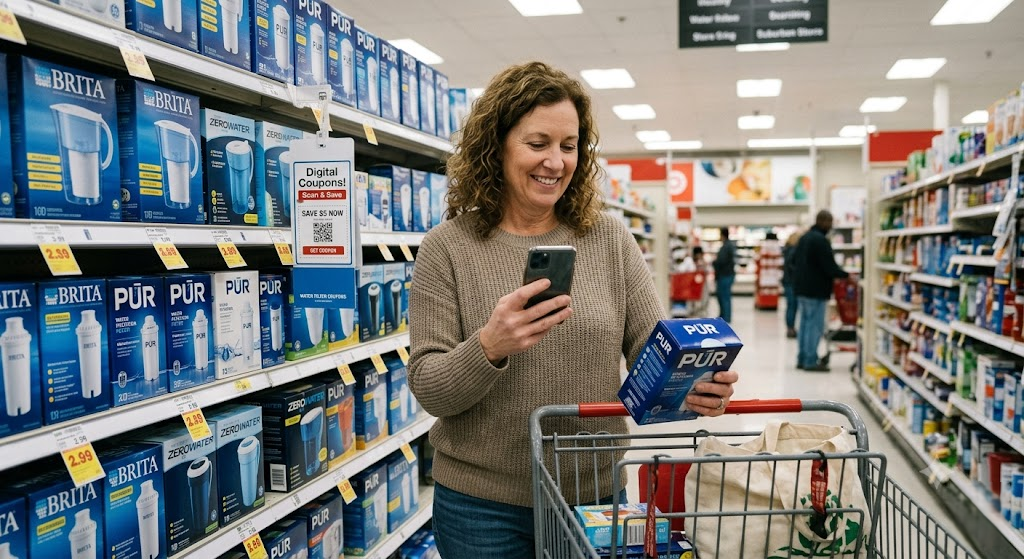
1. Pitchers and Countertop Dispensers (Brita, PUR, ZeroWater)
Because these units retail between $20 and $45, raw percentage coupons are rare. Instead, the best discounts come in the form of manufacturer rebate printouts or “Bundle & Save” promotions (e.g., Buy the 10-Cup Pitcher, get a 3-pack of Elite filters for 40% off). If you see a straight cash discount, anything over $5 off a single pitcher is a solid buy.
2. Countertop Reverse Osmosis & Distillers (AquaTru, Blueair, Express Water)
These sit in the $250 to $600 sweet spot. Because they require zero plumbing installation, they are heavily marketed to apartment renters. The standard welcome coupon is usually $25 to $30 off. However, during major promotional windows, brands regularly release flat-rate $100-off promo codes. Never settle for less than a 15% equivalent discount on countertop RO units.
3. Under-Sink Multi-Stage Systems (APEC, iSpring, Waterdrop G3P800)
This is the most aggressively couponed sector in the US market. Because tankless, high-output RO systems carry high retail price tags ($400–$800), manufacturers frequently use tiered discount codes: $40 off $300, $80 off $500, or $150 off $800. If an under-sink system isn’t discounted by at least $50 at the time of your purchase, wait two weeks; the cycle will refresh.
4. Whole-House Systems (SpringWell, Aquasana, Express Water)
Point-of-entry (POE) systems that treat water for every shower, washing machine, and sink in your home cost between $1,000 and $4,500. Coupon codes here are almost always percentage-based. A standard everyday code will net you 5% off, but peak holiday sales push these codes to 15% or 20% off, representing raw cash savings of $200 to $700.
The “Razor and Blade” Trap: Couponing for Replacement Filters
The most common amateur mistake in water treatment shopping is burning a massive 25% off coupon on the initial machine, only to discover six months later that the proprietary replacement carbon block costs $95 and is excluded from all future promotions.
To protect your wallet over a 5-to-10-year ownership timeline, apply these replacement filter strategies:
- Check the “Subscribe & Save” Fine Print: Most brands offer a standard 10% to 15% discount if you agree to auto-ship replacement filters every 6 or 12 months. Before committing, check the user portal: Can you skip deliveries with one click? Can you cancel immediately without forfeiting the initial discount? If yes, lock in the subscription discount on day one.
- Look for “Year One” Bundles: When buying the initial machine, test coupon codes on the “System + 2-Year Filter Supply” bundle rather than the standalone machine. Brands frequently apply higher percentage discounts to bundled SKUs to inflate their Average Order Value (AOV).
- Verify Third-Party NSF Compatibility: Some under-sink systems use standard 10-inch industry-standard drop-in cartridges, while others use patented twist-and-lock proprietary manifolds. Systems using standard housings allow you to bypass the brand’s website entirely and buy generic, NSF-42 certified replacement blocks on Amazon or supply houses for 60% less.
5 Insider Timing Hacks to Maximize Promo Codes
If you have some flexibility regarding when your new filter arrives, timing your checkout can double the power of a standard coupon code. Mark these windows on your calendar:
1. The Earth Day Surge (April 22)
While Black Friday dominates general electronics, Earth Day is the single biggest revenue week of the year for the water purification industry. Brands position clean water as an eco-friendly alternative to plastic waste. Expect site-wide promo codes ranging from 20% to 30% off across nearly all major US water brands during the entire third week of April.
2. The “New Year, New Health” Window (Jan 1 – Jan 15)
Water filter companies pivot their marketing heavily toward wellness resolutions in January. High-end alkaline purifiers and remineralizing RO systems see their steepest direct-to-consumer discounts during the first two weeks of the calendar year.
3. The Cart Abandonment Sequence
Create an account on the filter brand’s website, add your targeted system and a year’s supply of filters to your cart, go to the final checkout page so the system registers your email, and then simply close the browser tab. Do not buy. Roughly 70% of major filtration brands utilize an automated email cadence that will trigger a 10% off code 24 hours later, followed by a “Sweeten the Deal: 15% off your cart” code 48 hours later.
4. Stacking Cashback Extensions
Never rely on the coupon code alone. Browser extensions like Rakuten, TopCashback, and Honey frequently establish 4% to 12% cash back portals with direct-to-consumer plumbing brands. If you use a 15% off promo code at checkout while routing through an 8% Rakuten cash-back link, you have successfully engineered a ~21.8% compound discount.
5. Hunting for Municipal Utility Rebates
This is the most overlooked discount in the United States. Many local water districts and city governments offer direct bill credits or check rebates to homeowners who install certified water-conserving appliances or certified lead-reduction systems. For example, several municipal utility districts in California and Texas offer $50 to $100 rebates for installing high-efficiency (1:1 drain ratio) RO systems. Check your local water authority’s “Conservation Rebates” web page before checking out.
Comparison: Upfront Cost vs. Coupon Savings Potential
To help you budget your upgrade, the table below outlines what a savvy shopper should expect to spend after applying optimal discounts across the four main system tiers:
| Filtration System Type | Typical Retail Price | Realistic Target Coupon | Target Sale Price | Annual Filter Maintenance Cost |
|---|---|---|---|---|
| Pitcher / Dispenser | $35 – $55 | $10 Off (or Free Filter) | $25 – $45 | $40 – $70 |
| Countertop Reverse Osmosis | $350 – $475 | $75 Flat Code / 15% Off | $275 – $400 | $80 – $130 |
| Under-Sink Tankless RO | $500 – $750 | 20% Off Tiered Promo | $400 – $600 | $90 – $145 |
| Whole-House (POE) System | $1,400 – $2,800 | 15% – 20% Holiday Code | $1,190 – $2,240 | $100 – $250 |
Red Flags: When to Walk Away from a Discount
A low price is worthless if the water exiting the spout doesn’t actually remove the contaminants threatening your household. When hunting for coupon codes, keep your eyes peeled for three distinct warning signs:
First, beware the “Uncertified Knockoff” trap. Third-party marketplaces are flooded with imported filtration systems priced at $120 with an attached “50% Off Clickable Coupon.” If the product listing states “Tested to NSF Standards” rather than explicitly listing an NSF/ANSI Certification Number (such as Standard 42, 53, or 58) verified by IAPMO or WQA, do not buy it. “Tested to” is unregulated marketing speak; it means nobody independently vetted their lead or arsenic removal claims.
Second, watch out for inflated MSRPs. A common tactic among second-tier water appliance brands is to artificially mark a system at $899 year-round, only to permanently display a “Limited Time $400 OFF Coupon!” on the product page. Use price-tracking tools like CamelCamelCamel (for Amazon) to verify whether the “discounted” price is actually just the permanent baseline cost of the machine.
Third, never buy filters from unauthorized third-party resellers on social media. Counterfeit replacement water filters are a multi-million dollar illicit industry. Counterfeiters buy empty brand-name plastic housings, fill them with cheap, unwashed coconut carbon (which can actually leach heavy metals into your water), and sell them via Instagram ads with “Exclusive 40% Off Coupon” hooks. Always verify that your coupon directs you to the manufacturer’s secure domain or an officially listed authorized dealer.
Frequently Asked Questions
Can I stack a manufacturer coupon code with a seasonal website sale?
In most direct-to-consumer shopping carts, promo code fields are restricted to one use per checkout. If a brand is running an automated “20% Off Summer Sale” that auto-applies in the cart, typing in an influencer’s 10% off code will usually overwrite the store sale rather than combine with it. However, manufacturer discounts can almost always be stacked with third-party credit card cash-back offers (like Chase Offers or Amex Offers) and portal cash-back sites.
Do water filter coupons expire at midnight in my local time zone?
Most major US-based water filtration companies run their e-commerce platforms out of either Eastern Standard Time (EST) or Pacific Standard Time (PST). If a flash coupon code is slated to end on Cyber Monday, assume it expires at 11:59 PM Eastern Time to be safe, as East Coast corporate headquarters generally dictate automated store server rollovers.
Are military, first responder, or teacher discounts available for water filters?
Yes. Brands like Berkey, AquaTru, and Waterdrop partner with identity-verification networks like GovX, ID.me, or VerifyPass. If you are an active-duty service member, veteran, registered nurse, government employee, or educator, scroll to the website footer before looking for standard coupons. These verified programs typically generate a permanent, unique 10% to 15% off single-use promo code that works year-round.
What should I do if a valid promo code isn’t working at checkout?
First, check your cart for “excluded items.” Many brands allow coupons on complete systems but block them from applying to standalone replacement filters or digital TDS meters. If your cart contains only an eligible machine and the code still fails, open a live chat window on the site. E-commerce customer service agents have the administrative power to manually generate a custom checkout link with the discount applied if you tell them you are ready to purchase immediately.


