
 salehunter.net
 Anyone who has ever shopped for a French horn knows that sticker shock is practically a rite of passage. While a student flute, trumpet, or trombone can often be acquired for the cost of a weekend getaway, a reliable intermediate double French horn routinely commands the price of a used sedan. Because the manufacturing process requires over twenty feet of precisely tapered brass tubing, complex rotary valves, and hours of master artisan assembly, new retail prices are notoriously uncompromising.
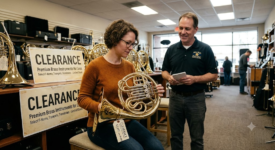
This steep financial barrier makes a French horn clearance sale one of the most fiercely monitored events in the American brass music community. Whether you are a parent attempting to graduate your eighth-grader from a middle school rental program, an adult comeback player joining a local community orchestra, or a university music major seeking a dependable backup instrument, clearance inventory represents your best opportunity to bypass retail markups.
However, buying a precision brass instrument off the discount rack requires a distinct strategy. Unlike buying a clearance television or a pair of running shoes, a discounted horn carries unique mechanical variables. Navigating these sales successfully requires knowing which blemishes are harmless bargains and which structural red flags will end up costing you hundreds of dollars at the repair bench.
The Anatomy of a Clearance Deal: Why Are They Discounted?

To hunt effectively, you first need to understand the retail mechanics of big-box American music stores and specialized brass dealers. Retailers do not slash $1,000 off a professional horn out of sheer generosity; they do it to solve an inventory problem. When browsing clearance landing pages at major US distributors, the instruments generally fall into four distinct categories:
- B-Stock and Cosmetic Blemishes: During the factory manufacturing process, an instrument might receive a tiny run in the epoxy lacquer, a microscopic buffing scratch, or a slight discoloration near a solder joint. Functionally, these horns are 100 percent brand new, but strict dealer agreements prevent them from being advertised as “A-Stock.” This category is the absolute holy grail of clearance shopping.
- Open-Box and Customer Returns: Many online retailers offer 30-day trial periods. When a customer orders a horn, plays it in their living room for two weeks, and decides the valve wrap doesn’t fit their hand ergonomics, it gets shipped back. Once the factory seal on the cardboard is broken, federal trade guidelines and store policies dictate it must be marked down as an open-box clearance item.
- Ex-Demo and Trade Show Floor Models: Every January, the global music industry gathers in Anaheim, California, for the NAMM Show. Manufacturers display their flagship models for thousands of attendees to test. Once the show wraps, packing these lightly played instruments back into standard retail rotation is impossible, so they are liquidated to preferred dealers at steep floor-demo discounts.
- Discontinued Model Rollovers: When a legendary manufacturer updates a classic line—even with a change as minor as a redesigned water key or a slightly altered bell rim—the outgoing stock must be cleared out immediately to free up climate-controlled warehouse space for the incoming SKU.
Single vs. Double Horns: Deciphering the Clearance Racks
When you land on a digital clearance rack, the price discrepancies can feel dizzying. You might see one French horn listed at $850 and another sitting right beside it at $3,400. Understanding the fundamental architecture of the instrument will keep you from accidentally buying the wrong tool for the job.
Single F or Single Bb Horns
These lightweight, three-valve instruments are designed strictly for elementary and early middle school beginners. On the clearance market, reputable single horns frequently drop into the $600 to $1,100 range. While they represent a fantastic bargain for a first-year band student, be warned: high school orchestral and wind ensemble repertoire almost universally requires a double horn. Buying a clearance single horn for a high school sophomore is a dead-end financial investment.
Double Horns (F/Bb)
This is the standard tool of the trade from high school through the professional symphonic level. A double horn packs two separate sets of tubing into one frame, operated by a thumb trigger that changes the pitch tendency of the instrument. When a quality double horn hits the clearance section, it rarely stays live on the server for more than forty-eight hours.
Within the double horn clearance market, pay close attention to the physical wrap of the tubing:
- Kruspe Wrap (e.g., Conn 8D): Features the Bb change valve situated close to the thumb trigger. These tend to offer a darker, larger, more traditional “American Hollywood” studio sound and require slightly larger hand spans to hold comfortably.
- Geyer/Knopf Wrap (e.g., Yamaha YHR-671): Features the change valve located further down the instrument behind the main valve cluster. These provide an open feel, smoother legato transitions, and a brighter, more European timbre that has dominated US orchestra auditions over the last decade.
Trusted Brands to Target (and the “Amazon Trap” to Avoid)
In the world of clearance shopping, brand heritage is your safety net. If a well-regarded manufacturer puts their name on a bell, they maintain strict engineering standards even on their blemished B-stock units.
The Gold Standard Targets
If you see any of the following models appear on a verified US dealer’s clearance tab, put them in your cart immediately and verify the return policy while the checkout timer ticks down:
- Yamaha (YHR-567, YHR-668, YHR-671): Yamaha’s consistency is legendary. Even a heavily scratched, open-box Yamaha double horn will possess better intonation and valve geometry than 90 percent of brand-new budget horns on the market.
- Conn (8D, 11D): The Conn 8D nickel-silver double horn has defined the American cinematic soundtrack for generations. Finding an ex-demo 8D on clearance is the brass equivalent of finding a discounted vintage Fender guitar.
- Holton (H179, Farkas models): Widely considered the ultimate step-up horn for serious American high schoolers. They are built with thick, durable brass that withstands the rigors of marching band rehearsal and daily school bus commutes.
- Eastman & Hans Hoyer: Over the last decade, Eastman has aggressively captured the intermediate market by offering professional appointments—like hand-spun bells and mechanical linkages—at accessible price points.
The Instrument-Shaped Object (ISO) Warning
As you search online for horn discounts, search algorithms will inevitably feed you targeted advertisements for brand-new French horns priced between $250 and $450 on major e-commerce marketplaces. Do not buy these under any circumstances.
Professional instrument technicians refer to these unbranded, ultra-cheap imports as “ISOs”—Instrument Shaped Objects. They are constructed from exceptionally soft, unregulated recycled brass that crushes under normal hand pressure. Worse yet, the rotary valves are often cast from cheap pot metal rather than machined brass. When an ISO breaks, most reputable band repair shops in the United States will outright refuse to work on it because the metal is too soft to hold a silver solder weld.
The Buyer’s 5-Point Inspection Checklist
Because clearance instruments often operate under modified return windows—sometimes shortened to just seven or fourteen days—your work begins the exact second the delivery driver drops the oversized box on your porch. Unpack the horn over a soft carpet, save every piece of factory packing material, and execute this five-step audit:
1. The Rotor Compression “Pop” Test
Rotary valves rely on a microscopic, airtight seal inside their brass casings to function. Pull out the corresponding valve slide halfway. Press the rotor key down, place your thumb firmly over the open tip of the slide tube to create a seal, and let go of the rotor key. You should hear a sharp, distinct *thump* or *pop* as the vacuum releases. If the key feels sluggish or makes a hollow, airy rushing sound, the valve casing has poor compression, which will ruin the horn’s slotting accuracy.
2. Scan for “Red Rot” (Dezincification)
Take a bright smartphone flashlight and peer deep into the mouthpipe (leadpipe) and the interior crooks of the tuning slides. You are looking for tiny, localized pinkish or reddish-brown freckles beneath the lacquer. This is dezincification—a chemical reaction where copper separates from the zinc in the brass due to acidic saliva exposure. Red rot is terminal; it eventually eats microscopic pinholes through the metal. Never accept a clearance horn with active red rot.
3. Evaluate the Location of the Dings
A massive, ugly dent in the wide, flaring throat of the bell looks terrifying to an uninitiated buyer, but it has almost zero impact on the acoustic projection of the horn and can be rolled out by a shop for $40. Conversely, a tiny, barely noticeable crease in the narrow leadpipe or the first inch of the valve knuckles will throw the entire harmonic series severely out of tune.
4. Inspect the Mechanical Linkages
Check how the finger levers connect to the rotors. Traditional horns use heavy-duty Dacron string, which is silent, highly responsive, and costs $3 to replace if it snaps. Modern professional horns often utilize mechanical ball-and-socket linkages. If a mechanical arm got bent during rough warehouse handling, it will produce a loud, distracting metallic *clack* every time you change notes.
5. Calculate the “Bench Tax”
Always assume that any clearance instrument has been sitting on a warehouse shelf for six to eighteen months. The factory rotor oil will have gummed up, and the slide grease will have dried into a sticky paste. Mentally add $120 to the purchase price of any clearance horn; this is the real-world cost of taking it directly to a local NAPBIRT-certified brass technician for an ultrasonic cleaning, string tensioning, and fresh synthetic lubrication.
The American Retail Calendar: When to Strike
Timing your purchase is just as critical as selecting the right model. In the United States retail ecosystem, French horn clearance events follow a predictable seasonal tide:
- Late January through February (The Post-NAMM Reset): As mentioned earlier, floor demos from the winter Anaheim trade show flood distributor warehouses in mid-February. This is the absolute peak window of the year to secure high-end professional double horns at 20 to 30 percent discounts.
- Late May through June (The School Year Shuffle): When American public schools dismiss for summer break, thousands of rental instruments are returned to regional music hubs. Dealers audit their rental fleets during June, selling off the slightly scuffed, two-year-old student models to make room for fresh fall inventory.
- October (The “Drop-Out” Wave): Six weeks into the autumn semester, a predictable wave of middle schoolers decide that marching band conflicts with fall athletics. Parents return practically untouched instruments to big-box retailers, triggering a localized surge of open-box deals.
- Cyber Week and Fiscal Year-End: Major online music retailers operate on strict quarterly volume bonuses from manufacturers. In late December, retailers will frequently slash prices on lingering B-stock just to hit their annual sales tiers before the tax year closes.
Final Thoughts: Securing the Horn
Purchasing a French horn on clearance is an exercise in calculated decisiveness. The brass market is relatively small compared to the consumer guitar or keyboard sector; when a genuine deal on a Yamaha 671 or a Conn 8D goes live, hundreds of private horn instructors, savvy band directors, and adult enthusiasts are looking at the exact same web page.
Establish your hard budget beforehand, decide firmly between a Kruspe or Geyer wrap, and bookmark the dedicated “Open Box & Clearance” tabs of the country’s premier brass distributors. When the right instrument appears backed by a verified return policy, pull the trigger. With a careful eye for mechanical integrity and a quick trip to your local repair shop, you can easily secure a world-class instrument for a fraction of its showroom cost.


