
 salehunter.net
The American garage has evolved. It is no longer just a dark, dusty storage space for forgotten cardboard boxes and parked vehicles. Today, the garage serves as a multi-functional extension of the home. It is the neighborhood DIY workshop, the late-night home gym, the ultimate automotive detailing studio, and the weekend hangout spot. However, nothing ruins the aesthetic and functionality of a transformed garage quite like a stained, cracked, and spalling concrete floor. While there are numerous flooring options available on the market, from volatile epoxy coatings to roll-out rubber mats, none offer the perfect blend of durability, customization, and user-friendly installation quite like interlocking garage floor tiles. Better yet, when you learn how to source discount interlocking garage floor tiles, you can achieve a premium, showroom-quality look without draining your home improvement budget.
Upgrading your garage flooring is a significant investment, both in terms of the value it adds to your property and the practical benefits it provides to your daily life. But striking the right balance between high-end performance and cost-effectiveness is where the real challenge lies. This comprehensive breakdown will explore the intricate world of modular garage flooring, the engineering behind the materials, and, most importantly, the insider strategies you need to secure the best possible discounts on premium interlocking tiles.
The Rise of Modular Garage Flooring

To understand why interlocking tiles have become the gold standard for garage renovations, we first need to look at the alternatives. Traditional concrete floors are notoriously porous. They eagerly absorb engine oil, transmission fluid, rust, and moisture, leading to stubborn stains that are nearly impossible to remove. Furthermore, concrete is highly susceptible to temperature fluctuations. In regions experiencing harsh winters and scorching summers, the constant freezing and thawing cycle inevitably leads to structural cracking and surface flaking.
For years, the default upgrade was epoxy flooring. While a professionally installed, multi-layer epoxy flake system can look fantastic, it comes with a myriad of drawbacks. Epoxy is notoriously expensive, labor-intensive, and highly sensitive to installation conditions. If your concrete substrate has too much moisture, or if the temperature drops unexpectedly during the curing process, the epoxy will fail, leading to blistering and peeling. Additionally, epoxy is prone to “hot tire pickup,” a phenomenon where the heat generated by your car’s tires literally melts the epoxy layer, peeling it right off the concrete when you back out of the garage.
Interlocking garage floor tiles completely bypass these issues. Engineered as a “floating floor” system, these tiles do not rely on adhesives or chemical bonds to adhere to the concrete. Instead, they feature an intricate system of pegs and loops that snap together securely, creating a monolithic surface that rests comfortably over your existing floor. This design inherently accommodates the expansion and contraction caused by temperature swings, making them highly resilient. More importantly, they provide an immediate visual transformation that requires zero drying time, zero noxious fumes, and zero specialized labor.
Decoding the Materials: Polypropylene vs. Polyvinyl Chloride
When shopping for discount interlocking garage floor tiles, it is crucial to understand exactly what you are paying for. Not all plastics are created equal, and choosing the right material for your specific needs will ensure your investment lasts for decades. The market is primarily divided into two main categories: rigid high-impact polypropylene and flexible polyvinyl chloride (PVC).
High-Impact Polypropylene (PP) Tiles: These are the classic rigid garage tiles. Polypropylene is an incredibly tough thermoplastic polymer known for its immense structural integrity and chemical resistance. High-quality PP tiles are engineered with an intricate substructure—often a grid or diamond-patterned backing—that allows them to support staggering amounts of weight. It is not uncommon for premium PP tiles to boast rollover capacities exceeding 40,000 to 80,000 pounds. This makes them the ideal choice for heavy-duty automotive work. You can safely park massive SUVs, roll heavy tool chests, and even use floor jacks and jack stands (with a protective piece of wood or metal plate) without worrying about crushing the tiles. Additionally, PP tiles are completely impervious to automotive fluids. If you spill brake fluid or oil, it wipes right off without staining or degrading the plastic.
Flexible Polyvinyl Chloride (PVC) Tiles: Often referred to as “rubberized” tiles, PVC modular flooring offers a completely different set of benefits. While they may not have the extreme rollover weight capacities of rigid PP tiles, they excel in comfort and acoustics. Flexible PVC provides a fantastic anti-fatigue surface, making it the premier choice for garage gyms, woodworking shops, or environments where you will be standing for prolonged periods. Furthermore, PVC tiles sit flush against the concrete, eliminating the hollow “clacking” sound sometimes associated with rigid plastic tiles. They are also incredibly easy to cut to size, requiring nothing more than a heavy-duty utility knife, whereas rigid tiles typically require a power saw.
Mastering the Hunt: How to Score Interlocking Tiles at a Discount
Now that you understand the materials, let’s dive into the core strategy: acquiring these premium flooring systems without paying full retail price. High-quality interlocking tiles can range anywhere from $3.00 to $6.00 per square foot. For a standard two-car garage (roughly 400 square feet), you are looking at a substantial bill. However, savvy consumers can slash these prices dramatically by employing a few strategic purchasing methods.
- Timing the Retail Calendar: The home improvement industry is highly cyclical. Manufacturers and major retailers predictably slash prices during specific times of the year. To get a substantial discount, plan your garage makeover around major holidays. Black Friday and Cyber Monday offer the deepest cuts, often featuring site-wide discounts of 15% to 25%. Memorial Day, Father’s Day, and Labor Day are also prime times for garage-specific sales, as brands target the traditional DIY seasons.
- Hunting for Overstock and Closeout Deals: Trends in interior design extend to the garage. Flooring companies frequently cycle out certain shades of blue, red, or metallic finishes to make room for new inventory. When a color is discontinued, the remaining stock is often heavily discounted on clearance. If you are flexible with your color palette, or if you prefer a classic industrial look utilizing greys and blacks, keeping a vigilant eye on the clearance sections of major online flooring retailers can yield massive savings.
- Exploring “Factory Seconds” and B-Grade Batches: This is arguably the best-kept secret in the discount garage flooring world. During the manufacturing process, a batch of plastic might be mixed with a slight color inconsistency—perhaps the red is a shade too dark, or the grey has a slight marbling effect. These tiles fail the strict aesthetic quality control tests for prime retail, but their structural integrity is exactly the same. Manufacturers label these as “factory seconds” or B-grade tiles and sell them at steep discounts, sometimes up to 50% off. Because garages are inherently utilitarian spaces, slight color variations are often unnoticeable once the floor is laid out, making B-grade tiles an incredible bargain.
- Leveraging Bulk Purchasing Power: If you are renovating a large workshop, a three-car garage, or simply coordinating with neighbors to upgrade your garages simultaneously, you can leverage bulk buying. Many direct-to-consumer flooring companies offer tiered pricing. The price per square foot drops significantly when you order over 500, 1000, or 2000 square feet. Reaching out directly to customer service representatives to negotiate a bulk rate or asking for a contractor’s discount can often shave a significant percentage off the final bill.
Designing Your Space on a Budget
Securing a discount isn’t just about how you buy; it’s also about how you design. You can stretch your budget further by employing strategic layout patterns. You do not have to cover the entire floor in premium, expensive tiles. A popular and cost-effective design strategy is to use discounted or clearance tiles for the main “parking pad” areas, and frame them with a border of slightly more expensive, contrasting tiles.
Alternatively, the classic checkerboard pattern allows you to mix and match. You might find a massive discount on silver tiles, but only a slight discount on black tiles. By creating a 50/50 checkerboard layout, you significantly lower the average cost per square foot compared to buying a solid color at full price. Another money-saving design hack is to leave a small perimeter gap around the edge of the garage. Because most garage floors are not perfectly square, you will eventually have to cut tiles to fit the walls. By painting the concrete perimeter black and stopping the tiles a few inches short of the wall, you save money on purchasing extra tiles specifically for cutting, and you avoid the labor-intensive process of trimming dozens of tiles to fit uneven drywall.
The Financial Advantage of DIY Installation
The true financial power of interlocking garage floor tiles lies in the installation. When you hire a contractor to pour epoxy or lay down traditional porcelain tiles, the labor often costs as much as, if not more than, the materials themselves. Modular tiles are designed specifically for the average homeowner to install with zero prior experience.
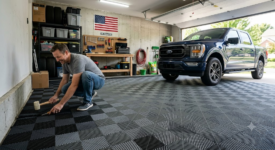
The installation process is refreshingly straightforward. First, you clear the garage and give the concrete a thorough sweeping. There is no need for acid etching, diamond grinding, or complex moisture mitigation systems required by chemical coatings. You simply start at the front center of the garage door lip, ensuring your first row is perfectly straight. From there, it is a simple matter of lining up the pegs and loops and stepping on the seams to lock them together. Many DIYers use a rubber mallet to speed up the process and save their feet, but it isn’t strictly necessary.
As you work your way to the back and side walls, you will eventually need to cut the final row of tiles to fit. For rigid polypropylene tiles, a standard circular saw, table saw, or jigsaw equipped with a fine-toothed plastic-cutting blade will slice through the material like butter. For flexible PVC tiles, a sharp utility knife and a straight edge are all you need. Two reasonably fit adults can easily floor a standard 400-square-foot garage in a single afternoon. By securing your tiles at a discount and providing your own sweat equity, you can effectively bypass thousands of dollars in contractor fees.
Tackling Climate, Moisture, and Maintenance Challenges
When investing in discount interlocking garage floor tiles, it is vital to select the right profile for your climate. Tiles generally come in two surface styles: solid top and ribbed (or vented) top. Solid top tiles look like traditional flooring and are incredibly easy to sweep. However, if you live in a region that sees heavy snowfall or excessive rain, ribbed tiles are the superior choice.
Vented tiles feature an open-profile design that allows water, melting snow, and road salts to drain through the surface and sit underneath the tile. The substructure of the tile elevates the walking surface above the moisture, keeping your feet and your stored items perfectly dry. Because the tiles are breathable, the ambient air in the garage gradually evaporates the trapped moisture, preventing mold and mildew growth. This makes vented tiles a phenomenal solution for older garages with chronic moisture issues or uneven concrete slabs that tend to puddle.
Maintaining an interlocking floor is incredibly low effort, which preserves the long-term value of your discounted purchase. For daily maintenance, a standard push broom or a leaf blower is highly effective for removing dust and debris. For a deeper clean, especially on solid-top tiles, a damp mop with a mild, non-degreasing soap works wonders. For vented tiles, a wet/dry shop vacuum effortlessly pulls dirt and debris out from beneath the channels. Once or twice a year, you can pull your cars out and hose the entire floor down or use a light pressure washer to keep the colors vibrant and fresh.
Perhaps the greatest advantage of this modular system is its spot-repair capability. If you happen to drop a heavy sledgehammer from a high shelf and physically crack a tile, or if an extremely harsh chemical somehow manages to stain one, you do not have to replace the entire floor. You simply pop out the damaged tile, snap in a replacement from your leftover stock, and the floor is as good as new. This localized repairability drastically reduces the long-term cost of ownership.
Conclusion
Elevating the look, feel, and utility of your garage does not require a massive bankroll. By understanding the functional differences between rigid and flexible materials, timing your purchases to align with major retail sales, and being willing to explore factory seconds or closeout deals, you can easily source discount interlocking garage floor tiles that meet the highest standards of quality. Coupled with the immense savings of a simple weekend DIY installation, modular flooring represents the absolute best value in modern garage renovation. It is an accessible, forgiving, and deeply satisfying home improvement project that turns an overlooked storage space into a premier functional environment.


