
 salehunter.net
 Americans run an average of 300 to 390 loads of laundry per household every single year. While we tend to budget carefully for major grocery staples like meat, dairy, and produce, the cleaning aisle operates as a silent siphon on the family bank account. Among laundry room supplies, fabric softener occupies a unique psychological space: it is technically a luxury rather than a sanitizing necessity, yet the sensory comfort of soft, static-free, signature-scented clothing makes it a non-negotiable staple for millions of homes.
Because brand loyalty runs exceptionally deep in the scent market—once a family falls in love with Downy April Fresh or Gain Original, they rarely switch—retailers mark up liquid conditioners, dryer sheets, and scent booster beads at aggressive margins. However, paying full retail price for fabric care is an avoidable consumer trap. By understanding the distribution cycles of the major consumer packaged goods (CPG) conglomerates, leveraging digital rebate stacks, and timing your purchases to corporate retail planograms, you can routinely secure your preferred fabric softener at a 40% to 70% discount.
The Hidden Economics of Laundry Day
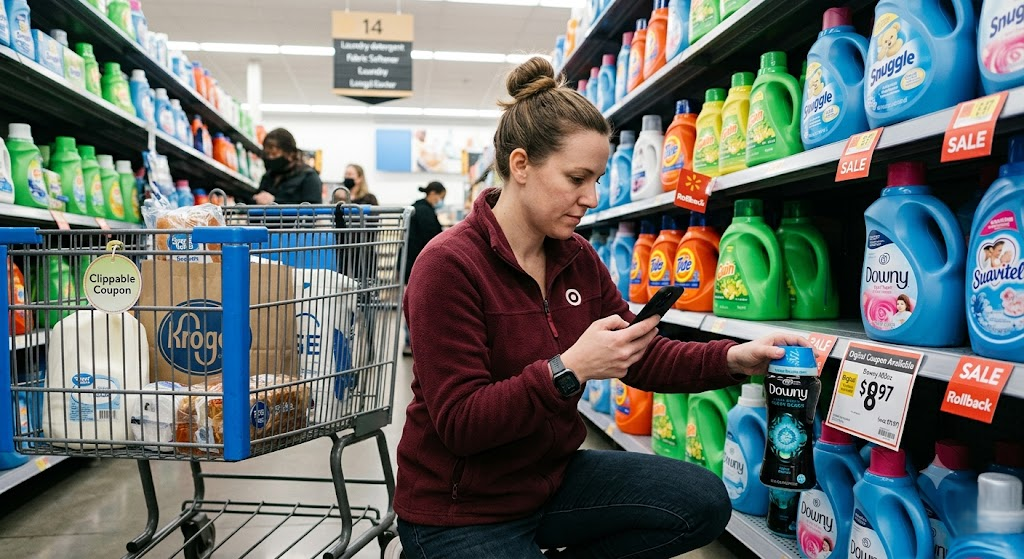
To master the fabric softener discount game, you first have to understand the battlefield. The American fabric care market is essentially a duopoly dominated by Procter & Gamble (Downy, Gain, Bounce) and Henkel (Snuggle, All). Because these corporations spend billions on national advertising campaigns to anchor their scents to your childhood memories, the base MSRP of a 129-ounce jug of premium liquid softener has steadily crept past the $13 to $15 mark.
When you look at a grocery store shelf, you are looking at tiered pricing designed to capture different demographics. The “convenience shopper” grabs the jug at eye level for $14.99. The “bargain hunter” looks down three shelves and grabs a generic store brand. But the “strategic shopper” takes home that exact same $14.99 name-brand jug for $6.50. Achieving this doesn’t require extreme couponing or hoarding ten years’ worth of product in a basement; it requires adopting a cost-per-load mindset and exploiting the promotional overlap between manufacturers and big-box retailers.
Mastering the “Stack”: The Golden Rule of Fabric Care Savings
In the modern US retail ecosystem, single coupons are practically worthless due to inflation. True high-percentage discounting relies on a technique known as stacking. Stacking is the legal, policy-approved practice of applying three distinct layers of promotions to a single item at the point of sale:
- Layer 1: The Store Sale. Waiting until the retailer drops the base price of the item (e.g., a Walmart Rollback or a Kroger Weekly Digital Deal).
- Layer 2: The Manufacturer Coupon (MFR). Applying a paper insert coupon from the Sunday paper or a digital manufacturer coupon clipped inside the store’s app.
- Layer 3: The Post-Purchase Rebate. Scanning your physical receipt into a third-party cash-back smartphone application.
Consider a real-world scenario with a standard 111-ounce bottle of Snuggle Liquid Fabric Softener retailing at $11.49. During a promotional week, Target places the item on sale for $9.99. Inside the Target app, there is a digital $2.00 manufacturer coupon available to clip. After purchasing the item at the register for $7.99 plus tax, you take a photo of your receipt using the Ibotta app, which happens to be running a $2.50 cash-back rebate on that specific bottle size. Your final out-of-pocket net cost drops to $5.49—a 52% discount achieved in roughly forty-five seconds of screen tapping.
Store-by-Store Battle Plan: Where the Real Discounts Hide
Not all retailers treat household chemicals the same way. Depending on where you live in the United States, your shopping strategy should pivot based on the corporate mechanics of the stores near you.
Target: The Gift Card Loophole
Target is widely considered the premier destination for high-end laundry discounts, provided you ignore their base shelf prices. Target rarely offers massive direct price slashes; instead, they rely on Spend $50, Get a $15 Target Gift Card household promotions run through the Target Circle program. These run roughly once every four to six weeks.
The secret to winning at Target is realizing that the $50 threshold is calculated before your manufacturer coupons are deducted. If you place $51 worth of Downy Infusions and Bounce sheets in your cart, clip $8 worth of digital manufacturer coupons in the app, you will pay $43 at the register. The cashier will then hand you a physical $15 gift card for your next trip. When you factor that gift card into the math, your net spend for $51 worth of premium softener was just $28.
Kroger and Affiliates: The Mega Event Advantage
If you shop at Kroger, Ralphs, Fred Meyer, King Soopers, or Harris Teeter, your calendar should revolve around the “Buy 5, Save $5” or “Buy 6, Save $6” Mega Events. During these sales, purchasing any mix-and-match quantity of participating items instantly strips $1.00 off the price of each item at the register.
Because fabric softeners are almost universally included in Mega Events, you can pair that instant $1.00 store drop with a $2.00 digital store coupon. This routinely brings mid-tier brands like Suavitel or standard Snuggle down to the $2.99–$3.49 range per bottle.
Warehouse Clubs: The Unit-Price Reality Check
Costco and Sam’s Club train consumers to assume that “bigger is always cheaper.” While warehouse clubs offer fantastic baseline per-ounce pricing on giant 170-ounce jugs of Ultra Downy, they are actually beaten by traditional grocery store coupon stacking roughly 70% of the time.
You should only buy fabric softener at a warehouse club during their instant-savings coupon books (typically $3.00 to $4.50 off per jug at the register) or during the annual Procter & Gamble Spend $100, Get $25 Costco Shop Card mail-in rebate event.
Hacking Amazon’s Subscribe & Save Algorithm
For those who despise physical shopping, Amazon offers some of the steepest fabric care discounts in the country, but the platform uses algorithmic pricing designed to catch lazy subscribers off-guard. To get a discount on Amazon, you must treat Subscribe & Save as an à la carte ordering tool rather than a set-and-forget subscription.
Amazon regularly attaches “Clip 20% Off Your First Delivery” digital green coupons to select scents of Seventh Generation, Gain, and Downy. To maximize this:
- Opt into Subscribe & Save to bump the baseline discount from 0% to 5% (or 15% if you have five items arriving that month).
- Clip the one-time 20% or $3.00 digital coupon.
- Complete the checkout process.
- As soon as the physical box lands on your front porch, navigate to your Amazon account settings and cancel the subscription. There is no penalty, fee, or account strike for doing this.
If you leave the subscription active, Amazon’s algorithm will automatically bill you the full fluctuating market price on month two, wiping out every cent you saved on the initial order.
The Big Three Rebate Apps You Need on Your Phone
If you aren’t utilizing digital rebate platforms, you are leaving an estimated $150 to $200 on the table annually across your household cleaning purchases. Three specific apps dominate the American laundry segment:
1. Ibotta: The undisputed king of laundry care cash-back. Ibotta frequently partners directly with Henkel and CPG brands to push new product lines. When a brand launches a new product—like Downy Rinse & Refresh or Snuggle Blue Sparkle Booster Beads—Ibotta will often host high-value $3.00 to $4.00 rebates to drive trial usage.
2. Fetch Rewards: Unlike Ibotta, which requires you to manually select offers before shopping, Fetch operates on a passive point-based system. However, Fetch is heavily backed by Unilever and Kimberly-Clark, and frequently offers massive bonus point drops (equivalent to $2.00 or $3.00) simply for purchasing any Suavitel or Snuggle product, regardless of the store you bought it from.
3. P&G Good Everyday: This is Procter & Gamble’s proprietary direct-to-consumer rewards portal. By uploading receipts containing Tide, Downy, Gain, or Bounce, you accumulate points redeemable for gift cards to Starbucks, Dunkin’, or Target. More importantly, the portal houses printable, high-value manufacturer coupons that are not distributed in Sunday newspapers.
The Secret Retail Calendar for Laundry Markdowns
Retail stores do not put items on sale at random; they operate on strict corporate quarterly calendars. If you want to buy fabric softener at absolute rock-bottom prices, mark your calendar for three specific windows:
The Spring Cleaning Push (March 15 – April 30): Retailers allocate massive floor space to cleaning end-caps during early spring. This is when manufacturer coupon inserts hit their highest monetary values of the year.
The Back-to-College Transition (July 25 – August 20): Big-box stores order massive surpluses of laundry detergent, fabric softener, and pop-up hampers to target college freshmen moving into dorms. By the third week of August, stores panic-clear any remaining inventory to make room for Halloween displays. Look for unadvertised yellow clearance stickers on smaller 60-ounce bottles.
The Seasonal Scent Shift (January & September): Brands love releasing limited-edition holiday scents (e.g., “Autumn Berry Spice” or “Winter Frost”). Retail planograms mandate that these items must be completely purged from the shelves by January 10th and September 1st to make room for spring and fall lineups respectively. You can routinely find premium liquid softeners marked down by 75% simply because the plastic bottle has a picture of a snowflake on it.
The Dilution Trap: Reading the Shelf Tags Correctly
A final warning for the savvy consumer: manufacturers have quietly engaged in “shrinkflation” by altering the viscosity and concentration metrics of liquid softeners. A bottle that used to service 60 loads may now be packaged in the exact same physical plastic jug, but labeled for 48 loads.
When comparing discounts across different stores, completely ignore the bold dollar price on the yellow sticker. Look at the microscopic font in the bottom right corner of the shelf tag that reads Price Per Fl. Oz. or Price Per Load. A bottle of generic softener priced at $4.00 might require two full caps per wash, resulting in a real cost of $0.14 per load, whereas an ultra-concentrated name-brand jug bought on a promotional stack for $6.99 might require only half a cap, netting out to $0.07 per load. True discounting is a game of mathematics, not sticker shock.


