 salehunter.net
 There is a unique kind of sticker shock reserved exclusively for outdoor enthusiasts walking into a paddlesports shop for the first time. You run your hand along the sleek, pristine gunwales of a 16-foot Kevlar touring canoe, look down at the dangling price tag, and realize it costs as much as a reliable used sedan. Even standard, entry-level three-layer polyethylene boats have quietly crept well past the four-figure mark in recent years.
But here is the open secret of the American paddling community: almost nobody who understands the industry pays full Manufacturer’s Suggested Retail Price (MSRP) for a brand-new canoe.
Because canoes are massive, cumbersome, and expensive for retailers to store, the market operates on very specific cycles of supply, floor-space panic, and fleet rotation. Whether you are looking for a featherlight composite tripping boat for the Boundary Waters or a rugged whitewater workhorse for Appalachian rivers, securing a serious canoe discount comes down to knowing where to look, when to strike, and which industry loopholes to exploit.
The Paddler’s Calendar: Timing Your Purchase
In the United States, the retail canoe market is rigidly tied to the seasons. If you go canoe shopping on the first sunny Saturday of May, you are going to pay absolute top dollar. To capture a genuine discount, you have to align your wallet with the retail calendar.
1. The Late-Summer Floor Sweep (August to October)
By late August, independent outfitters and big-box outdoor retailers face a logistical nightmare: incoming winter inventory. Skis, snowboards, insulated outerwear, and snowshoes take up massive square footage, and a 17-foot tandem canoe consumes the retail footprint of roughly forty winter jackets.
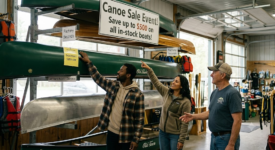
To clear their racks before the autumn freeze, shops will routinely slash in-stock canoe prices by 15% to 30%. This is the single best window to buy a brand-new, A-stock boat. When negotiating during this window, pay attention to floor models. If a boat has been sitting on a lower rack getting brushed against by customers all summer, point out any superficial scuffs on the hull and ask the floor manager for an additional 5% to 10% “open-box” discount.
2. Spring Demo Days (March to April)
As the ice thaws, regional paddlesport shops host weekend “Demo Days” at local lakes and rivers. These events allow prospective buyers to test-paddle various models.
What many buyers don’t realize is that the moment a brand-new canoe touches the water for a 15-minute test paddle, it can no longer legally or ethically be sold as “brand new.” At the end of a Demo Day weekend, outfitters will immediately sell off the weekend’s demo fleet. These boats have typically spent a total of four hours in the water, possess zero structural wear, and are routinely marked down by $200 to $500.

The Livery Fleet Hack: The Best-Kept Secret in USA Paddling
If you want the steepest possible discount on a professional-grade canoe, you need to stop shopping at retail stores and start looking at vacation rental outfitters.
Across the United States, major paddling destinations are anchored by massive rental liveries. Think of the outfitters servicing the Boundary Waters Canoe Area Wilderness (BWCAW) in Minnesota, the Allagash Wilderness Waterway in Maine, the Current River in Missouri, or the Saco River in New Hampshire. These operations purchase fleets of 50 to 200 high-end canoes at commercial wholesale rates.
To keep their rental fleets looking fresh and reliable, these outfitters sell off 30% to 50% of their inventory every single year, usually beginning right after Labor Day.
- The Savings: You can routinely purchase a 1-to-2-year-old Wenonah, Northstar, Old Town, or Nova Craft canoe for 40% to 55% off its original retail price.
- The Reality Check: These boats have been used by tourists. They will have cosmetic “river rash”—fine superficial scratches along the gel coat or Royalex/T-Formex skin from being pulled onto gravel bars.
- The Strategy: Do not wait until September to call them. Call major rental outfitters in May or June and ask to be put on their “Autumn Fleet Sell-Off Contact List.” The most desirable hulls (such as lightweight Kevlar ultra-light layups) are often spoken for via deposit before the summer paddling season even finishes.
Hunting “Factory Seconds” and Blems
Major canoe craftsmen—including premium builders like Esquif, Wenonah, and Sanborn—maintain hyper-strict quality control standards. When a canoe comes out of the mold, it undergoes a meticulous inspection. If a boat exhibits a minor aesthetic imperfection, it is stamped as a “Factory Second” or a “Blem” (blemished) and sold at a deep markdown.
What constitutes a blemish? In 95% of cases, it is entirely imperceptible to the average paddler. It might be a slight discoloration in the resin, a tiny run in the exterior gel coat, a weave pattern in the fiberglass that didn’t set perfectly straight, or a decal that was applied two degrees off-center.
Factory seconds carry the exact same structural warranties as first-run boats, but they leave the factory floor discounted by $300 to $800. Because manufacturers rarely advertise blems on their main websites to protect their brand equity, you have to hunt for them:
- Contact regional authorized dealers and ask specifically: “Do you have any factory blems on your current manifest, or can you request one on your next factory shipment?”
- Check the manufacturer’s social media pages. Smaller boutique builders frequently post “Shop Blem Alerts” on Instagram or Facebook Stories for local pickup.
Leveraging Memberships, Co-ops, and Pro Deals
If you are forced to buy at peak season, standard consumer discounts can be unlocked through affiliation networks.
The REI Co-op Caveat
Recreational Equipment, Inc. (REI) is the largest paddle retailer in the US. Members eagerly await the famous 20%-off member coupons issued in March and November. However, if you read the fine print, hard-shell boats, canoes, and kayaks are almost universally excluded from these 20% coupons due to shipping overhead.
The workaround: Use your membership to buy through the REI Outlet online, where discontinued previous-year canoe colorways are dumped at 20% to 30% off. Furthermore, standard full-price canoe purchases made at REI still qualify for the annual 10% Co-op Member Reward (dividend), effectively giving you a 10% rebate on a $2,000 boat.
Occupational Discounts (GovX and ID.me)
If you are active-duty military, a veteran, a firefighter, law enforcement officer, EMT, nurse, or public school teacher, do not checkout online without checking verification portals. Major conglomerate outdoor brands (such as Old Town’s parent company, Johnson Outdoors) frequently partner with platforms like GovX to offer verified civil servants flat 10% to 15% discounts off canoes and kayaks.
The Hidden Trap: Don’t Let “LTL Freight” Eat Your Discount
Imagine this scenario: You live in Ohio. You spend three weeks scouring the internet and finally find a shop in Vermont offering a gorgeous Royalex canoe discounted by $450. You click “Add to Cart,” proceed to the checkout screen, and watch your jaw hit the desk when the shipping fee populates: $520.
You have just discovered the great filter of the modern canoe market: Less-Than-Truckload (LTL) Freight.
Standard couriers like UPS, FedEx, and USPS cannot physically transport a 16-foot rigid canoe. It must be strapped to a wooden pallet, loaded onto an eighteen-wheeler, and delivered via commercial freight. LTL freight rates have skyrocketed across the United States. A discount found online is completely worthless if the boat has to cross three state lines on a flatbed.
To preserve your discount, practice strict geography rules:
- Utilize “Ship-to-Store”: If buying from a national chain (Bass Pro Shops, Cabela’s, Dick’s Sporting Goods), always select “Free Ship-to-Store.” The company absorbs the freight cost by piggybacking your boat onto their scheduled weekly distribution trucks.
- The Regional Dealer Network: If buying from a brand like Esquif or Wenonah, call your local dealer and ask when their next “factory truck” is arriving. If you order a discounted boat or blem to be placed on their already-scheduled bulk shipment, the dealer will often waive the individual freight fee entirely.
Navigating the Used Market: Inspecting Your “Steal”
The ultimate discount is buying a pre-owned vessel. On Facebook Marketplace, Craigslist, and the classifieds section of Paddling.com, high-end canoes frequently change hands for 50% to 70% below retail. However, a cheap canoe with structural damage is not a discount; it is a disposal project. When evaluating a used boat, apply this three-point inspection:
1. Test for “Oil-Canning”
Flip the canoe upside down and press your palm firmly into the center of the bottom hull. It should feel rigid. If the plastic or composite material buckles inward with a distinct *pop* and stays flexed like a crushed aluminum soda can, the hull has suffered severe hydrodynamic fatigue. It will drag in the water like a parachute. Walk away.
2. Inspect the Gunwale Screws for Cold Cracks
If the canoe is made of Royalex or polyethylene and features wooden gunwales, look closely at the hull right where the screws pass through the wood into the plastic. In northern US states, extreme winter cold causes plastic to shrink faster than wood. If the previous owner didn’t loosen the gunwale screws before winter storage, the tension will create vertical “cold cracks” running down the hull.
3. Check for UV Degradation
Plastic canoes left unprotected in the sun lose their plasticizers over time. If a brightly colored boat (like red or dark green) has faded to a chalky, pastel shade, scrape your fingernail gently against the deck. If fine plastic powder peels off, the polymer has photo-degraded. The boat will be brittle and liable to shatter upon impact with a river boulder.
The Accessory Bundle Pivot
Sometimes, an independent shop owner simply cannot move on the baseline price of a canoe. Their wholesale margins on boats are surprisingly slim—often hovering around 20% to 25%.
If the salesperson tells you, “I’m sorry, $2,100 is the absolute lowest I can go on this hull,” pivot your negotiation to the high-margin items. Say this:
“I understand you have to protect your margin on the boat. If I pay the $2,100 sticker price today, will you throw in two Bending Branches wooden paddles and a pair of NRS life vests at 40% off?”
Retail markups on paddles, PFDs (Personal Flotation Devices), foam car-topping blocks, and dry bags sit between 45% and 60%. The shop owner can easily grant you a massive discount on the gear to secure the big-ticket boat sale. You still walk out the door keeping $150 to $200 in your pocket—you just saved it on the mandatory accessories rather than the fiberglass.