 salehunter.net
 Absorbent Glass Mat (AGM) batteries are the undisputed heavyweights of the modern energy storage and automotive world. Whether you are outfitting a rugged overlanding rig, powering a marine vessel for a weekend on the lake, setting up an off-grid solar cabin, or simply ensuring your daily commuter starts flawlessly on a freezing January morning, AGM technology is the gold standard. However, that superior performance, deep-cycling capability, and vibration resistance come with a notoriously hefty price tag. Finding a legitimate AGM battery discount is a top priority for savvy consumers who want premium reliability without entirely draining their wallets. Navigating the battery market requires a bit of insider knowledge, timing, and an understanding of how automotive retail actually works in the United States.
Understanding the Premium Price Tag
Before you can effectively hunt for a discount, it helps to understand why you are paying a premium in the first place. Unlike traditional flooded lead-acid batteries, AGM batteries utilize ultra-thin fiberglass mats sandwiched between the lead plates. These mats are saturated with battery acid, meaning there is no free-flowing liquid inside the casing. This design makes the battery virtually spill-proof, incredibly resistant to the harsh vibrations of off-roading or marine wave impacts, and capable of being mounted in almost any orientation. Furthermore, AGM batteries boast incredibly low internal resistance. This allows them to deliver massive bursts of starting amps and recharge up to five times faster than their flooded counterparts.
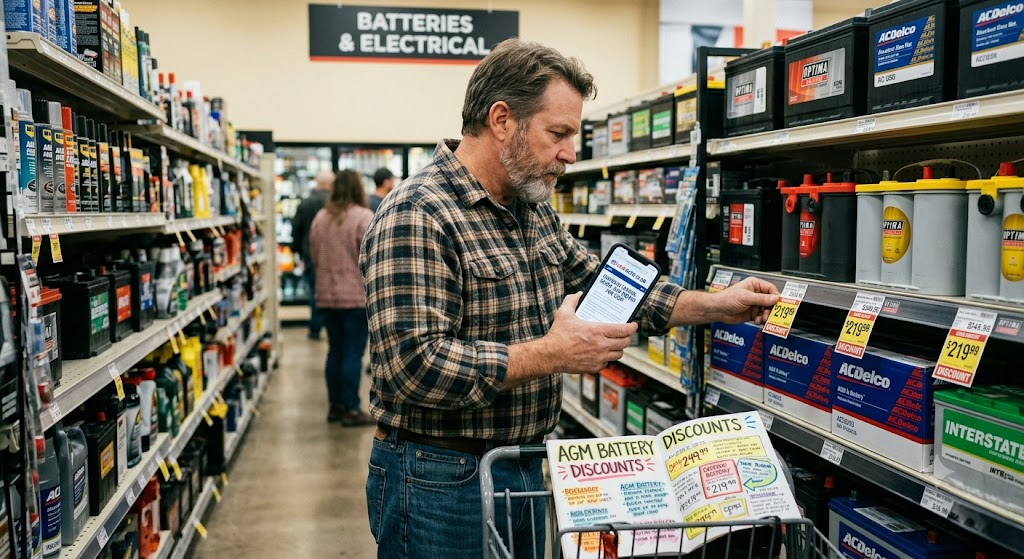
Because the manufacturing process requires higher purity lead, specialized fiberglass materials, and heavily reinforced cases to handle internal pressure, the baseline cost is naturally higher. When you are looking for an AGM battery discount, you are not trying to find a “cheap” battery; you are looking for strategies to bring the cost of a premium, tier-one product down to a manageable level.
The Secret of the Manufacturing Matrix
One of the best-kept secrets in the American battery market is that there are only a handful of actual battery manufacturers in the country, despite there being dozens of brands. The vast majority of automotive and marine AGM batteries sold in the USA are manufactured by companies like Clarios (formerly Johnson Controls), East Penn Manufacturing (Deka), and Stryten Energy (formerly Exide).
Why does this matter for your wallet? Because a highly marketed, heavily branded AGM battery sold at a premium auto parts store might roll off the exact same assembly line as a cheaper, store-brand battery sold at a warehouse club. Recognizing these manufacturing parallels is your first major discount hack. You do not always need to wait for a sale; sometimes, simply choosing the less-marketed label yields an immediate 20% to 30% discount for identical internal chemistry and performance.
Warehouse Clubs: The Permanent Discount
If you have a membership to warehouse clubs like Costco or Sam’s Club, you already have access to some of the best year-round AGM battery discounts available. These retailers operate on high volume and low margins, passing the savings directly to the consumer.
- Costco: Costco typically stocks Interstate-branded batteries. Their Interstate AGM lineup is heavily subsidized by Costco’s purchasing power. An Interstate AGM that costs well over $250 at a dedicated battery shop or auto parts store can frequently be found at Costco for $170 to $190.
- Sam’s Club: Sam’s Club is famous for carrying Duracell-branded AGM batteries. These are generally manufactured by East Penn (Deka), which is widely considered one of the highest-quality lead-acid manufacturers in North America. Their Group 31 marine AGM batteries are a legendary bargain among boaters and solar enthusiasts.
Strategic Timing: When to Buy
Like almost all consumer goods, automotive and deep-cycle batteries follow retail seasons. If your battery hasn’t completely died and you have the luxury of planning ahead, timing your purchase can unlock massive savings.
Spring Pre-Season Sales: April and May are massive months for marine and RV preparation. Retailers know consumers are pulling their boats and campers out of storage and discovering dead batteries. Look for “Buy One, Get One 50% Off” deals or heavy flat-rate discounts on deep-cycle AGM batteries at marine supply stores and outdoor retailers.
Pre-Winter Auto Promotions: October and November mark the time when people realize their aging car battery won’t survive the upcoming winter freezes. Major auto parts chains frequently run mail-in rebates or instant gift card promotions (e.g., “Buy an AGM battery, get a $50 store gift card”) during the late fall.
Black Friday and Cyber Monday: Yes, even batteries go on sale during the biggest shopping weekend of the year. Direct-to-consumer premium brands, such as Optima Batteries or Odyssey, frequently offer 15% to 25% off their entire inventory, often with free heavy-freight shipping included.
The “Buy Online, Pick Up In-Store” (BOPIS) Hack
If you need an AGM battery today and cannot wait for shipping or a seasonal sale, the “Buy Online, Pick Up In-Store” method is your best friend. Major American automotive retailers like Advance Auto Parts, AutoZone, and O’Reilly Auto Parts run aggressive online-only promotional codes to compete with massive e-commerce giants like Amazon.
It is incredibly common to find banner ads on their websites offering “20% off your order of $100 or more.” If you walk directly into the store and ask the cashier for a battery, you will pay full retail price. However, if you sit in the parking lot, order the AGM battery on your smartphone using the 20% off promo code, and select in-store pickup, you can walk inside five minutes later and claim your heavily discounted battery. On a $250 AGM battery, a simple promo code instantly saves you $50.
Leveraging the Core Charge
In the United States, almost every battery purchase includes a “core charge.” This is a deposit (usually ranging from $15 to $25) that is added to your bill to encourage you to recycle your old lead-acid battery. When you bring your old battery back, you get that money refunded.
However, you can leverage scrap logic to your advantage. If you are building a solar bank or a dual-battery setup for an overlanding vehicle, you might not have an “old” battery to trade in, meaning you are forced to swallow that extra $25 core fee. To avoid this, visit a local scrapyard, a friendly local mechanic, or even check local classifieds for completely dead, worthless junk batteries. You can often pick these up for $5 or even for free. Trade that junk battery in at the auto parts store to instantly waive the $25 core charge on your expensive new AGM unit, netting yourself a quick, easy discount.
Factory Blems and Open-Box Deals
For those who are truly hunting for the absolute lowest price and don’t care about aesthetics, “factory blems” (blemished batteries) are the holy grail of AGM battery discounts. During the manufacturing and shipping process, the heavy plastic casings of batteries often get scuffed, scratched, or the stickers get torn.
These cosmetic imperfections mean the battery cannot be sold as “new” at full retail price, even though the internal chemistry and performance are 100% flawless. Local, independent battery distributors and specialty battery shops frequently buy pallets of these blemished batteries and sell them to consumers at a steep discount, often up to 40% off retail. You still get a warranty, you still get brand-new AGM power, but you pay a fraction of the cost simply because the sticker is peeling. Always call your local specialty battery shops (like Batteries Plus or local independent industrial battery suppliers) and ask if they have any “blems” in your required group size.
Avoiding the Fake Discount Trap: Check the Date Codes
As you hunt for bargains, you must be vigilant to ensure your “discount” isn’t actually a trap. Lead-acid batteries, even high-quality AGMs, naturally self-discharge over time. If a battery sits on a retail shelf for two years without being float-charged, its total lifespan and capacity will be permanently diminished due to a process called sulfation.
Some shady retailers or deep-discount online sellers will heavily mark down AGM batteries simply because they are old stock that needs to be cleared out. Buying a heavily discounted, half-sulfated battery will end up costing you more in the long run when it fails prematurely.
Always read the alphanumeric date code stamped on the casing or a sticker on the battery before you buy it. The format is usually a letter indicating the month (A = January, B = February, C = March, etc.) followed by a number indicating the year (3 = 2023, 4 = 2024, 5 = 2025). For example, a battery stamped with “D24” was manufactured in April 2024. As a general rule, never buy an AGM battery that is more than six months old, no matter how steep the discount is, unless the seller can prove it has been actively maintained on a smart charger.
Navigating Manufacturer Rebates
Finally, do not ignore the power of the classic mail-in rebate. While they require a bit of paperwork, premium brands use them heavily to preserve their “luxury” brand image while still offering competitive pricing. Premium brands like Optima will occasionally offer $25 to $50 factory rebates during peak automotive seasons. Bookmark the rebate pages of major manufacturers and check them before making a major purchase. Pairing a manufacturer rebate with a retailer’s sale price is the ultimate stacking strategy for scoring an unbeatable AGM battery discount.
Securing a fantastic price on an AGM battery doesn’t require luck; it requires strategy. By understanding manufacturing origins, utilizing warehouse club memberships, timing the seasonal market, leveraging online promo codes for local pickup, and knowing how to read date codes, you can secure reliable, long-lasting AGM power for a fraction of the sticker price.