
 salehunter.net
 Keeping up with a routine manicure in the United States has officially crossed the threshold from a simple afternoon errand into a legitimate personal budget category. With the average cost of a standard gel manicure hovering between $40 and $55—and intricate Russian manicures, Apres Gel-X extensions, or custom nail art easily pushing past the $100 mark—maintaining pristine fingertips every two to three weeks can quietly drain hundreds of dollars from your disposable income each month.
Yet, giving up the ritual feels non-negotiable for many. Beyond the aesthetic polish, regular nail care is an anchor of personal grooming, professional presentation, and mental self-care. The secret to bridging the gap between high-end aesthetic goals and strict household budgets is not settling for low-quality strip-mall shops; it is understanding the economics of the beauty industry. Finding a reliable nail salon discount is less about extreme couponing and more about strategic booking, timing, and consumer psychology.
The Economics of the Empty Chair: Why Salons Offer Deals
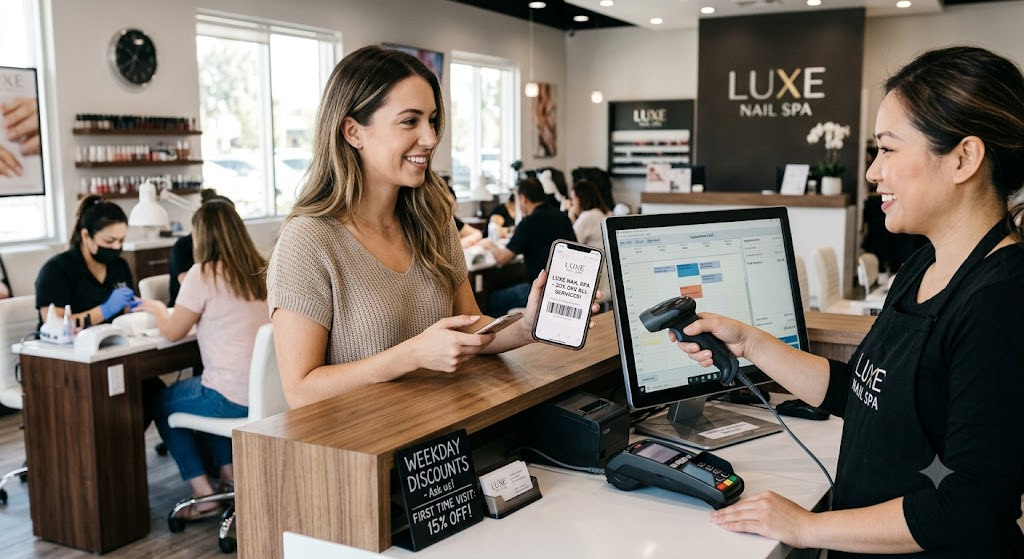
To successfully score bargains without offending your technician or receiving a rushed job, you first have to understand how nail salons operate. Unlike traditional retail stores that slash prices to clear out physical, depreciating inventory, a salon’s primary inventory is time. When a nail technician sits at an empty station at 10:30 AM on a Tuesday, that hour is gone forever. The salon cannot box up that unbought hour, set it on a shelf, and sell it to a walk-in client on Saturday afternoon.
Therefore, legitimate nail salon discounts are almost always engineered to solve a specific business problem: filling dead air. When a salon owner publishes a promotion, they are not devaluing their artistry; they are attempting to monetize a time slot that would otherwise generate zero revenue. Approaching discounts with this mindset transforms you from a penny-pincher into a valued client helping a local business optimize its daily schedule.
Timing is Everything: The Golden Hours of Discount Booking
If you are trying to find a discounted appointment at 5:30 PM on a Friday or 11:00 AM on a Saturday, you are fighting an uphill battle against peak market demand. Instead, pivot your personal schedule to target the beauty industry’s natural valleys.
- The Mid-Week Morning Slump: Tuesdays and Wednesdays between 9:30 AM and 1:30 PM represent the lowest foot-traffic volume for American nail salons. Many independent shops and mid-sized regional chains quietly run “Happy Hour” specials during these windows, offering 10% to 20% off standard services just to keep the energy in the room alive.
- The Post-Holiday Lull: The second and third weeks of January, as well as the immediate fourteen days following the Fourth of July and Labor Day, are notoriously slow across the country. Consumer discretionary spending tightens sharply right after major holidays. Savvy salon managers push aggressive digital flash sales during these exact windows to make payroll.
- The Rainy Day Walk-In: Severe weather is a salon’s worst enemy. When a torrential downpour or unexpected snowstorm hits a metro area, same-day cancellations skyrocket. If you live close to a reputable salon and the weather turns nasty, call their front desk an hour before you want to go in. Ask point-blank: “I know the weather is keeping people inside today; do you happen to have any same-day walk-in specials for a gel manicure?” More often than not, a manager eager to recoup lost daily revenue will authorize an impromptu discount on the spot.
The Untapped Goldmine of Cosmetology Academies
One of the most heavily underutilized routes to a steep discount is booking your service at an accredited cosmetology academy or nail technician school. Major national institute networks, alongside regional state-licensed academies, constantly require live models for their students to earn their legally mandated practical floor hours.
Because these establishments are educational facilities first and businesses second, their service menus are priced strictly to cover the cost of the raw chemical products. You can routinely secure a spa pedicure, a structured builder-gel manicure, or a full set of acrylics for 50% to 70% less than standard market rates.
Navigating a beauty school, however, requires a very specific consumer strategy. First, always request a senior student or a “floor-ready” near-graduate. These students have already completed months of theory and mannequin practice and are merely refining their speed and client bedside manner before taking their state board licensing exams. Second, adjust your time expectations. A manicure that takes 45 minutes at a standard salon will likely take 75 to 90 minutes at an academy because a licensed master instructor must physically inspect the student’s work at three distinct milestones: cuticle prep, base application, and final topcoat finish.
Digital Sleuthing: Algorithms, Apps, and Social Flash Sales
The era of clipping physical paper coupons out of the local Sunday circular is largely dead. Today’s most lucrative nail salon discounts live inside localized digital ecosystems.
The Instagram Story Watch: Independent nail artists and booth-renters rely heavily on Instagram to manage their books. When a regular client cancels a 3:00 PM slot at 11:00 AM, the artist will almost immediately post an Instagram Story: “Last minute opening today at 3 PM! DM to claim for 20% off.” If you follow five to ten talented nail artists in your specific zip code, turn on their individual Story notifications. You will catch these flash-discounts hours before they get absorbed.
The Booking App Loophole: Major salon scheduling platforms widely used across the U.S.—including Vagaro, Booksy, and GlossGenius—frequently subsidize promotional codes to incentivize consumers to book through their software rather than calling the shop directly. Search within these apps using built-in filters for “New Client Promo.” Additionally, many brick-and-mortar salons offer an automated $5 to $15 discount applied to your first appointment strictly for downloading their proprietary branded booking app.
Navigating the Groupon Minefield: Third-party voucher sites offer undeniable bargains, but they require extreme vetting. High-end salons typically use Groupon for one specific reason: a brand-new location is opening and desperately needs to build an initial customer database. Before buying a voucher, check the salon’s standard Google Reviews page and type “Groupon” into the search filter. If past voucher-buyers note that they were treated indifferently, given the least experienced tech, or subjected to relentless hard-selling for upgrades, skip it. A cheap manicure is never a bargain if the technician damages your natural nail plate out of resentment for a discounted payout.
The Math Behind Loyalty Programs and Pre-Paid Bundles
If you are a creature of habit who visits the exact same establishment every two to three weeks, hunting for one-off promotional codes is actually working against your wallet. Your best financial strategy is long-term yield optimization.
- The Guaranteed Calendar Discount: Speak directly to the salon owner or lead manager. Offer to book your appointments six months out on a strict, recurring bi-weekly schedule. In the independent salon world, guaranteed future cash flow is king. You can frequently negotiate a locked-in 10% standing discount simply by committing to be a reliable, non-canceling fixture on their ledger.
- The Bulk Package Purchase: Inquire if the front desk sells “Series Cards.” Many shops will happily sell a bundle of six gel manicures upfront for the price of five. Mathematically, this yields an instant 16.6% discount across the board. Always ask for the written terms regarding expiration dates; a fair industry standard allows a full 12 months to redeem a six-pack.
- The High-ROI Referral: Client acquisition costs in the personal care sector are remarkably high. When you find a technician whose retention and shaping you love, ask them: “Do you run a personal referral program?” Many independent operators will gladly credit your account $10 or $15 for every new paying client who cites your name at checkout. Refer four coworkers over six months, and one of your routine maintenance visits is entirely subsidized.
The Unspoken Etiquette of the Discounted Client
When you sit down at a manicure table with a promo code or digital voucher in hand, your personal conduct dictates whether that salon will ever want to extend a courtesy to you again. There is one sacred, non-negotiable rule of the American beauty service industry:
Always calculate your tip based on the original, non-discounted menu price.
If a salon runs a seasonal special dropping a $65 spa pedicure down to $45, the technician did not perform 30% less physical labor on your feet. In standard commission-split salons, the business entity absorbs part of the promotional hit, but the individual technician’s take-home pay shrinks proportionally. Tipping 20% on the original $65 value ($13) rather than the discounted $45 value ($9) preserves your relationship with the artisan. Technicians remember poor tippers instantly; they remember gracious, empathetic clients forever. A discounted client who tips fairly on the true value of the labor is routinely rewarded with “off-the-books” loyalty perks down the line—an unbilled broken nail repair, a free layer of structural builder gel, or a complimentary scented paraffin wax dip.
Red Flags: When a Discount is Actually a Warning Sign
There is a vast gulf between a discounted salon experience and a fundamentally cheap salon. True consumer savvy requires protecting your dermatological health. If you observe an establishment advertising standard baseline prices that seem wildly disconnected from the rest of your city’s market average, look for three distinct warning signs:
- The MMA Acrylic Trap: Liquid Methyl Methacrylate (MMA) is a bonding monomer strictly banned for use in nail salons by the FDA and nearly all state cosmetology boards. It causes severe contact dermatitis, permanent allergic sensitization, and adheres so rigidly to the natural nail plate that if the enhancement catches on a door handle, it can rip the natural nail bed completely off the bone. However, MMA costs roughly one-third the price of safe, legal Ethyl Methacrylate (EMA). If an acrylic full-set discount seems impossibly cheap, smell the air: MMA has an unmistakably sharp, pungent, sweet-fruity odor that stings the nostrils, whereas safe EMA smells faintly of standard acrylic. Furthermore, if a technician has to soak your nails in pure acetone for over an hour and aggressively pry the product off with a metal tip to get it to budge, they used MMA.
- Sanitation Shortcuts: Medical-grade autoclaves—the specialized steam-sterilization units required to properly sanitize metal nippers and pushers—are expensive to purchase and draw significant electricity. Hyper-cheap salons frequently bypass true sterilization, opting instead to quickly rinse tools in tap water or dunk them in overused blue disinfectant solution. Observe the abrasive tools: emery boards, buffer blocks, and arbor sanding bands are porous and legally classified as single-use items. If your technician pulls a grey, heavily scuffed file out of a dusty desk drawer to shape your nails, stop the service immediately.
- The Bait-and-Switch Menu: Be highly skeptical of hyper-low advertised base rates (e.g., “$18 Gel Manicure”). Once you are seated and prepped, these establishments frequently deploy predatory add-on pricing: $5 for basic cuticle pushing, $5 for shaping anything other than a basic square, $10 to soak off your existing gel, and $3 for a quick-dry topcoat. By the time you reach the register, your “$18 bargain” totals $41. Always establish the exact, all-inclusive “out-the-door” price before a technician applies the first drop of product to your hands.
Securing an exceptional nail salon discount does not require surrendering your standards to questionable strip-mall operators. By aligning your booking habits with the natural scheduling ebbs of the salon world, leveraging digital software incentives, exploring educational cosmetology floor hours, and practicing flawless tipping etiquette, you can easily shave 15% to 30% off your annual beauty expenditure. Be deliberate with your calendar, respect the physical labor of the technician, and keep your eyes vigilant for the telltale signs of compromised sanitation. Both your household budget and your natural nail beds will thrive.