
 salehunter.net
 There is a standing joke in American culture about the length of CVS receipts. You buy a single pack of gum, and suddenly you are holding a paper scroll that rivals the height of a toddler. But for the initiated—the savvy shoppers who treat frugality as a competitive sport—that mile-long slip of paper isn’t waste; it is currency. It is the physical manifestation of the CVS promo code ecosystem, a complex but incredibly rewarding landscape that goes far beyond a simple “10% off” sticker.
In the current economic climate, where inflation has touched everything from toothpaste to ibuprofen, mastering the art of the drug store run is no longer just a hobby for extreme couponers; it is a necessary survival skill for the average household. CVS, unlike many big-box retailers that offer flat, uninspiring discounts, operates a gamified rewards system. It requires a bit of learning, but once you understand how to layer a CVS promo code with manufacturer coupons, ExtraBucks, and store-specific threshold rewards, you unlock a level of savings that feels almost like a glitch in the matrix.
This deep dive isn’t just about finding a code to paste into a checkout box. It is about understanding the architecture of CVS savings so you never pay full price for essentials again.
The Digital Pivot: Why the App is Your New Best Friend
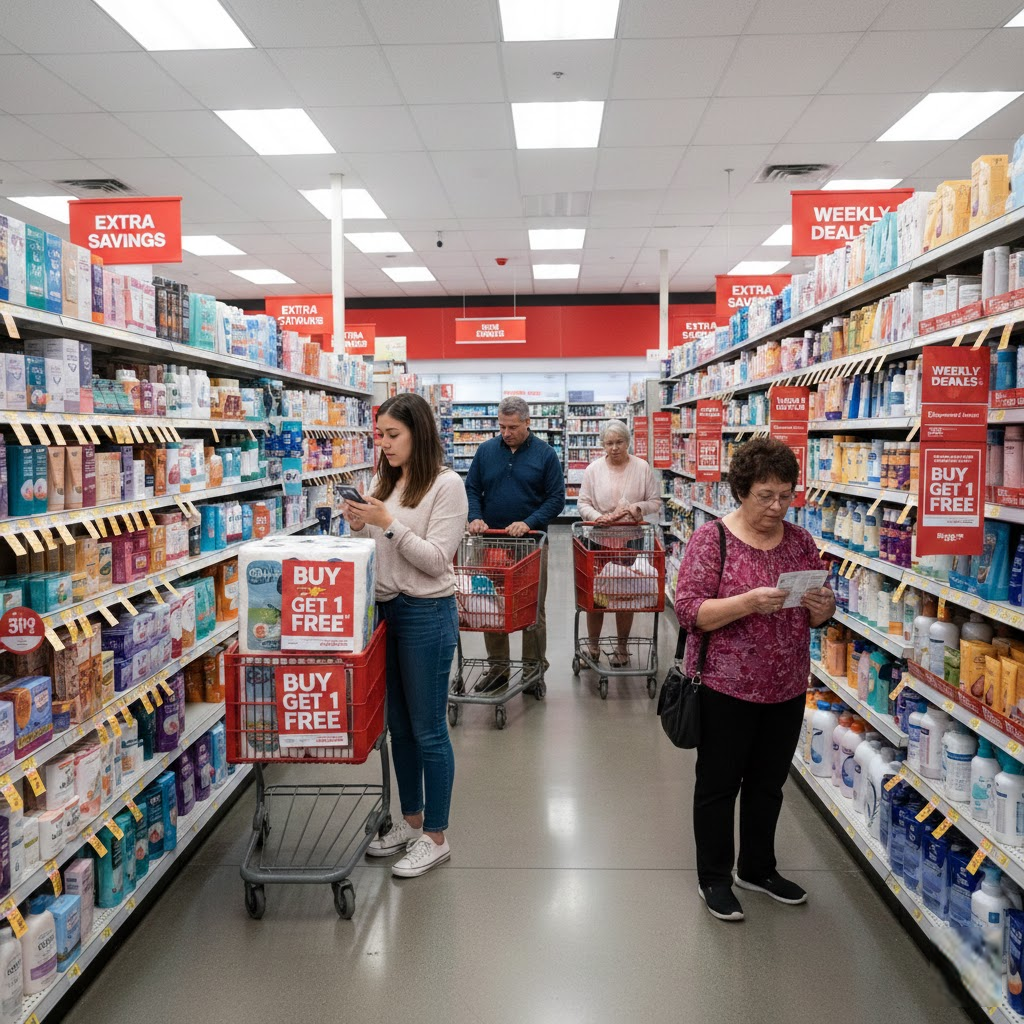
For years, the “Red Box”—that crimson kiosk standing like a sentry at the front of every CVS store—was the hub of all savings. You scanned your card, and it spit out coupons. While the kiosk still exists, the real power has migrated to your pocket. If you are hunting for a CVS promo code and you do not have the CVS Pharmacy app installed, you are fighting with one hand tied behind your back.
The app is where the “stacking” magic happens. This is where you link your ExtraCare card to digital offers. One of the most common mistakes shoppers make is assuming that promo codes found on third-party websites are the only way to save. Often, the best codes are “Clip-to-Card” offers exclusive to the app user. For instance, CVS frequently pushes “Just for You” deals based on your purchase history. If you buy diapers regularly, the algorithm knows. Suddenly, a “40% off one item” promo appears in your dashboard. This is not a generic code shared on the internet; it is a unique digital token generated specifically to keep your business.
Furthermore, the app allows for the seamless integration of Manufacturer Coupons. In the old days, you had to clip paper squares from the Sunday newspaper. Now, companies like Procter & Gamble or L’Oréal push digital coupons directly to the CVS platform. When you apply a site-wide CVS promo code (like the frequent SAVE20 or PICKUP20) at checkout, the system automatically checks your clipped manufacturer coupons. If you have “stacked” them correctly, you receive the percentage off and the dollar-off manufacturer deduction.
Deconstructing the “BOPIS” Strategy
One of the most reliable ways to trigger a working CVS promo code is to utilize the BOPIS method: Buy Online, Pick Up In-Store. Retailers love this model because it saves them shipping costs and gets foot traffic into the store. Consequently, CVS incentivizes it heavily.
It is very common to see codes specifically tailored for pickup orders. Codes like CVSPICKUP20 or simply PICKUP often grant a 20% discount on orders that are placed through the website or app but collected locally. This is a massive advantage over shopping in the aisles with a physical cart. If you walk in and grab a bottle of shampoo, you pay the shelf price unless it’s on sale. If you stand in the parking lot, order that same bottle on your phone using a pickup promo code, and wait ten minutes, you save 20%. It is the exact same product, from the exact same shelf, sold to you at a significantly lower price simply because you changed the transaction method.
Moreover, online pricing at CVS can sometimes differ from in-store pricing. While not always the case, web exclusives are real. By shopping online for pickup, you gain access to the full repository of digital codes that a cashier cannot manually enter at a register.
The Hierarchy of Promo Codes
Not all promo codes are created equal. To maximize value, you need to understand the different “species” of discounts you will encounter in the CVS wild.
1. The Percentage-Off Code
These are the heavy hitters. Common examples include SAVE30 (save 30% on your order) or 20OFF. These usually come with a cap (e.g., “up to $20 in savings”) and invariably have exclusions. You generally cannot use these on sale items. This is a crucial distinction. If a vitamin brand is “Buy One Get One Free,” the percentage-off code will likely not apply to it. These codes are best used on full-priced, high-ticket items like premium skincare, electrical beauty tools, or medical devices.
2. The Threshold Code
These codes require a minimum spend, such as “Save $10 on orders of $60+.” These are mathematically superior to percentage-off codes when buying items that are already on sale. Since percentage codes rarely work on sale items, threshold codes are the workaround. If you have a cart full of discounted snacks and BOGO vitamins, a threshold promo code like SAVE10 will usually still apply to the total dollar amount, regardless of the individual item discounts.
3. The Category Exclusive
CVS is famous for segmenting its audience. You will frequently see codes like BEAUTY20 or VITAMIN25. These are often released around seasonal shifts—allergy season brings antihistamine codes; summer brings suncare codes. A savvy shopper anticipates these. Don’t buy sunscreen in October; buy it in May when the category codes go live.
ExtraCare Plus: The Subscription Math
In the age of “subscription fatigue,” where every service wants a monthly fee, it is natural to be skeptical of the ExtraCare Plus (formerly CarePass) program. However, for anyone hunting for a CVS promo code, this program is less of a subscription and more of a math equation that solves itself in your favor.
The premise is simple: You pay $5 a month (or $48 a year), and CVS gives you a $10 monthly promo reward. This is not a point system where you have to earn it; it is an automatic deposit. If you shop at CVS at least once a month, you are essentially paying $5 to get $10. It is an immediate 100% return on investment. The $10 reward acts like a universal promo code—it applies to almost anything in the store.
But the real perk for the promo hunter is the “Free Shipping” benefit and the “20% off CVS Health Brand products.” The 20% discount is hard-coded into your account. When you combine this automatic 20% off with a manufacturer coupon and perhaps a site-wide promo code during a sale event, the price of generic health essentials (pain relief, bandages, vitamins) drops to rock bottom levels. It effectively turns CVS into a wholesaler for your medicine cabinet.
The Art of “Rolling” ExtraBucks
You cannot discuss CVS promo codes without discussing the engine that drives the entire system: ExtraBucks. While technically “rewards currency,” seasoned shoppers treat ExtraBucks exactly like promo codes.
The strategy is called “rolling.” Here is how it works:
Week 1: You see a deal that says, “Buy 2 Toothpastes, Get $5 ExtraBucks.” You use a digital coupon to lower the price of the toothpaste, pay the balance, and receive the $5 reward.
Week 2: You need laundry detergent. There is a deal: “Spend $20 on Detergent, Get $5 ExtraBucks.” You use the $5 ExtraBucks from Week 1 as a promo code to pay for the detergent. You pay less out of pocket, and you trigger the new $5 reward.
Week 3: You use the Week 2 reward for the next deal.
By rolling rewards, you are never actually spending “new” money. You are simply recycling the same $5 or $10 of store credit over and over again. When you combine this rolling technique with an actual promo code (like a SHIP30 for free shipping), your out-of-pocket cost for household goods can drop by 70-90% compared to grocery store prices.
Navigating Exclusions and The Fine Print
Nothing deflates the excitement of a shopping spree faster than the dreaded “Promo Code Not Applied” error message. CVS is generous, but they are strict about their boundaries. Understanding the “Red Tape” is essential.
The “Sale” Trap: As mentioned, sitewide percentage codes (e.g., SAVE25) almost never apply to items that are on a “Buy One, Get One” promotion. If you are trying to maximize a 25% off code, ensure your cart is filled with full-priced items. If you mix them, the code will only deduct from the eligible full-priced items, often resulting in a smaller discount than you anticipated.
The Alcohol and Prescription Barrier: In the United States, laws strictly regulate discounts on alcohol and prescription medications. You will never find a CVS promo code that legally reduces your co-pay or discounts a bottle of wine. However, you can earn rewards on prescriptions (10 credits for filling a script, 3 credits for a refill) which convert to ExtraBucks, which can then be used to buy merchandise. You are essentially using your pharmacy needs to subsidize your shampoo budget.
Expiration Anxiety: CVS promo codes are notoriously ephemeral. A “Flash Sale” code often lasts only 24 to 48 hours. The digital coupons you clip to your card also have hard deadlines. A pro tip is to check the app every Sunday morning. This is when the new weekly ad cycle begins, and it is usually when the freshest batch of manufacturer coupons and store codes are uploaded to the system.
The Psychological Edge: Why We Coupon
Why go through all this trouble? Why not just pay the sticker price? Beyond the obvious financial benefit, there is a psychological component to hunting for the perfect CVS promo code. It is a reclaiming of control. In an era of algorithmic pricing and fluctuating inflation, the price on the shelf feels arbitrary. By applying a code, you are rejecting the assigned value and negotiating your own terms.
There is a genuine dopamine hit when you watch the total on the digital register plummet. You see the subtotal: $85.00. Then, the codes hit. The manufacturer coupons knock off $15. The store promo code slashes another 20%. Your ExtraBucks wipe out another $10. The final total: $32.50. That feeling of “beating the house” is addictive.
Advanced Stacking: A Real-World Scenario
Let’s walk through a theoretical but highly realistic “perfect transaction” to visualize how these elements coalesce.
Imagine you need facial moisturizer (Retail: $25), shampoo (Retail: $8), and paper towels (Retail: $12). Total: $45.
1. Check the App: You see a manufacturer coupon for the moisturizer ($3 off) and the shampoo ($2 off). You clip them.
2. Check for Promo Codes: CVS is running a “Buy Online, Pick Up In-Store” promotion. The code is PICKUP20 for 20% off pickup orders.
3. Check Your Rewards: You have $5 in ExtraBucks from a previous week.
4. The Stack:
* The system first applies the manufacturer coupons: $45 – $5 = $40.
* The 20% promo code applies to the subtotal: 20% off $40 is an $8 discount. New total: $32.
* You apply your $5 ExtraBucks. Final toal: $27.
You just turned a $45 purchase into a $27 purchase, simply by spending three minutes on your phone before driving to the store. Furthermore, that purchase of $27 likely triggered 2% back in rewards earnings and perhaps hit a spending threshold for a Beauty Club reward (spend $30 on beauty, get $3 ExtraBucks), setting you up for the next trip.
The “Silent” Savings: Email and Text Alerts
If you are serious about promo codes, you must surrender a bit of your digital privacy. CVS runs separate marketing campaigns via email and SMS. The SMS channel is particularly potent. Often, you will receive a random text message on a Thursday with a “Mystery Offer.” You click the link, and it reveals a unique, one-time-use CVS promo code, often ranging from 30% to 40% off a single item.
These codes are not indexed on coupon websites because they are generated specifically for your phone number. They are the “silent” savings that only subscribers see. If you are wary of spam, set up a dedicated email address just for shopping rewards, but do not opt out of the texts—that is where the aggressive “flash” offers usually live.
Conclusion: The Lifestyle of the Saved Dollar
Navigating the world of CVS promo codes is a microcosm of modern consumerism. It rewards attention, patience, and a bit of strategy. The days of simply walking in, grabbing items, and paying what is asked are over for those who value their hard-earned money. By leveraging the app, understanding the distinction between percentage and threshold codes, utilizing BOPIS, and mastering the flow of ExtraBucks, you transform a mundane errand into a victory.
The next time you see someone walking out of CVS with a receipt that trails behind them like a wedding train, don’t laugh. That receipt is a scorecard. It is proof that they played the game, used the codes, and won. With the right strategy, your next receipt can be just as long—and your bank account will thank you for it.