
 salehunter.net
 There is a very specific, quiet thrill that comes with turning over a sleek, matte-black compact from a luxury brand and seeing a bright yellow sticker that reads $14.99 instead of $38.00. In the hyper-fast world of American beauty retail, the cheek category has exploded. We have officially moved past the single, dusty-rose pressed powder our mothers kept at the bottom of their purses; today, American consumers navigate a labyrinth of liquid serums, bouncy putty creams, baked jellies, and finely milled micro-powders.
However, trying to keep up with every seasonal shift or viral social media trend can rapidly drain a bank account. This is where the strategic art of shopping the blush clearance section comes into play.
For decades, shoppers viewed the clearance rack as the retail graveyard—the place where expired, broken, or universally unflattering cosmetics went to gather dust. Today, that couldn’t be further from the truth. Thanks to rapid corporate rebranding cycles and hyper-short social media trend lifespans, some of the highest-quality cheek formulas in the world routinely get slashed by 50% to 75%. If you understand retail distribution psychology, know how to test for formula degradation, and master a few basic color-theory hacks, you can build a prestige makeup vanity for pennies on the dollar.

The Economics of the Markdown: Why Good Blush Gets Dumped
To shop clearance effectively, you first have to dismantle the assumption that a discounted product is a defective product. In roughly nine out of ten instances, the formula sitting inside a clearance compact is identical to the one sitting on the full-price display three feet away. Retail giants mark down blush inventory for four primary corporate reasons:
- The “Clean Beauty” Reformulation Wave: The US cosmetics industry is currently undergoing a massive ingredient overhaul. When a major brand decides to remove talc from its powders or transition its packaging to 100% post-consumer recycled plastic, retailers are contractually obligated to sweep the “old” SKUs off the floor to maintain brand uniformity. The old formula—often beloved by die-hard fans—is immediately pushed to clearance.
- The Viral Over-Projection Trap: Micro-trends dictate modern beauty production. If a specific cold-girl pink blush goes viral on TikTok in November, a brand’s forecasting department might rush-order 150,000 units. By the time that stock is manufactured, cleared through US customs, and delivered to distribution centers six months later, the internet has already moved on to “sunset peach.” Those surplus units bypass the main aisles entirely and head straight to discount bins.
- The Post-Holiday Pallet Breakup: Every January, retailers face a real estate crisis. Limited-edition holiday cheek palettes that retailed for $48 must be cleared out to make physical room for spring launches. Retailers will routinely slash these multi-pan sets to $20 just to get the cardboard boxes off their warehouse floors.
- Seasonal Palette Rotations: Cosmetics operate on a strict fashion calendar. Bright corals, neon tangerines, and hot fuchsias get prime shelf space in April, but by late August, store managers are instructed to discount them heavily to clear the visual palette for autumn terracottas, toasted mauves, and deep berries.
The Hunting Grounds: Decoding US Retailers
Not all discount sections operate on the same logic. Depending on whether you are hunting for French pharmacy staples, indie darlings, or classic department store luxury, you have to tailor your footwork to the specific retail environment.
Sephora’s Digital “Sale” Tab (The Thursday Trick)
Sephora is notoriously protective of its in-store aesthetic; you will rarely find messy, overflowing red-tag bins on their physical showroom floors. Instead, their true clearance lives on their website and app under the “Sale” navigation tab. The insider secret: Sephora’s corporate digital team updates permanent markdowns most aggressively early on Thursday mornings. When hunting online, skip the sorted “Best Sellers” filter and immediately sort by “Price: Low to High” to catch unannounced brand exits.
Ulta Beauty’s Secret Yellow Tags
Walk straight past the illuminated prestige boutiques at the front of Ulta and navigate to the standalone end-caps facing the back perimeter walls. Ulta utilizes small, discreet yellow stickers to mark down discontinued inventory. Furthermore, mark your calendar for the two weeks immediately following Ulta’s massive “21 Days of Beauty” event. Items that failed to sell out during their 24-hour 50%-off spotlight are routinely quietly rolled over into the store’s permanent clearance inventory.
Nordstrom Rack: The Prestige Sanctuary
If your taste leans toward Tom Ford, Hourglass, NARS, or Yves Saint Laurent, skip the traditional drugstore entirely and drive to Nordstrom Rack. Because mainline Nordstrom department stores refresh their high-end beauty counters on a strict monthly cycle, untouched overstock gets funneled directly to “The Rack.” It is entirely normal to find $55 Italian-baked powders sitting in plastic security boxes for $18.
TJ Maxx and Marshalls: The Chaos Method
Shopping off-price beauty aisles requires patience and a sharp eye. The inventory here is unpredictable because it relies on third-party liquidators buying up canceled department store orders. When browsing these shelves, your number one rule is visual inspection: look at the clear factory tape sealing the cardboard box. If that tape has been sliced, peeled back, or replaced with standard Scotch tape, put the item back immediately. Someone has swatched it.
CVS and Target: The Stackable Math
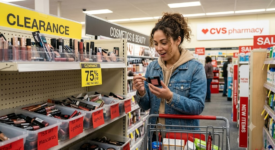
Drugstore clearance is the only tier of retail where you can legitimately walk out of a store with a product for under a dollar. Target places its bright red clearance stickers on end-caps facing the cosmetics wall. CVS, however, is the crown jewel of stacked discounts. If CVS puts a Maybelline or Milani blush on clearance for 50% off, their automated register system still recognizes it as a standard brand purchase. This means you can apply a manufacturer coupon, apply a “20% off your entire purchase” store coupon, and pay for the remaining balance using your accumulated ExtraBucks.
Cream vs. Powder: The Hard Rules of Shelf Life
When you buy retail makeup at full price, shelf life is an afterthought. When you shop the clearance rack, shelf life is your primary governing metric. You are purchasing inventory that has likely been sitting inside a climate-uncontrolled shipping container or a dry warehouse for eight to eighteen months.
The Safe Bet: Pressed Powders
Traditional powder blushes are the cockroaches of the beauty world—they are practically immortal. Because powder contains zero water, it offers an incredibly hostile environment for bacteria and mold. A factory-sealed pressed powder blush is generally safe to open and use up to three years after its manufacture date. Even if a discounted powder develops “hard pan”—that stiff, glossy film caused by sitting in variable retail humidity—you can easily fix it. Take a strip of standard household tape, press it firmly onto the surface of the powder, and peel it back. The tape will lift the hardened top micron of product right off, leaving a soft, brand-new powder bed underneath.
The High-Risk Bet: Creams and Liquids
Liquid blush wands, cushion stamps, and cream sticks are a completely different biological playground. These formulas rely on water, plant emollients, and carrier oils. Once the preservative system in a liquid product begins to degrade, it becomes a petri dish.
Before putting a discounted liquid cheek product into your basket, run it through the Three-Point Quality Audit:
- The Pigment Suspension Check: Hold clear glass or acrylic packaging up to the overhead store lights. Do you see a thick layer of yellowish, translucent oil resting on top of a separated block of solid pigment at the bottom? While minor oil separation is normal in clean-beauty brands, hard curdling means the chemical emulsifiers have permanently snapped.
- The Olfactory Warning: If the store has a dedicated open tester unit for that specific clearance item, smell it. Rancid carrier oils give off a highly distinct, unmistakable odor: it smells like childhood play-dough, stale wax crayons, or old cooking oil. If the tester smells sour, the sealed box sitting behind it is likely turning as well.
- The Batch Code Decode: Turn the box over and locate the 3-to-6 digit alphanumeric code stamped directly into the bottom (note: this is distinct from the printed barcode). Pull out your smartphone and visit a free web database like CheckFresh.com. Type in the brand and the stamped code; the site will ping the manufacturer’s database and tell you the exact day, month, and year that specific unit rolled off the assembly line. If the date is older than 24 months for a liquid, or 18 months for a “clean/preservative-free” formula, leave it on the shelf.
Color Theory for Bargain Hunters: Buying the “Scary” Shades
Have you ever noticed that when you browse a picked-over clearance section, the universally flattering, soft peachy-pinks are completely sold out, leaving behind a sea of intimidating, hyper-vibrant compacts? You will almost always find neon tangerines, deep bruised plums, shocking fuchsias, and dark terracotta bricks sitting lonely on the discount shelf.
Do not let high-contrast pigment scare you away. In fact, clearance shopping is the single best way to advance your personal makeup technique.
The average consumer shops with “pan bias”—they judge a cosmetic by how intense it looks packed densely inside the packaging, rather than how it behaves when diffused across human skin. A startlingly bright, royal purple cream blush, when picked up with a dual-fiber stippling brush and tapped sheerly over the cheekbones, acts as a color-corrector on light-to-medium skin tones, neutralizing sallow undertones to create a breathtaking, crisp winter flush.
Conversely, those deep, rusty brick-reds that sit abandoned by fair-skinned shoppers are absolute magic on melanated skin. While pastel pinks often leave a chalky, grey cast on deep complexions, a clearance-priced terracotta melts into the skin to mimic a genuine, sun-baked warmth.
When a luxury $40 cheek product drops to $11, the financial barrier to experimentation disappears. Buy the weird plum. Buy the neon orange. Apply it with a much lighter hand than your standard daily blush, and you will frequently stumble into a signature look you never would have dared to pay full retail price to test.
The Pro-Sanitation Protocol
Once you bring your clearance haul home, treat it like thrifted vintage clothing: wash it before you wear it. Even if a box looked completely sealed, retail environments are inherently dusty.
For powder blushes, lightly mist the exposed surface of the pan with 70% isopropyl alcohol in a fine spray bottle. Do not use 91% or 99% isopropyl alcohol; counterintuitively, pure alcohol evaporates too quickly to effectively pierce the cell walls of surface microbes. The 30% water content in 70% isopropyl is scientifically necessary to act as a Trojan horse, holding the alcohol against the bacteria long enough to destroy it. Let the compact air-dry open on a clean towel for twenty minutes; the alcohol will evaporate entirely without altering the powder’s performance or scent.
Armed with a discerning eye, a smartphone for batch codes, and a basic understanding of retail inventory dumps, the clearance aisle stops being a gamble. It becomes your own personal, highly curated beauty supply house.