
 salehunter.net
 There is a specific kind of quiet that falls over a marina early in the morning, right before the engines fire up. It’s the sound of anticipation. But for a boat owner with a dead engine or an underpowered hull, that silence isn’t peaceful—it’s frustrating. The search for outboard motors for sale is a journey almost every captain takes eventually, whether you are repowering a beloved vintage whaler or outfitting a brand-new skiff. It is also a significant financial commitment, often ranking second only to the purchase of the hull itself.
The market has shifted drastically in the last decade. We aren’t just looking at the simple choice between two-stroke and four-stroke anymore. We are navigating a complex landscape of direct-injection technology, high-thrust models for pontoons, and the rapidly encroaching silence of electric propulsion. Whether you are scrolling through listings for a portable 5HP kicker or hunting for a massive 300HP offshore beast, understanding the nuance of the current inventory is the only way to ensure you don’t end up with an expensive anchor hanging off your transom.
The Evolution of Power: What You Are Actually Buying
To make a smart purchase, you have to understand what is currently on the transom. For years, the “two-stroke vs. four-stroke” debate dominated the conversation. If you are looking at used outboard motors for sale from the 90s or early 2000s, this distinction is critical. Traditional two-strokes were light and punchy but smoky and thirsty. Four-strokes were clean and quiet but heavy and sluggish out of the hole.
Today, that gap has closed. Modern four-strokes from manufacturers like Yamaha and Suzuki have shed weight, while modern direct-injection two-strokes (like the now-discontinued Evinrude E-TEC) cleaned up their act significantly. However, if you are buying new or late-model used, you are almost exclusively looking at four-stroke technology. These engines offer incredible fuel efficiency and reliability that was unheard of twenty years ago. They are whisper-quiet at idle—so quiet, in fact, that many new owners accidentally try to start an engine that is already running.
The Electric Revolution: We cannot ignore the new category appearing in search results: electric outboards. Brands like Torqeedo and ePropulsion are no longer just for dinghies. They are viable options for lakes with combustion engine bans and for anglers who prioritize stealth over speed. While they carry a higher upfront cost and require battery management, the lack of maintenance (no oil changes, no winterizing) makes them a compelling “motor for sale” to consider for smaller craft.
Matching the Motor to the Transom
One of the most common mistakes buyers make is obsessing over the brand while ignoring the specifications. You might find an incredible deal on a 150HP outboard, but if the shaft length is wrong, it’s useless to you. Before you even click on a listing, you need three non-negotiable numbers: Horsepower, Shaft Length, and Weight.
1. The Horsepower Sweet Spot
Every boat hull has a certification plate, usually located near the transom, stating the maximum horsepower rating. Never exceed this. Not only is it dangerous, making the boat unstable and prone to chine walking, but it also creates massive liability and insurance issues. Conversely, underpowering a boat is a recipe for misery. A boat that struggles to get on plane burns more fuel and wears the engine out faster than a properly powered vessel. Aim for 75% to 100% of the hull’s maximum rating. If your boat is rated for a 200HP, a 150HP is the bare minimum you should consider; a 175HP or 200HP is ideal.
2. Shaft Length Matters
Outboards are not “one size fits all.” They come in short (15″), long (20″), and extra-long (25″ or 30″) shaft lengths. This measurement is the distance from the mounting bracket to the cavitation plate. If you buy a short shaft for a boat designed for a long shaft, the prop will spin in aerated water, and you won’t go anywhere. If you put a long shaft on a short transom, you create excessive drag and risk hitting the bottom in shallow water. Measure your transom height vertically from the top center to the bottom of the keel. Match the motor to this measurement.
3. The Weight Factor
This is particularly important when repowering older boats. Vintage fiberglass hulls were designed in the era of lightweight two-strokes. Bolting a heavy, early-generation four-stroke to a 1980s transom can alter the center of gravity, causing the scuppers to sit below the waterline. If you are looking at older hulls, pay close attention to the weight of the motor you are buying. Modern four-strokes are lighter, but it’s still a calculation that needs to be done.
New vs. Used: Navigating the Market
When typing “outboard motors for sale” into a search bar, you are immediately faced with the price disparity between factory-new and pre-owned units. Each path has its own set of rules.
Buying New: The Warranty Peace of Mind
Buying new is expensive, there is no way around it. A new 300HP outboard can cost as much as a decent family sedan. However, you are buying reliability and warranty. Most major manufacturers offer 3 to 5-year warranties, with promotional periods often extending that to 7 years. If you are not mechanically inclined, or if your time on the water is limited and precious, buying new ensures that your Saturday morning is spent fishing, not troubleshooting a carburetor.
Dealer Incentives: While promo codes are rare for whole engines, dealers often run “repower seasons,” typically in the late fall or early spring. This is when you’ll see incentives like “free rigging components” (controls, gauges, harnesses) which can save you thousands. Rigging creates hidden costs; the engine price often doesn’t include the throttle box, cables, or digital displays required to run it.
Buying Used: The High-Stakes Hunt
The used market is where the deals are, but it’s also where the heartbreak lives. A used outboard can run for thousands of hours if maintained, or fail in five minutes if it was abused. When evaluating a used motor, skepticism is your best friend.
The Eye Test: Start with the aesthetics. A cowl that is scratched and sun-faded suggests the motor sat outside uncovered. If the owner didn’t care enough to cover it, did they care enough to flush the salt out after every use? Look at the skeg (the fin at the bottom). Is it ground down or bent? This indicates shallow water strikes, which can damage the internal gears.
The Compression Test: Never buy a used outboard without a compression test. This is the single most telling diagnostic. You want to see cylinders within 10% of each other. If one cylinder is significantly lower (e.g., 120, 120, 120, 90), walk away. That engine is a ticking time bomb.
Check the Oil: Pull the dipstick (if four-stroke). The oil should look like honey or dark syrup. If it looks milky or like a chocolate milkshake, water is getting into the block—a catastrophic failure. Similarly, ask to drain a small amount of gear lube from the lower unit. It should be clean oil. If water comes out first, or if the lube is milky, the seals are blown.
The Major Players: Brand Profiles
Brand loyalty runs deep in the boating world, often bordering on religious fervor. However, the reality is that all major modern manufacturers produce excellent products. The best brand for you is often determined by which dealer is closest to your marina for service.
Yamaha
Often considered the gold standard for reliability, especially in the saltwater market. Their resale value is exceptionally high. If you find a used Yamaha outboard for sale at a low price, be suspicious—it’s likely too good to be true. Their “VMAX” SHO series is legendary among bass anglers for its hole shot.
Mercury Marine
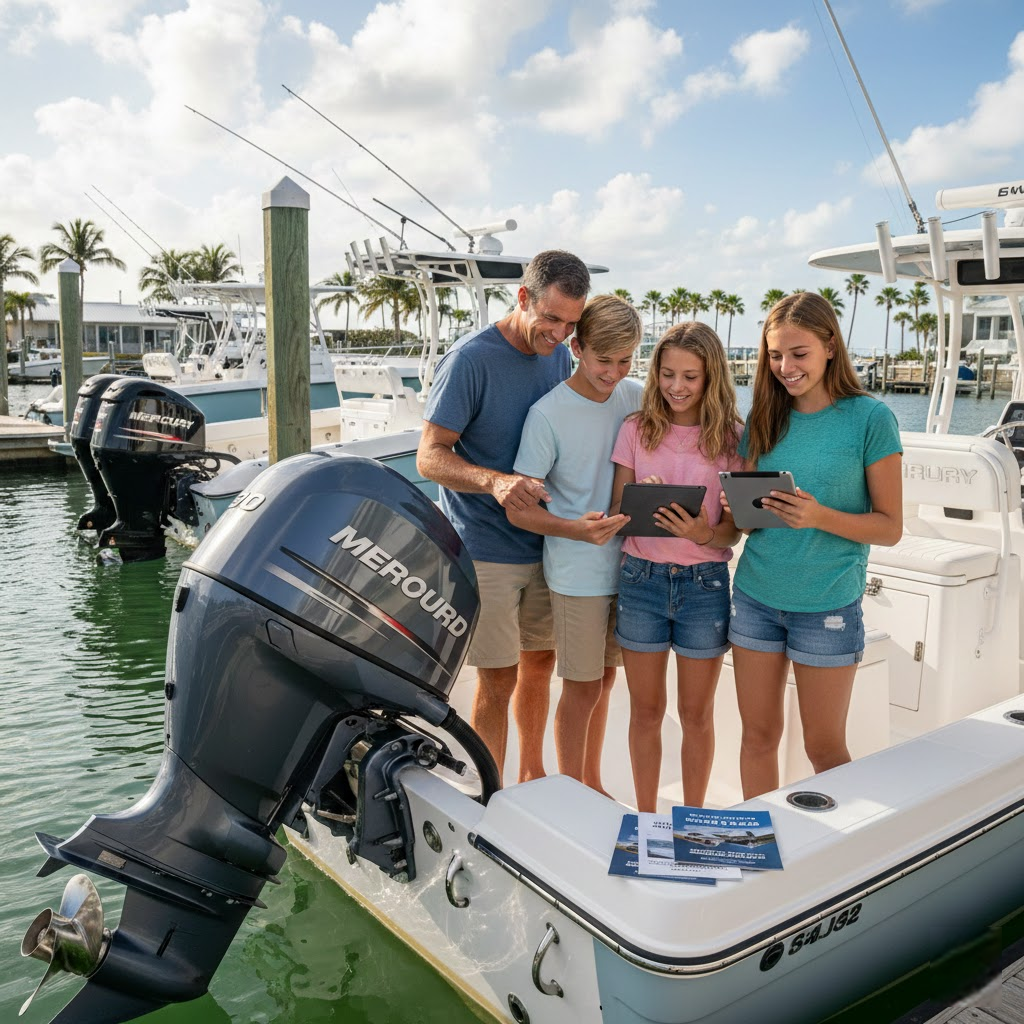
The American giant. Mercury dominates the high-performance and racing scenes, but their consumer engines (the Verado and FourStroke lines) are fantastic all-arounders. They have arguably the best dealer network in the USA. Their new V6 and V8 outboards have been game-changers, offering massive torque without the weight penalty of older supercharged models.
Suzuki
Once the budget option, Suzuki has rebranded itself as the “Ultimate Outboard Motor.” They are known for aggressive gearing ratios that allow them to swing larger propellers, providing better grip and thrust. This makes them a favorite for repowering heavier boats. They often come in at a lower price point than Yamaha or Mercury, offering excellent value.
Honda
Honda brought four-stroke technology to the mainstream. They are renowned for durability—many commercial crabbers and government agencies run Hondas because they simply refuse to die. They are sometimes criticized for being slightly heavier or less “sporty” than the competition, but their VTEC technology (borrowed from their cars) provides great fuel economy.
Tohatsu
The unsung hero. Tohatsu actually manufactures smaller engines for many other brands (including Mercury in the past). If you are looking for portable outboards for sale (under 30HP), Tohatsu is a powerhouse. They are simple, rugged, and affordable.
Where to Look: Marketplaces and Safety
Finding the inventory is the next step. The platform you choose dictates the risk level.
- Marine Dealerships: The safest route. They often take trade-ins when customers upgrade. A dealer-sold used motor usually has been inspected and might even come with a short shop warranty. You will pay a premium here, but you are paying for accountability.
- Boat Trader / YachtWorld: These platforms are geared towards whole boats, but they have sections for engines. The sellers here are usually more professional than on general classified sites.
- Facebook Marketplace / Craigslist: The Wild West. You will find the absolute lowest prices here, but also the most scams. Never send a deposit for a motor you haven’t seen in person. A common scam involves listing a high-end motor for a “too good to be true” price and claiming the seller is in the military and will ship it. This is always a scam. Cash on the barrelhead, in person, after a compression test is the only way to transact here.
- Online Outboard Retailers: For smaller engines (under 25HP), you can buy directly online from authorized retailers. Since these motors can be shipped via standard freight or ground (unlike 500lb V6s), this is a convenient option. Look for “free shipping” deals, as freight for an outboard can be pricey.
The Hidden Costs of Ownership
When budgeting for an outboard, the sticker price is just the entry fee. Smart buyers factor in the lifecycle costs. Routine maintenance is required every 100 hours or annually, whichever comes first. This includes engine oil, oil filters, fuel filters, and gear lube. Every 300 hours (or three years), you are looking at water pump impellers and potentially thermostats.
If you buy a used motor that lacks maintenance records, you must budget for an immediate “baseline service.” This means changing every fluid, filter, spark plug, and the water pump impeller immediately. It’s an extra $300 to $800 depending on the engine size and whether you do the labor yourself, but it resets the clock and gives you a starting point for your own maintenance schedule.
Furthermore, consider the prop. Used motors often come with a beat-up propeller. A damaged prop causes vibration that can destroy the lower unit gears. Budgeting $150 to $600 for a new aluminum or stainless steel prop is a wise move to protect your investment.
Conclusion: The thrill of the Turn-Key
There is nothing quite like the feeling of turning the key (or pulling the cord) and hearing an engine settle instantly into a smooth, steady idle. It promises a day of freedom, whether that means chasing tuna fifty miles offshore or towing kids on a tube around the lake. Finding the right outboard motors for sale requires patience. It requires looking past the shiny cowl and understanding the mechanics underneath.
Don’t rush the process. Measure your transom twice. Check the compression. Research the specific model year for known issues. Whether you choose the raw American muscle of a Mercury, the refined reliability of a Yamaha, or the high-thrust efficiency of a Suzuki, the right motor transforms your boat from a floating hull into a vessel of adventure. The water is waiting; make sure you have the power to enjoy it.