 salehunter.net
 The thrill of the hunt is the undeniable heartbeat of the vintage fashion community. There is an unparalleled rush that comes from pulling a perfectly faded, single-stitch graphic tee from a crowded rack, or discovering a pristine 1970s penny lane coat buried in the back of a boutique. In an era dominated by fast fashion and fleeting micro-trends, wearing true vintage is the ultimate sartorial flex. It guarantees individuality, promotes environmental sustainability, and connects us to the craftsmanship of the past.
However, as the appetite for sustainable fashion has skyrocketed over the past decade, so have the prices. What was once a frugal alternative to mall shopping has transformed into a highly curated, and often expensive, collector’s market. Coveted pieces from the 1980s, 1990s, and Y2K eras are routinely marked up by hundreds of dollars. But do not let sticker shock deter you. Scoring a massive vintage clothing discount is entirely possible if you know where to look, how to negotiate, and what hidden details to search for. This comprehensive guide will arm you with the insider strategies needed to build an extraordinary vintage wardrobe without draining your bank account.
Digital Digging: Mastering Online Vintage Discounts
The internet has democratized vintage shopping, bringing curated global inventories right to our smartphones. While platforms like Depop, Poshmark, eBay, and Etsy are saturated with buyers, they are also rife with opportunities for steep discounts if you employ the right tactics.
The Art of the Polite Lowball and the Bundle
On peer-to-peer selling apps, the listed price is rarely the final price. Most sellers inflate their starting prices precisely because they expect buyers to negotiate. If you find a piece you love, utilize the offer button, but do so strategically. A standard rule of thumb is to offer 15% to 20% below the asking price. If an item has been sitting in a seller’s shop for several months (you can often see when the listing was posted or last updated), they are much more likely to accept a lower offer just to clear their inventory.
Bundling is another highly effective strategy. If you find a seller whose aesthetic matches yours, browse their entire closet. Buying three items at once significantly increases your bargaining power. Sellers save on shipping materials and trips to the post office when they bundle, making them far more receptive to slashing the overall price by 30% or more.
The “Cart Abandonment” and “Liking” Strategy
Patience is a virtue, especially when shopping for vintage online. When you “like” an item on Poshmark or add it to your cart on Etsy, the platform’s algorithm often notifies the seller. Many sellers have automated workflows set up to immediately send a discount code—often ranging from 10% to 25%—to anyone who shows interest. If you want a vintage clothing discount with zero negotiation required, simply like the item and wait 48 hours. Let the discounts come to you.
Exploiting Misspellings and Poor SEO
This is perhaps the best-kept secret among vintage resellers. Not every seller knows exactly what they have, nor do they know how to properly spell designer names or format their listings. An everyday person cleaning out their grandmother’s closet might list a highly valuable Yves Saint Laurent blazer simply as “Yve Saint Lorent jacket” or “old blue blazer.”
Because these listings have terrible Search Engine Optimization (SEO), they do not show up in standard searches. Consequently, they get zero views and zero bids. By purposefully searching for common typos of popular vintage brands, or using incredibly generic search terms (like “vintage tagged 1990” instead of “1990s Nirvana Tour Shirt”), you can bypass the competition and secure incredibly rare pieces for pennies on the dollar.
Brick-and-Mortar Secrets: Hacking Physical Retail
While online shopping offers convenience, there is no substitute for evaluating the weight of vintage denim or the drape of vintage silk in person. Navigating physical spaces requires a different set of strategies to secure the best vintage clothing discounts.
The Golden Hour at Flea Markets
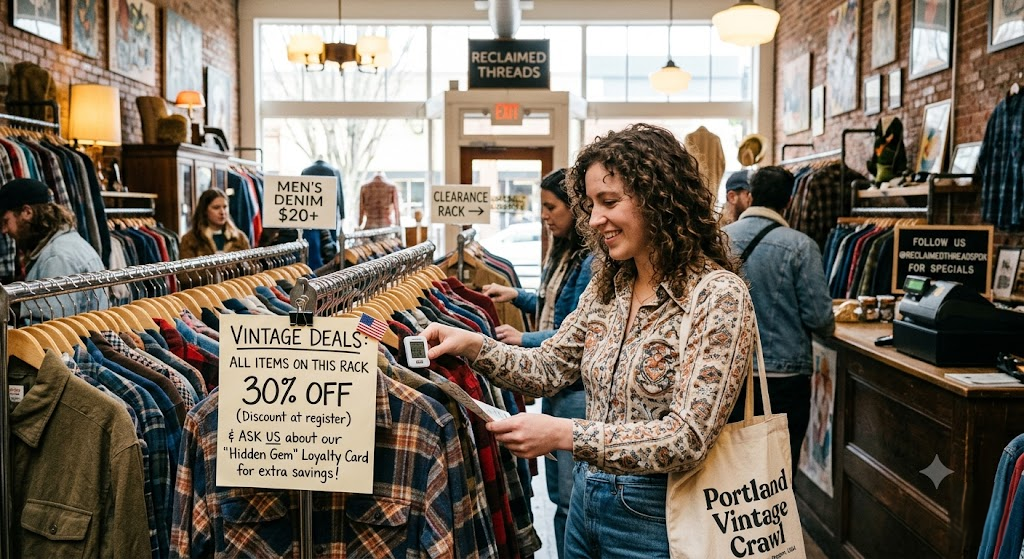
Flea markets are the traditional battlegrounds for vintage enthusiasts. Most guides tell you to arrive at 5:00 AM to get the best items. While the early bird gets the worm, the latecomer gets the massive discount. If a vintage vendor has spent the entire weekend baking in the sun, the last thing they want to do is pack up heavy racks of clothing, load them back into a van, and store them away.
Arrive about an hour before the flea market officially closes. This is the “Golden Hour.” Walk up to a vendor with cash in hand and ask for their best price on an item. You will be astounded at how quickly a $60 vintage sweatshirt becomes a $20 sweatshirt when the alternative is taking it back home.
Navigating Estate Sales for Half-Price Days
Estate sales are goldmines for true, untouched vintage—often spanning decades of a single person’s wardrobe. Estate sale liquidators have a very strict timeline: they usually have three days to empty a house completely. Because of this ticking clock, their pricing structure is highly predictable.
- Day One: Everything is priced at retail or slightly below. This is for collectors who are willing to pay top dollar for pristine items.
- Day Two: Prices usually drop by 25%.
- Day Three: This is the holy grail for bargain hunters. Everything is typically marked down by 50%, and by the afternoon, many liquidators will offer a “fill a bag for $10” deal just to get rid of the remaining inventory.
If you have an eye for styling and don’t mind digging, attending the final day of an estate sale is one of the most reliable ways to secure a massive vintage clothing discount.
Going to the Source: Rag Houses and Kilo Sales
If you want to bypass the retail markup entirely, you have to shop where the vintage boutiques shop. Enter the world of rag houses and kilo sales.
The Rise of the Kilo Sale
Originally popularized in Europe, vintage kilo sales have taken the United States by storm. At these events, massive warehouses are filled with tons of uncurated vintage clothing. You do not pay per item; instead, you pay by weight. A typical rate might be $20 per kilo (roughly 2.2 pounds). Because lightweight items like vintage silk scarves, slip dresses, and single-stitch t-shirts weigh next to nothing, you can walk away with an entire wardrobe of incredible pieces for the price of one fast-fashion t-shirt.
Building Relationships with Wholesalers
Rag houses are textile recycling facilities where millions of pounds of donated clothing are sorted. While traditionally closed to the public, many rag houses now allow “pickers” to come in and buy bulk bales of vintage clothing. If you are serious about vintage—perhaps even looking to start your own side hustle—contacting local textile recyclers to see if they allow public picking is a game-changer. You will pay literal pennies per garment, representing the ultimate vintage clothing discount.
Decoding Tags: Spotting Underpriced Hidden Gems
Sometimes, the best discount is the one the seller gives you by mistake. When a seller doesn’t recognize the value of a garment, they price it low. To capitalize on this, you need to become an expert at decoding vintage labels and construction details.
The Power of the ILGWU Tag
If you spot a small, blue and white tag bearing the letters ILGWU (International Ladies’ Garment Workers’ Union), you are holding a piece of American history. These tags were sewn into garments made in the USA between the 1930s and the 1990s. The specific design of the union tag changed over the decades, making it a reliable tool for dating an item. A seller might list a dress simply as “old floral dress” for $10. But if you spot a 1950s ILGWU tag inside, you immediately know you are getting a highly valuable, mid-century piece at an incredible discount.
Identifying Single Stitch and Hardware
In the world of vintage t-shirts, the “single stitch” is king. Before the mid-1990s, t-shirts were typically finished with a single row of stitching on the hems and sleeves. Modern shirts use a double-needle stitch. If you are at a thrift store or browsing an online listing with poor photos, look closely at the hem. Finding a single-stitch shirt priced at a standard thrift store rate is an immediate win.
Similarly, inspect the hardware. Zippers made by brands like Talon, Scovill, or Ideal are strong indicators of true vintage (pre-1980s). Unknowing sellers frequently price these older, impeccably constructed garments identically to cheap, modern donations.
The “Fixer-Upper” Discount: Embracing Imperfection
In a world obsessed with perfection, embracing a little wear and tear is a fantastic strategy for scoring deep discounts. Many vintage buyers pass on garments that have minor flaws, leaving them sitting on racks or online shops, ripe for negotiation.
Negotiating Damage
If you find an incredible 1960s wool cardigan that is missing a button, or a 1980s leather jacket with a broken zipper pull, point this out to the seller. Use the flaw as leverage to ask for a 30% to 40% vintage clothing discount. More often than not, the seller will accommodate you, viewing a damaged item as a liability they are eager to offload.
Simple Restoration Magic
The beauty of acquiring damaged vintage at a discount is that most flaws are easily fixable. You do not need to be a master tailor to replace a button or sew a basic hem. Furthermore, vintage garments were built to last and can withstand restoration treatments that would destroy modern fabrics.
For items with a lingering “vintage smell” (usually just a buildup of dust and stale air), a simple spritz of cheap vodka mixed with water will neutralize the odor as it evaporates. For stubborn yellowing on vintage linens and cottons, soaking the garment in an oxygen-based cleaner (like OxiClean) and warm water can breathe life back into pieces that others deemed ruined. By investing just a little bit of elbow grease, you multiply the value of your deeply discounted find.
The True Value of Vintage
Securing a vintage clothing discount is about much more than just saving money. It is a rewarding process that sharpens your eye for quality, deepens your appreciation for garment history, and connects you more intimately with your personal style. By mastering the digital landscape, understanding the rhythms of physical sales, buying by weight, decoding tags, and embracing minor restorations, you effectively bypass the traditional retail markup.
The next time you are hunting for that perfect retro piece, remember that the initial price tag is merely a suggestion. Armed with these strategies, you are no longer just a shopper; you are an educated collector capable of curating a museum-worthy wardrobe on a shoestring budget. Happy hunting.